

Sunday, August 2, 2026
Science
No Result
View All Result
  • Login
  • HOME
  • SCIENCE NEWS
  • CONTACT US
  • HOME
  • SCIENCE NEWS
  • CONTACT US
No Result
View All Result
Scienmag
No Result
View All Result
Home Science News Mathematics

Skyrmions move at record speeds: a step towards the computing of the future

April 18, 2024
in Mathematics
Reading Time: 2 mins read
0
Skyrmions move at record speeds: a step towards the computing
68
SHARES
615
VIEWS
Share on FacebookShare on Twitter
ADVERTISEMENT

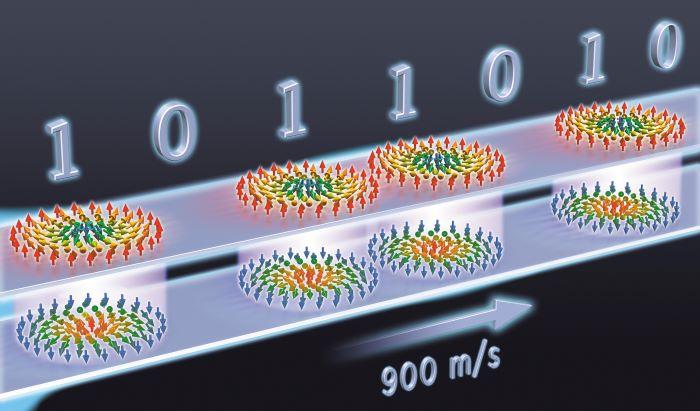
An international research team led by scientists from the CNRS1 has discovered that the magnetic nanobubbles2 known as skyrmions can be moved by electrical currents, attaining record speeds up to 900 m/s.

Antiferromagnetic skyrmions moved in a magnetic racetrack by an electrical current.

Credit: © Bruno Bourgeois and Olivier Boulle

An international research team led by scientists from the CNRS1 has discovered that the magnetic nanobubbles2 known as skyrmions can be moved by electrical currents, attaining record speeds up to 900 m/s.

Anticipated as future bits in computer memory, these nanobubbles offer enhanced avenues for information processing in electronic devices. Their tiny size3 provides great computing and information storage capacity, as well as low energy consumption.

Until now, these nanobubbles moved no faster than 100 m/s, which is too slow for computing applications. However, thanks to the use of an antiferromagnetic material4 as medium, the scientists successfully had the skyrmions move 10 times faster than previously observed.

These results, which were published in Science on 19 March, offer new prospects for developing higher-performance and less energy-intensive computing devices.

This study is part of the SPIN national research programme5 launched on 29 January, which supports innovative research in spintronics, with a view to helping develop a more agile and enduring digital world.


notes : 

1 – The French laboratories involved are SPINTEC (CEA/CNRS/Université Grenoble Alpes), the Institut Néel (CNRS), and the Charles Coulomb Laboratory (CNRS/Université de Montpellier).

2 – A skyrmion consists of elementary nanomagnets (“spins”) that wind to form a highly stable spiral structure, like a tight knot.

3 – The size of a skyrmion can reach a few nanometres, which is to say approximately a dozen atoms.

4 – Antiferromagnetic stacks consist of two nano-sized ferromagnetic layers (such as cobalt) separated by a think non-magnetic layer, with opposite magnetisation.

5 – The SPIN priority research programme and equipment (PEPR) is an exploratory programme in connection with the France 2030 investment plan.


Journal

Science

Article Title

Fast current induced skyrmion motion in synthetic antiferromagnets without skyrmion Hall effect

Article Publication Date

19-Apr-2024

Share27Tweet17
Previous Post

China’s sinking cities indicate global-scale problem, Virginia Tech researcher says

Next Post

FAU and Mainstreet Research Florida poll shows Trump holds solid lead over Biden

Related Posts

Initial HIV Therapy in Adults Associated With Treatment-Related Weight Gain
Mathematics

Initial HIV Therapy in Adults Associated With Treatment-Related Weight Gain

August 1, 2026
Expanded Alcohol Screening and Brief Intervention Could Reduce Premature Deaths
Mathematics

Expanded Alcohol Screening and Brief Intervention Could Reduce Premature Deaths

July 31, 2026
Light’s hidden properties save quantum information from the chaos of bad weather
Mathematics

Light’s hidden properties save quantum information from the chaos of bad weather

July 30, 2026
Pusan National University researchers have developed a hybrid quantum network with indistinguishable quantum sources
Mathematics

Pusan National University researchers have developed a hybrid quantum network with indistinguishable quantum sources

July 30, 2026
Controlled breathing may reduce drug cravings, new study finds
Mathematics

Controlled breathing may reduce drug cravings, new study finds

July 30, 2026
Cleveland Clinic and IBM researchers create quantum machine learning framework to predict neoantigen immune response
Mathematics

Cleveland Clinic and IBM researchers create quantum machine learning framework to predict neoantigen immune response

July 29, 2026
Next Post
FAU and Mainstreet Research Florida poll shows Trump holds solid

FAU and Mainstreet Research Florida poll shows Trump holds solid lead over Biden

  • Mothers who receive childcare support from maternal grandparents show more

    Mothers who receive childcare support from maternal grandparents show more parental warmth, finds NTU Singapore study

    27656 shares
    Share 11059 Tweet 6912
  • University of Seville Breaks 120-Year-Old Mystery, Revises a Key Einstein Concept

    1061 shares
    Share 424 Tweet 265
  • Bee body mass, pathogens and local climate influence heat tolerance

    682 shares
    Share 273 Tweet 171
  • Researchers record first-ever images and data of a shark experiencing a boat strike

    546 shares
    Share 218 Tweet 137
  • Groundbreaking Clinical Trial Reveals Lubiprostone Enhances Kidney Function

    531 shares
    Share 212 Tweet 133
Science

Embark on a thrilling journey of discovery with Scienmag.com—your ultimate source for cutting-edge breakthroughs. Immerse yourself in a world where curiosity knows no limits and tomorrow’s possibilities become today’s reality!

RECENT NEWS

  • How Inflammatory Markers Affect Physical Performance in Community-Dwelling Older Adults: Systematic Review
  • Older Adults’ Views on Managing Chronic Pain in Primary Care
  • Brain-region microstructure and gene activity reveal Alzheimer’s neurodegeneration
  • Bentham Science Launches International Journal of Wireless and Communication Engineering Innovation

Categories

  • Agriculture
  • Anthropology
  • Archaeology
  • Athmospheric
  • Biology
  • Biotechnology
  • Blog
  • Bussines
  • Cancer
  • Chemistry
  • Climate
  • Earth Science
  • Editorial Policy
  • Marine
  • Mathematics
  • Medicine
  • Pediatry
  • Policy
  • Psychology & Psychiatry
  • Science Education
  • Social Science
  • Space
  • Technology and Engineering

Subscribe to Blog via Email

Success! An email was just sent to confirm your subscription. Please find the email now and click 'Confirm Follow' to start subscribing.

Join 5,147 other subscribers

© 2025 Scienmag - Science Magazine

Welcome Back!

Login to your account below

Forgotten Password?

Retrieve your password

Please enter your username or email address to reset your password.

Log In
No Result
View All Result
  • HOME
  • SCIENCE NEWS
  • CONTACT US

© 2025 Scienmag - Science Magazine
