

Saturday, November 14, 2026
Science
No Result
View All Result
  • Login
  • HOME
  • SCIENCE NEWS
  • CONTACT US
  • HOME
  • SCIENCE NEWS
  • CONTACT US
No Result
View All Result
Scienmag
No Result
View All Result
Home Science News Biology

Computational Model Explains Brain Wave Coupling in Parkinson’s Disease

November 7, 2026
in Biology
Cassandra Pierce
By Cassandra Pierce Scienmag Editorial Profile - Systems Neuroscience
Reading Time: 2 mins read
0
Computational Model Explains Brain Wave Coupling in Parkinson’s Disease

Computational Model Explains Brain Wave Coupling in Parkinson's Disease

65
SHARES
587
VIEWS
Share on FacebookShare on Twitter
ADVERTISEMENT

Researchers Hiba Sheheitli, Luke A. Johnson, Jing Wang, Joshua E. Aman, and Jerrold L. Vitek demonstrated that coupled beta and high-frequency oscillations emerge from synchronized bursting in a minimal biophysical model of the parkinsonian subthalamic nucleus. Local field potentials recorded from the subthalamic nucleus in Parkinson’s disease display exaggerated beta-band oscillations from 13 to 30 Hz coupled to high-frequency oscillations between 200 and 400 Hz, with high-frequency oscillation amplitude phase-locked to the beta cycle. While this phase-amplitude coupling represents a promising biomarker of the parkinsonian state, biophysical mechanisms explaining its emergence, the determinants of high-frequency oscillation frequency, and its behavior in the medicated state had remained unresolved.

The study showed that a heterogeneous population of excitatory Izhikevich neurons with recurrent coupling produces three distinct dynamical regimes. The first regime is asynchronous tonic firing. The second regime is asynchronous bursting, in which individual neurons burst independently to generate broadband high-frequency oscillation power without producing coherent population-level phase-amplitude coupling. The third regime is synchronous bursting, which directly gives rise to beta-band and high-frequency phase-amplitude coupling.

These dynamical regimes are governed by two biophysically interpretable parameters that capture complementary effects of dopamine depletion: one reflecting intrinsic neuronal excitability and the other reflecting synaptic coupling strength. The transition from asynchronous to synchronous bursting in the model emulates the emergence of pathological neuronal activity in the parkinsonian subthalamic nucleus. Furthermore, the peak frequency of high-frequency oscillations varies continuously across the two-parameter landscape, suggesting a potential mechanism for clinically observed shifts between slow oscillations of 200 to 300 Hz and fast oscillations of 300 to 400 Hz between medication states.

The character of the synchronization transition depends directly on baseline excitability. At low excitability, bursting and synchrony co-emerge sharply, whereas intermediate excitability produces a decoupled transition in which the bursting fraction saturates while population synchronization continues to increase with coupling strength. This asynchronous-to-synchronous bursting transition and phase-amplitude coupling also arise in an extended model featuring reciprocal coupling to an inhibitory population of globus pallidus externa-like neurons, with the beta frequency varying according to synaptic coupling delays between the two populations.

The model provides a numerical dissection of how mesoscopic local field potential features map onto microscopic neuronal dynamics while generating testable predictions for future clinical and experimental studies. Additionally, the authors noted that the model serves as a computational building block for future circuit-level models that may inform brain stimulation strategies tailored to patient-specific dynamical states of the subthalamic nucleus.

Subject of Research: Computational modeling of subthalamic nucleus oscillations in Parkinson's disease

Article Title: Coupled beta and high-frequency oscillations emerge from synchronized bursting in a minimal model of the parkinsonian subthalamic nucleus

Article References: Sheheitli, H., Johnson, L. A., Wang, J., Aman, J. E., & Vitek, J. L. (2026). Coupled beta and high-frequency oscillations emerge from synchronized bursting in a minimal model of the parkinsonian subthalamic nucleus. PLOS Computational Biology, 22(10), e1014921. https://doi.org/10.1371/journal.pcbi.1014921

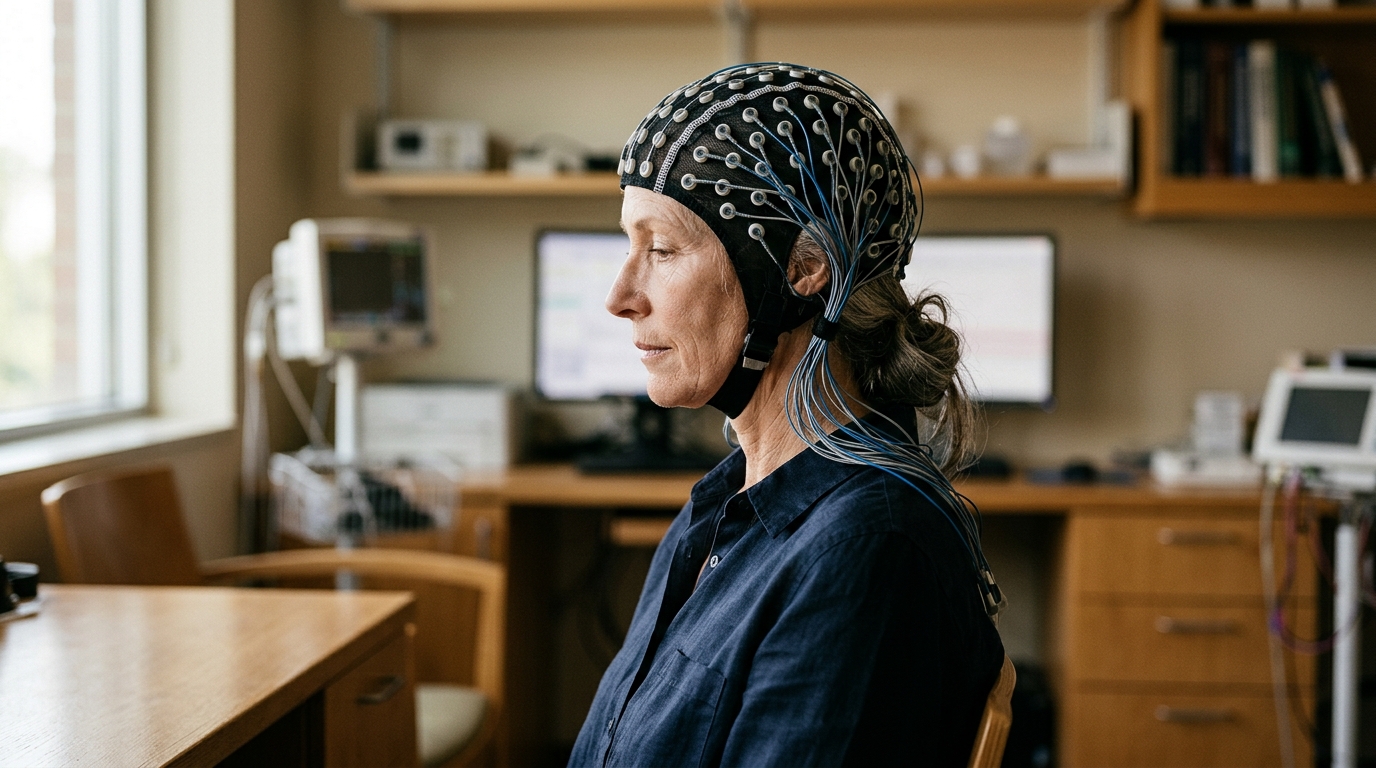
Image Credits: AI Generated

DOI: 10.1371/journal.pcbi.1014921

Keywords: Parkinson's disease, subthalamic nucleus, computational neuroscience, phase-amplitude coupling, beta oscillations, high-frequency oscillations, neuronal dynamics, Coupled, beta, high-frequency, oscillations, emerge

Cite Scienmag News

Cassandra Pierce. (November 7, 2026). Computational Model Explains Brain Wave Coupling in Parkinson’s Disease. Scienmag. https://scienmag.com/computational-model-explains-brain-wave-coupling-in-parkinsons-disease/

Cassandra Pierce. "Computational Model Explains Brain Wave Coupling in Parkinson’s Disease." Scienmag, 7 November 2026, https://scienmag.com/computational-model-explains-brain-wave-coupling-in-parkinsons-disease/. Accessed 14 November 2026.

Cassandra Pierce. "Computational Model Explains Brain Wave Coupling in Parkinson’s Disease." Scienmag. November 7, 2026. https://scienmag.com/computational-model-explains-brain-wave-coupling-in-parkinsons-disease/

Tags: betabeta oscillationscomputational neurosciencecoupledemergeHigh-frequencyhigh-frequency oscillationsneuronal dynamicsoscillationsParkinson's diseasephase-amplitude couplingsubthalamic nucleus
Share26Tweet16
Previous Post

Initial Binary Fraction Drives Dynamical Evolution and Structure of Open Clusters

Next Post

Picosecond Laser Demonstrates Safety and Efficacy for Treating Xanthelasma Palpebrarum

Related Posts

Extra-Early Cowpea Trials in Niger Reveal Distinct Environments and Stable Genotypes
Biology

Extra-Early Cowpea Trials in Niger Reveal Distinct Environments and Stable Genotypes

November 14, 2026
Mitochondrial Cristae System Proposed as Checkpoint in Retinal Pigment Epithelial Degeneration
Biology

Mitochondrial Cristae System Proposed as Checkpoint in Retinal Pigment Epithelial Degeneration

November 14, 2026
Molecular Profiling Uncovers Key Genes Linked to Triple-Negative Breast Cancer Recurrence
Biotechnology

Molecular Profiling Uncovers Key Genes Linked to Triple-Negative Breast Cancer Recurrence

November 14, 2026
Kumtagh Desert Aridity Drives Divergent Microbial Survival Strategies Across Domains
Biology

Kumtagh Desert Aridity Drives Divergent Microbial Survival Strategies Across Domains

November 14, 2026
ExP Heatmap Visualizes Dense Regional Genomic Comparisons Across Ordered Population Pairs
Biotechnology

ExP Heatmap Visualizes Dense Regional Genomic Comparisons Across Ordered Population Pairs

November 14, 2026
Protozoan Richness and Microbial Network Complexity Peak During Spring in Chishui River
Biology

Protozoan Richness and Microbial Network Complexity Peak During Spring in Chishui River

November 14, 2026
Next Post
Picosecond Laser Demonstrates Safety and Efficacy for Treating Xanthelasma Palpebrarum

Picosecond Laser Demonstrates Safety and Efficacy for Treating Xanthelasma Palpebrarum

  • Mothers who receive childcare support from maternal grandparents show more optimized

    Mothers who receive childcare support from maternal grandparents show more parental warmth, finds NTU Singapore study

    27656 shares
    Share 11059 Tweet 6912
  • University of Seville Breaks 120-Year-Old Mystery, Revises a Key Einstein Concept

    1061 shares
    Share 424 Tweet 265
  • Bee body mass, pathogens and local climate influence heat tolerance

    682 shares
    Share 273 Tweet 171
  • Researchers record first-ever images and data of a shark experiencing a boat strike

    546 shares
    Share 218 Tweet 137
  • Groundbreaking Clinical Trial Reveals Lubiprostone Enhances Kidney Function

    531 shares
    Share 212 Tweet 133
Science

Embark on a thrilling journey of discovery with Scienmag.com—your ultimate source for cutting-edge breakthroughs. Immerse yourself in a world where curiosity knows no limits and tomorrow’s possibilities become today’s reality!

RECENT NEWS

  • Extra-Early Cowpea Trials in Niger Reveal Distinct Environments and Stable Genotypes
  • Kathakali Artists in Kerala Face Economic Precarity Despite Long Training and Prestige
  • Fecal Microbiota Transplantation Shows Higher Response Rates in Pediatric Abdominal Pain Trial
  • Studies Link Gut Bacteria and Waste Clearance Systems to Alzheimer’s Disease

Categories

  • Agriculture
  • Anthropology
  • Archaeology
  • Athmospheric
  • Biology
  • Biotechnology
  • Blog
  • Bussines
  • Cancer
  • Chemistry
  • Climate
  • Earth Science
  • Editorial Policy
  • Marine
  • Mathematics
  • Medicine
  • Pediatry
  • Policy
  • Psychology & Psychiatry
  • Science Education
  • Science News
  • Social Science
  • Space
  • Technology and Engineering

Subscribe to Blog via Email

Enter your email address to subscribe to this blog and receive notifications of new posts by email.

Join 5,150 other subscribers

© 2026 Scienmag - Science Magazine

Welcome Back!

Login to your account below

Forgotten Password?

Retrieve your password

Please enter your username or email address to reset your password.

Log In
No Result
View All Result
  • HOME
  • SCIENCE NEWS
  • CONTACT US

© 2026 Scienmag - Science Magazine

Discover more from Science

Subscribe now to keep reading and get access to the full archive.

Continue reading

