


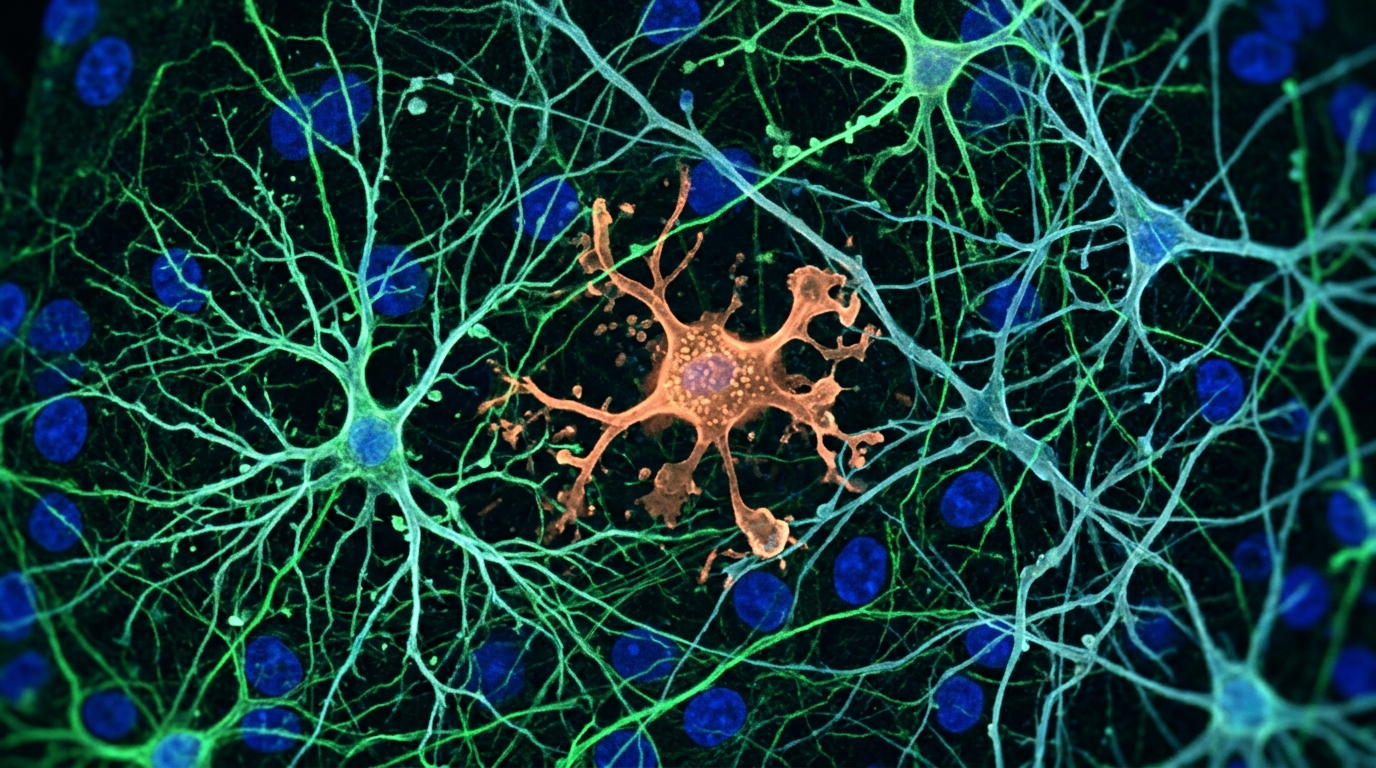
During prenatal human neurodevelopment, the cerebral cortex experiences an extensive generation of somatic genetic abnormalities that are subsequently purged through a rigorous wave of developmental selection. Investigating somatic copy number variants in individual brain cells from fetal stages through adult life, researchers discovered that an average of 25.9 percent of prenatal cortical neurons harbor highly aberrant genomes characterized by widespread copy number variants across multiple chromosomes. These chromosomal disturbances do not persist uniformly into maturity; instead, their frequency drops by approximately 4.5-fold after birth. The marked clearance of these structurally compromised cells occurs primarily during the perinatal window, coinciding closely with established periods of programmed cell death in the developing brain, while cells possessing smaller copy number burdens undergo a far more gradual attrition across the human lifespan.
Human cortical neurons are long-lived, postmitotic cells that do not undergo renewal once differentiated, placing extraordinary demands on the maintenance of genomic integrity over decades of life. Proper neuronal function and physiological activity are exceptionally sensitive to gene dosage, with copy number alterations and heterozygous point mutations known to contribute to a wide spectrum of neurodevelopmental and neuropsychiatric conditions. To determine how the neuronal genetic architecture is assembled and refined across developmental time, investigators examined somatic copy number variants across 2,357 individual postmortem human neurons spanning prenatal stages to late adulthood. By employing two complementary single-cell whole-genome sequencing technologies, the team tracked how structural genomic diversity arises, persists, or undergoes targeted elimination in the human cerebral cortex.
The study utilized both Tn5-transposase-based amplification across 1,526 neurons from 16 individual donors and primary template amplification across 831 neurons from 12 individual donors to profile single-cell genomic architectures. Across both platforms, prenatal cortical neurons exhibited widespread genomic alterations, with the proportion of aberrant cells ranging between 12.7 percent and 46 percent across donors. A Fisher meta-analysis evaluating the transition from prenatal to postnatal life confirmed that the proportion of neurons harboring widespread copy number variants fell by approximately 4.5-fold, demonstrating a highly statistically significant reduction with a P-value of 3.5 × 10⁻⁶. This substantial decline demonstrates that the genomic landscape of human cortical neurons is actively filtered rather than static across early life.
To uncover the molecular mechanisms accompanying this selective depletion, investigators evaluated 44,861 single nuclei using paired single-nucleus assay for transposase-accessible chromatin and single-nucleus RNA sequencing across both prenatal and postnatal brain specimens. This multiomic profiling demonstrated that cortical neurons bearing high copy number variant burdens displayed pronounced dysregulation of synaptic gene expression modules. Rather than exhibiting random cellular dysfunction, neurons with widespread genomic rearrangements showed perturbed transcriptional regulation of key synaptic pathways, suggesting that impaired synaptic gene expression directly links high genomic copy number burdens to cellular elimination during early circuit formation.
Surviving neurons that persisted into postnatal life demonstrated a striking non-random depletion of specific structural alterations, providing evidence of purifying selection. Genomic regions harboring copy number variants in surviving cells were significantly depleted for dosage-sensitive genes and loci implicated in neurodevelopmental disorders, confirmed by hypergeometric tests yielding P-values below 0.05. Further evaluation revealed strong negative selection against neurons with structural disruptions in autism-related genes curated by the SFARI database, postsynaptic genes, and broader neurodevelopmental risk loci. The intensity of this negative selection appears proportional to the overall genomic burden, with widespread structural changes inflicting severe cellular fitness penalties compared to smaller, sub-chromosomal copy number alterations.
The elimination of genomically aberrant cells aligns with two distinct temporal phases across human life. The initial, marked elimination occurs during late gestation and the perinatal window, mirroring the classical developmental wave of programmed cell death that prunes roughly 30 percent of cortical neurons during circuit assembly and synaptogenesis. Cortical neurogenesis begins between 10 and 12 gestational weeks and continues to approximately 24 gestational weeks for excitatory neurons, extending potentially into the postnatal period for neocortical inhibitory neurons. In contrast to the dramatic perinatal drop in cells with widespread multi-chromosome variants, neurons bearing smaller sub-chromosomal copy number alterations undergo a slow, continuous decline. A meta-analysis tracking this postnatal trajectory estimated a 13 percent loss of copy number variant-bearing neurons over a span of 60 years, matching the roughly 10 percent decline in aging neuron counts documented through stereological analyses.
Analysis of structural breakpoint distributions demonstrated that the somatic copy number landscape is shaped by at least two distinct biological mechanisms operating during human neurodevelopment. First, replication stress during progenitor cell divisions leaves a distinct molecular footprint, with structural breakpoints clustering significantly at early-replicating genomic loci defined by embryonic stem cell reference tracks. This replication-induced chromosomal damage corresponds to the abundant formation of micronuclei in the fetal cerebral cortex, which undergo an age-dependent clearance matching the elimination of primary nuclei carrying copy number variants. Second, recurrent DNA copy losses localized precisely to double-strand break hotspots identified by BLISS assays in neural progenitor cells and postmitotic neurons, implicating non-homologous end-joining DNA repair at constitutively fragile genomic loci as an independent driver of somatic variation.
Rigorous experimental protocols and computational benchmarks ensured that detected copy number variants reflected true biological phenomena rather than isolation or amplification artifacts. Neuronal nuclei isolated from frontoparietal postmortem brain tissue were dissected under light microscopy, dissociated through gentle dounce homogenization, and isolated via flow cytometry gating for forward scatter, side scatter, and DAPI content, with postnatal neurons additionally stained with Alexa Fluor 488-conjugated anti-NeuN antibodies. Whole-genome libraries generated through Tn5 tagmentation underwent stringent sequencing on NovaSeq 6000 platforms to reach a target size of 0.5 Gb per single-cell library. Sequencing reads were aligned to the human GRCh37d5 reference assembly, followed by duplicate marking and base quality score recalibration adhering strictly to GATK best practices.
To establish stringent cell-filtering criteria, the researchers used single-cell libraries prepared from a human neural progenitor cell line subjected to staurosporine-induced apoptosis as a benchmark dataset. This model provided transfer-learning reference profiles distinguishing viable cells from early apoptotic cells with intact nuclear envelopes and degraded cells with compromised nuclear membranes. Using Scanpy to build neighborhood graphs and Leiden clustering, cells were classified into discrete quality tiers, retaining only high-quality cells with median absolute pairwise differences below 0.5 and excluding batches where high-quality cells fell below 65 percent or yielded fewer than 25 total passing cells. Copy number variants were called with HiScanner in read-depth-only mode for transposase-amplified libraries with 500 kb bin sizes, filtering out events under 5 Mb, pseudoautosomal regions, and calls with P-values of 0.05 or higher, followed by fragment-optical-density validation against a diploid baseline distribution.
For primary template amplification libraries, HiScanner jointly leveraged read depth and B-allele frequencies alongside matched bulk whole-genome sequencing controls, excluding recurrent artifacts appearing across three or more donors, segments smaller than 5 Mb, and extreme copy states exceeding four copies. The researchers reconstructed mutational processes by decomposing single-cell profiles into 48-channel copy number summary vectors matched to COSMIC pan-cancer signatures using SigProfilerAssignment and SigProfilerMatrixGenerator. Unsupervised Leiden clustering on signature exposure spaces identified four distinct cell groupings: diploid predominant, gain predominant, focal loss predominant, and broad loss predominant, confirming consistent decomposition across both amplification chemistries through cosine similarity evaluations.
Multiomic snATAC-seq and snRNA-seq datasets processed with Cell Ranger ARC, Seurat, and Signac packages provided cell-type-specific resolution across excitatory neurons, inhibitory neurons, progenitors, and glial populations. After filtering multiplets using AMULET and removing low-complexity nuclei falling below 1,000 RNA molecules or 1,000 ATAC fragments, copy number states were inferred from chromatin accessibility data using epiAneufinder at 100 kb resolution. Nuclei showing outlier proportions of copy number-altered bins beyond 1.5 times the interquartile range above the third quartile were classified as copy number variant neurons. Stratified permutation tests comprising 10,000 label shuffles per sample and cell type confirmed that synaptic gene module dysregulation was robustly linked to aberrant genomic status across both prenatal and postnatal cohorts.
All human postmortem brain specimens analyzed in the study were obtained in compliance with state and federal regulations under approvals from the Boston Children’s Hospital and Mass General Brigham Institutional Review Boards, with informed consent granted by donors or next of kin. Tissue resources were provided by the NIH NeuroBioBank, Autism BrainNet Collection, University of Washington Birth Defects Research Laboratory, and Mayo Clinic Brain Bank, with primary datasets deposited across dbGaP under accession phs004946 and SFARI Base repositories. Together, these detailed genomic and multiomic analyses reveal that the perinatal period acts as an indispensable quality-control checkpoint in human neurodevelopment, utilizing programmed cell death pathways to competitively purge structurally aberrant neurons and ensure that mature functional brain circuits are composed predominantly of stable, euploid cells.
Subject of Research: Perinatal genomic quality control and elimination of copy number variants in human cortical neurons
Article Title: Perinatal elimination of genetically aberrant human cortical neurons
Article References: Shao, D. D., Zhao, Y., Brew, J., Adla, Y., Ghosh, U., Viswanadham, V. V., Luquette, L. J., Zhao, S., Kriz, A. J., Qian, X., Taketomi, T., Coy, S., Santagata, S., Miller, M., Tsuruta, F., Park, P. J., & Walsh, C. A. (2026). Perinatal elimination of genetically aberrant human cortical neurons. Nature. https://doi.org/10.1038/s41586-026-11190-3
Image Credits: AI Generated
DOI: 10.1038/s41586-026-11190-3
Keywords: Neurodevelopment, Somatic CNVs, Cortical Neurons, Single-Cell Genomics, Replication Stress, Programmed Cell Death, Synaptogenesis, Human Genetics, Perinatal, elimination, genetically, aberrant
Cite Scienmag News
Cassandra Pierce. (November 7, 2026). Developing Human Brain Clears Aneuploid Cortical Neurons Around Birth. Scienmag. https://scienmag.com/developing-human-brain-clears-aneuploid-cortical-neurons-around-birth/
Cassandra Pierce. "Developing Human Brain Clears Aneuploid Cortical Neurons Around Birth." Scienmag, 7 November 2026, https://scienmag.com/developing-human-brain-clears-aneuploid-cortical-neurons-around-birth/. Accessed 20 November 2026.
Cassandra Pierce. "Developing Human Brain Clears Aneuploid Cortical Neurons Around Birth." Scienmag. November 7, 2026. https://scienmag.com/developing-human-brain-clears-aneuploid-cortical-neurons-around-birth/




