


Making ever smaller and more powerful chips requires new ultrathin materials: 2D materials that are only 1 atom thick, or even just a couple of atoms. Think about graphene or ultra-thin silicon membrane for instance. Scientists at TU Delft have taken an important step in application of these materials: they can now measure important thermal properties of ultrathin silicon membranes. A major advantage of their method is that no physical contact needs to be made with the membrane, so pristine properties can be measured and no complex fabrication is required.

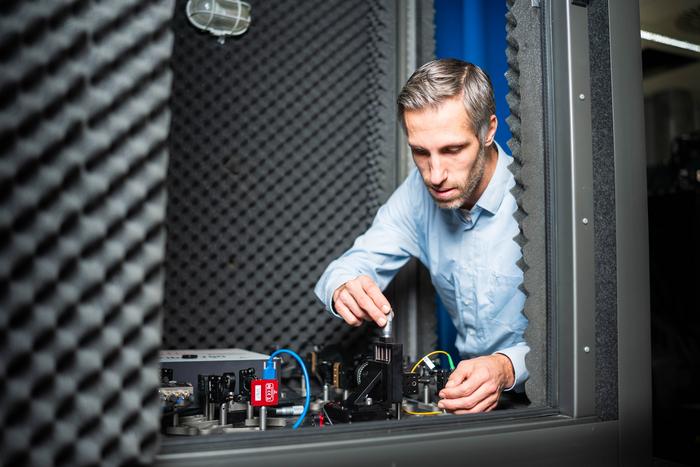
Credit: Studio Wavy / TU Delft
Making ever smaller and more powerful chips requires new ultrathin materials: 2D materials that are only 1 atom thick, or even just a couple of atoms. Think about graphene or ultra-thin silicon membrane for instance. Scientists at TU Delft have taken an important step in application of these materials: they can now measure important thermal properties of ultrathin silicon membranes. A major advantage of their method is that no physical contact needs to be made with the membrane, so pristine properties can be measured and no complex fabrication is required.
“Extremely thin membranes have very different properties from the materials we see around us. For example, graphene is stronger than steel yet extremely flexible,” says TU Delft researcher Gerard Verbiest. “These are properties that make these materials very suitable for use in sensors, provided those properties are properly understood.”
As with many electronics, heat conduction is a big challenge for realising the best performance. It helps determine how well a material will respond to certain loads a chip or sensor has to carry. Heat conduction in two dimensions is fundamentally different from that in three dimensions. As a consequence, the thermal properties of 2D materials are of great interest, from both scientific and application points of view. However, few techniques are available for the accurate determination of these properties in ultrathin suspended membranes.
The researchers used an optomechanical methodology for extracting the thermal expansion coefficient, specific heat, and thermal conductivity of ultrathin membranes made of 2H-TaS2, FePS3, polycrystalline silicon, MoS2, and WSe2. It involved driving a suspended membrane using a power-modulated laser and measuring its time-dependent deflection with a second laser. This way, both the temperature-dependent mechanical fundamental resonance frequency of the membrane and characteristic thermal time constant at which the membrane cools down are measured
Collaboration between science and industry is crucial for development of this technology. Verbiest: “By measuring thin silicon membranes in this project we have shown the technique we developed in Delft to work on materials relevant to the semiconductor industry. This gives research an extra boost, because the insights then potentially lead immediately to a future industrial application, which is important for the Netherlands and a significant motivation for such research.”
The obtained thermal properties are in good agreement with the values reported in the literature for the same materials. This research provides an optomechanical method for determining the thermal properties of ultrathin suspended membranes, which are difficult to measure otherwise. It provides a route toward improving our understanding of heat transport in the 2D limit and facilitates engineering of 2D structures with a dedicated thermal performance.
Journal
APL Materials
Method of Research
Imaging analysis
Subject of Research
Not applicable
Article Title
ptomechanical methodology for characterizing the thermal properties of 2D materials
Article Publication Date
26-Feb-2024
Cite Scienmag News
Denise Maddox. (April 18, 2024). Properties of new materials for microchips can now be measured well. Scienmag. https://scienmag.com/properties-of-new-materials-for-microchips-can-now-be-measured-well/
Denise Maddox. "Properties of new materials for microchips can now be measured well." Scienmag, 18 April 2024, https://scienmag.com/properties-of-new-materials-for-microchips-can-now-be-measured-well/. Accessed 4 September 2026.
Denise Maddox. "Properties of new materials for microchips can now be measured well." Scienmag. April 18, 2024. https://scienmag.com/properties-of-new-materials-for-microchips-can-now-be-measured-well/

