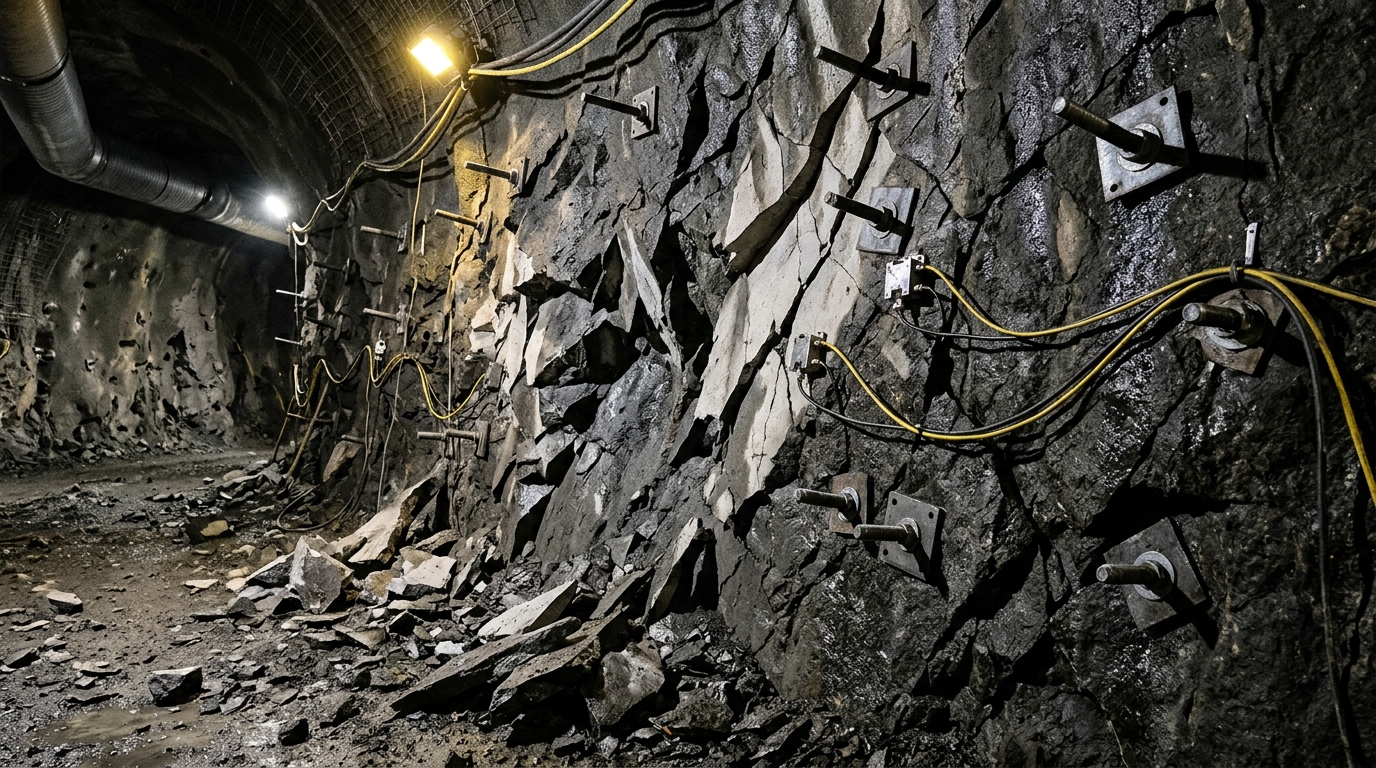
Engineers digging tunnels and shafts deep underground face a sudden and violent hazard: rockburst, the explosive failure of rock that occurs when highly stressed rock near an excavation releases stored strain energy. Predicting how intense such an event will be has long depended on empirical rules and, more recently, on machine learning models whose inner workings are difficult to interpret. A new open-access study in Geomechanics and Geophysics for Geo-Energy and Geo-Resources proposes an integrated framework that combines automated hyperparameter tuning, multi-level prediction and an explanation technique called SHAP analysis, aiming to make rockburst intensity forecasts both more accurate and more transparent.
The research team, led by Couxian Shu and Shupeng Huang with colleagues including Jinhai Liu and Kaixin Feng, built a database of 121 unique rockburst cases drawn from underground engineering experience. Because intense rockbursts are rare compared with milder events, the dataset was imbalanced, which can bias classifiers toward the majority classes. To counter this, the team applied SMOTE, a synthetic oversampling method that generates synthetic minority-class examples, but only on the training set. This restriction matters: applying resampling before data splitting can leak information from validation data into training and inflate apparent performance.
At the core of the framework is the Schrödinger optimization algorithm, or SRA, a nature-inspired search method the authors used to tune the hyperparameters of nine representative machine learning algorithms. Hyperparameters, settings such as tree depth or learning rate that are not learned from data, strongly influence how well a model generalizes. Across the investigated models, SRA-based tuning raised the average classification accuracy by 9.84 percent compared with untuned counterparts, according to the study.
The tuned models were then applied to two related tasks. The first was four-class rockburst intensity prediction, grading events from none through weak, moderate and intense categories. The second was a binary risk warning that separates cases into two groups, N plus L versus M plus S, a simplified alarm scheme for engineering decision-making. In 50 repeated stratified data-splitting experiments, designed to test how sensitive the model was to how the data were partitioned, the best performer, SRA-XGBoost, achieved an average accuracy of 93.49 percent, with a 95 percent confidence interval ranging from 89.79 to 97.18 percent. The authors report that this indicates the model maintained strong overall predictive capability under different data partitioning conditions.
Accuracy alone, however, does not explain why a model reaches its conclusions, a persistent obstacle to deploying machine learning in safety-critical geotechnical settings. To open the black box, the researchers used SHAP, or SHapley Additive exPlanations, a technique borrowed from cooperative game theory that assigns each feature a contribution value for every individual prediction. The analysis revealed that the interaction between the stress concentration factor, a measure of how much stress concentrates around an excavation, and the elastic energy index, an indicator of the energy a rock can store and release, was one of the most significant feature interactions influencing model predictions. The authors interpret this as suggesting a strong association between the combined variations of these two quantities and predicted rockburst intensity, consistent with the physical understanding that bursts arise where high stress concentration meets rock capable of storing substantial elastic energy.
Beyond feature interactions, SHAP analysis revealed important feature contributions across the model’s predictions, giving engineers a ranked view of which input variables drive each intensity grade. The authors argue that this interpretability layer turns the framework into more than a prediction engine: it becomes an explainable assessment tool whose reasoning can be inspected against engineering judgment and rock mechanics theory.
To test the framework outside the training database, the team carried out independent validation using 18 field cases from the Jiangbian Hydropower Station. Predicted rockburst grades showed good agreement with observed grades in these cases. The researchers are careful to frame this as preliminary engineering evidence for the applicability of the proposed model under the specific conditions of this project, rather than proof of universal performance across all deep underground works.
The study addresses three limitations the authors identify in existing approaches: poor characterization of the nonlinear relationships between controlling factors and rockburst intensity, inadequate hyperparameter optimization, and limited model interpretability. By coupling SRA-based tuning with multi-level prediction and SHAP-based interpretation, the framework integrates prediction optimization, risk assessment and interpretability analysis into a unified rockburst prediction system, which the authors describe as providing a theoretical reference for rockburst risk prediction, evaluation and explainable intelligent assessment.
For deep underground projects such as hydropower caverns, deep mines and traffic tunnels, where excavation depths and in-situ stresses keep rising, the practical appeal lies in the combination of quantified accuracy, uncertainty bounds from repeated splitting experiments and a transparent account of which geological and mechanical factors the model weighs most heavily. Whether the reported performance transfers broadly to other sites and rock conditions remains a question for further field validation, but the study offers a documented, reproducible pipeline, from case database construction through class-imbalance handling, algorithm optimization and explanation, that other research groups can examine, adapt and test against their own rockburst records.
Subject of Research: Interpretable machine learning for predicting rockburst intensity in deep underground engineering
Article Title: Interpretable machine learning for rockburst intensity prediction in deep underground engineering using Schrödinger optimization and SHAP analysis
Article References: Shu, C., Huang, S., Liu, J., & Feng, K. (2026). Interpretable machine learning for rockburst intensity prediction in deep underground engineering using Schrödinger optimization and SHAP analysis. Geomechanics and Geophysics for Geo-Energy and Geo-Resources. https://doi.org/10.1007/s40948-026-01265-w
Image Credits: AI Generated
DOI: 10.1007/s40948-026-01265-w
Keywords: rockburst, machine learning, Schrödinger optimization algorithm, SHAP analysis, hyperparameter tuning, XGBoost, deep underground engineering, rock mechanics, class imbalance, SMOTE, Jiangbian Hydropower Station, predictive modeling
Cite Scienmag News
Denise Maddox. (November 6, 2026). Machine Learning Model Predicts Rockburst Intensity in Deep Underground Engineering. Scienmag. https://scienmag.com/machine-learning-model-predicts-rockburst-intensity-in-deep-underground-engineering/
Denise Maddox. "Machine Learning Model Predicts Rockburst Intensity in Deep Underground Engineering." Scienmag, 6 November 2026, https://scienmag.com/machine-learning-model-predicts-rockburst-intensity-in-deep-underground-engineering/. Accessed 9 November 2026.
Denise Maddox. "Machine Learning Model Predicts Rockburst Intensity in Deep Underground Engineering." Scienmag. November 6, 2026. https://scienmag.com/machine-learning-model-predicts-rockburst-intensity-in-deep-underground-engineering/