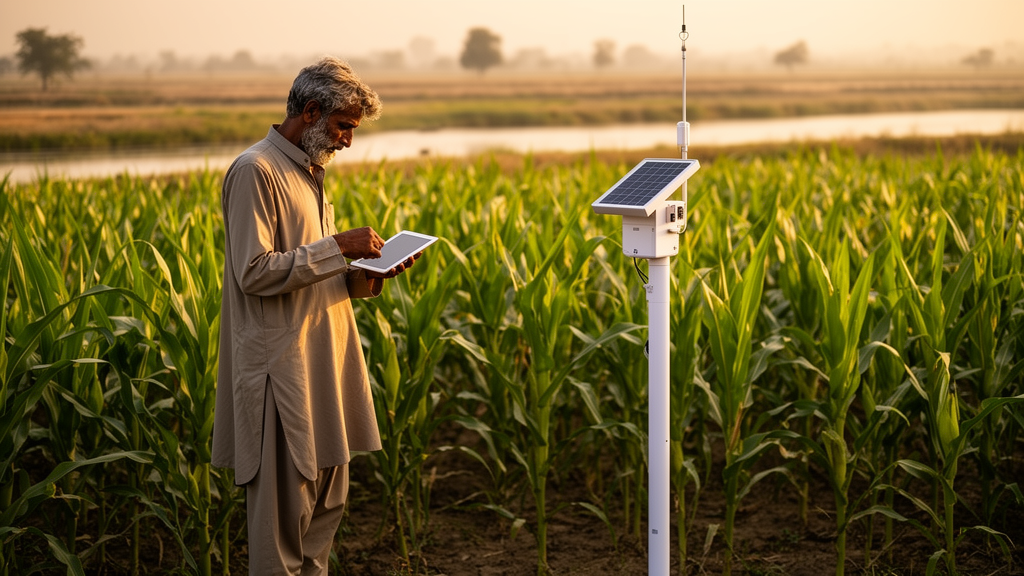
Maize fields in Peshawar, Pakistan, could see yields fall by 14 percent under a moderate warming pathway and by 16 percent under a high-emissions pathway by the end of the century, according to a modeling study that coupled real-time field sensors with crop and climate simulations. The work, published in Agriculture & Food Security, combined two years of field experiments with the DSSAT CSM-CERES maize model and projections from five global climate models under representative concentration pathways 4.5 and 8.5, covering the period from 2006 to 2100.
The research team, led by Uzair Ahmad and Ferdous Sohel, conducted a two-year field experiment during the 2020 and 2021 growing seasons at the New Development Agricultural Research Center of the University of Agriculture Peshawar. The site sits at 365 meters elevation in a semiarid climate where maximum average temperatures range from 48 degrees Celsius down to 16 degrees Celsius and average rainfall varies between 116 and 8 millimeters. Two maize hybrids were evaluated: hybrid-1, designated SB92-K97, and hybrid-2, designated SB-909.
The experimental design used a split-plot arrangement with four replications in a randomized complete block layout. Both hybrids were grown in main plots, while six nitrogen rates, from zero up to 300 kilograms per hectare, were applied to subplots. Irrigation totaled 510 millimeters in 2020 and 520 millimeters in 2021, applied twice each season and timed to crop growth stages using water from the Warsak Canal, sourced from the Kabul River. The hybrids were planted on June 18, 2020, and June 30, 2021, following a wheat crop, and harvested on September 30, 2020, and October 12, 2021.
What distinguishes this study from earlier DSSAT applications is its sensor-driven recalibration loop. Wireless soil moisture sensors and DS18B20 digital temperature sensors were installed at depths of 15, 30, and 45 centimeters across the plots, recording volumetric water content and temperature every 15 minutes and transmitting data to a central logging system. The model’s soil water balance and temperature-dependent phenology parameters were evaluated daily against these aggregated sensor readings.
Raw sensor data passed through a two-step filtering process: a median filter removed short-term electrical spikes, and weekly gravimetric soil sampling plus a redundant secondary sensor at each depth cross-validated the readings. Sensor drift was corrected monthly. This continuous feedback allowed the researchers to refine genetic coefficients such as P1, P5, G2, G3, and PHINT throughout the growing season. The recalibrated model reduced the root mean square error for anthesis date predictions to 1.8 days for hybrid-1 and 2.1 days for hybrid-2, and achieved yield prediction errors of 68 kilograms per hectare for hybrid-1 and 79 kilograms per hectare for hybrid-2.
Calibration relied on the well-fertilized, well-irrigated treatment receiving 240 kilograms of nitrogen per hectare from the 2020 season, using a manual trial-and-error approach rather than computationally intensive automated methods that can require up to 70,000 simulations. The model showed acceptable calibration with yield errors of 397 kilograms per hectare for hybrid-1 and 411 kilograms per hectare for hybrid-2. Evaluation against 2021 data across the other nitrogen rates confirmed the model’s reliability, with the harvest index error margin ranging from 0.84 to 2.89 percent. The 2021 season was warmer and drier, with a mean temperature of 26.4 degrees Celsius and 350.8 millimeters of precipitation, compared with 25.3 degrees Celsius and 410 millimeters in 2020, and the kernel filling rate decreased by 4 to 6 percent in both hybrids under those warmer, drier conditions.
Climate projections drew on five global climate models from the CMIP5 ensemble: GFDL-ESM2M from the United States, CanESM2 from Canada, ACCESS1.0 from Australia, MPI-ESM-LR from Germany, and CMCC-CM from Italy. Outputs were downscaled using bilinear interpolation in Python and bias-corrected with the delta method for temperature and solar radiation and the ratio method for precipitation, supplemented by a quantile mapping approach that aligned the cumulative distribution functions of modeled variables with observed data. The validated climate data were organized into baseline, near-future, mid-future, and far-future periods spanning 2006 through 2100.
The projections indicate substantial warming. Nighttime minimum temperatures climb by 3 to 5 degrees Celsius over baseline across the models in the far-future RCP 8.5 scenario, with CanESM2 and MPI-ESM-LR projecting minima above 24 degrees Celsius, which intensifies respiration losses and reduces net carbon gain in the crop. Solar radiation remains relatively stable at 17 to 22 megajoules per square meter per day, while precipitation shows high variability with no consistent trend, though ESM2M under RCP 8.5 projects persistently low annual rainfall below 0.5 millimeters per day.
Irrigation demand is projected to rise steadily. The baseline average of 263 millimeters is expected to increase to 275 millimeters in the near future under RCP 4.5, a 5 percent rise, reaching 301 millimeters in the far-future period, a 15 percent increase. Under RCP 8.5, projected needs reach 322 millimeters in the far future, 22 percent above baseline.
The authors acknowledge important limitations. The study was conducted at a single location, so applying its findings to other semiarid regions requires careful consideration of local soil properties, weather extremes, and farming practices. Structural uncertainty in DSSAT maize yield projections ranges between 8 and 15 percent based on prior intercomparison studies, translating to an estimated 350 to 520 kilograms per hectare of potential variation under baseline climate conditions. Bias-corrected CMIP5 outputs for the region still show 0.7 to 1.2 degrees Celsius of variability in mean seasonal temperature projections and 8 to 12 percent variability in seasonal rainfall estimates across models under RCP 8.5. Socioeconomic factors such as farmer decision-making and access to technology were not included in the analysis, and adjustments for different soil types, altitudes, and soil physical properties were excluded, factors the authors say should be considered in future research.
Subject of Research: Integration of real-time soil sensor data with DSSAT crop modeling and global climate model projections to assess maize yield impacts in a semiarid Pakistani cropping system
Article Title: Modeling the impact of climate change in the semiarid maize cropping system through real-time sensor–GCM integration
Article References: Ahmad, U., & Sohel, F. (2026). Modeling the impact of climate change in the semiarid maize cropping system through real-time sensor–GCM integration. Agriculture & Food Security, 15(1), Article 8. https://doi.org/10.1186/s40066-025-00591-8
Image Credits: AI Generated
DOI: 10.1186/s40066-025-00591-8
Keywords: maize, climate change, DSSAT, crop modeling, Peshawar, Pakistan, semiarid agriculture, soil sensors, irrigation, nitrogen management, RCP scenarios, yield projection
Cite Scienmag News
Alan Morgan. (October 30, 2026). Real-time sensors sharpen climate forecasts for Pakistan’s maize fields. Scienmag. https://scienmag.com/real-time-sensors-sharpen-climate-forecasts-for-pakistans-maize-fields/
Alan Morgan. "Real-time sensors sharpen climate forecasts for Pakistan’s maize fields." Scienmag, 30 October 2026, https://scienmag.com/real-time-sensors-sharpen-climate-forecasts-for-pakistans-maize-fields/. Accessed 30 October 2026.
Alan Morgan. "Real-time sensors sharpen climate forecasts for Pakistan’s maize fields." Scienmag. October 30, 2026. https://scienmag.com/real-time-sensors-sharpen-climate-forecasts-for-pakistans-maize-fields/