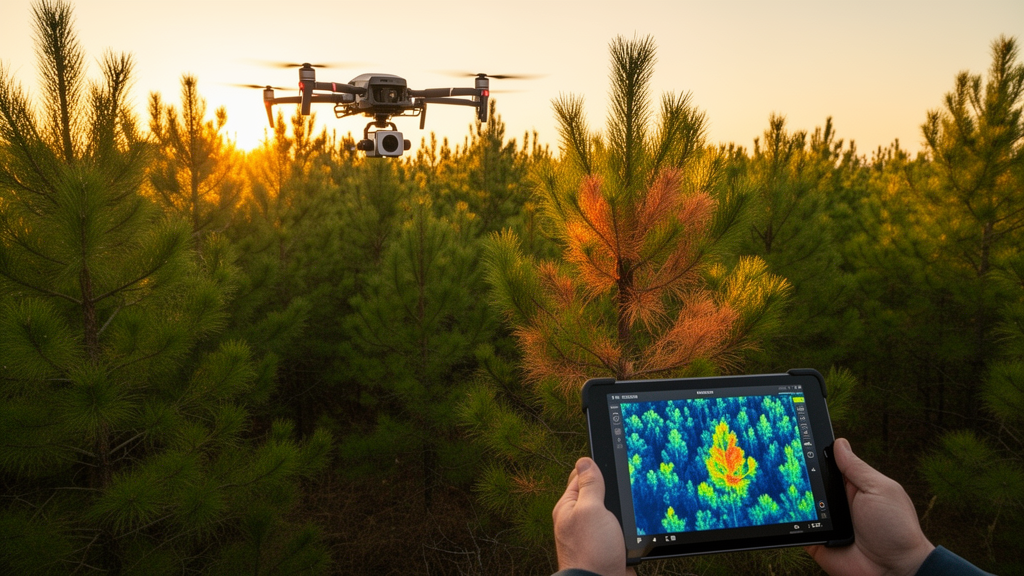
Researchers have developed a multi-scale vision transformer model that uses drone-mounted hyperspectral imagery to identify pine trees infected with pine wilt disease at the green attack and early stages, when the disease is most controllable but hardest to detect. The model achieved an identification accuracy of 87.40% for the green attack stage and 88.21% for the early stage, according to the study published in Scientific Reports.
Pine wilt disease, caused by the pine wood nematode Bursaphelenchus xylophilus, is a devastating forest disease characterized by rapid spread and high mortality. The green attack and early stages of its pathogenesis are considered critical windows for disease control, but conventional RGB drone images lack obvious visual features at these stages, which has limited the accuracy of existing identification methods.
To exploit that advantage, the team designed an efficient spectral-spatial feature fusion module aimed at capturing subtle changes in the spectral and spatial features of pine trees during the green attack stage. They also introduced an improved Gaussian self-attention mechanism to enhance the modeling of spectral differences between central pixels and their neighboring pixels, allowing the network to focus on the fine spectral contrasts that distinguish infected trees from healthy ones.
The architecture integrates a lightweight Transformer with a multi-scale feature pyramid, fusing features that range from the pixel level to the canopy level while keeping the parameter count low. On the study’s benchmarks, the model reached an overall accuracy of 87.90% and a Kappa coefficient of 83.25%, outperforming both traditional machine learning methods and other deep learning models compared in the paper.
The study also evaluated the model's efficiency. The model contains only 2.45 million parameters, with a computational cost of 112.42 million FLOPs, a training time of 114 minutes and a testing time of 25 minutes. The authors report that this combination of targeted design choices improves recognition accuracy for the green attack and early stages while supporting large-scale monitoring and scientific prevention and control of PWD-infected trees. The article was published as a shared early version, citable with a permanent DOI and subject to further edits before the final Version of Record.
Subject of Research: Early detection of pine wilt disease in pine trees using a multi-scale vision transformer applied to UAV-based hyperspectral imagery
Article Title: Multi-scale vision transformer model with UAV-based hyperspectral imagery for early identification of pine wilt disease infected trees
Article References: Shi, H., Zhang, R., Chen, M., Liu, H., Zhang, D., & Chen, L. (2026). Multi-scale vision transformer model with UAV-based hyperspectral imagery for early identification of pine wilt disease infected trees. Scientific Reports. https://doi.org/10.1038/s41598-026-65601-6
Image Credits: AI Generated
DOI: 10.1038/s41598-026-65601-6
Keywords: pine wilt disease, pine wood nematode, hyperspectral imaging, UAV remote sensing, vision transformer, early detection, forest health, spectral-spatial fusion, self-attention, machine learning, Scientific Reports, Multi-scale
Cite Scienmag News
Teresa Odom. (October 29, 2026). AI Model Spots Pine Wilt Disease in Trees Before Symptoms Show. Scienmag. https://scienmag.com/ai-model-spots-pine-wilt-disease-in-trees-before-symptoms-show/
Teresa Odom. "AI Model Spots Pine Wilt Disease in Trees Before Symptoms Show." Scienmag, 29 October 2026, https://scienmag.com/ai-model-spots-pine-wilt-disease-in-trees-before-symptoms-show/. Accessed 30 October 2026.
Teresa Odom. "AI Model Spots Pine Wilt Disease in Trees Before Symptoms Show." Scienmag. October 29, 2026. https://scienmag.com/ai-model-spots-pine-wilt-disease-in-trees-before-symptoms-show/