

Thursday, November 5, 2026
Science
No Result
View All Result
  • Login
  • HOME
  • SCIENCE NEWS
  • CONTACT US
  • HOME
  • SCIENCE NEWS
  • CONTACT US
No Result
View All Result
Scienmag
No Result
View All Result
Home Science News

Soil Anomaly Methods Flag Different Patterns in Ghana Mining Areas

October 29, 2026
in Science News
Bethany Barker
By Bethany Barker Scienmag Editorial Profile - Catalysis
Reading Time: 2 mins read
0
Soil Anomaly Methods Flag Different Patterns in Ghana Mining Areas

Soil Anomaly Methods Flag Different Patterns in Ghana Mining Areas

65
SHARES
587
VIEWS
Share on FacebookShare on Twitter
ADVERTISEMENT

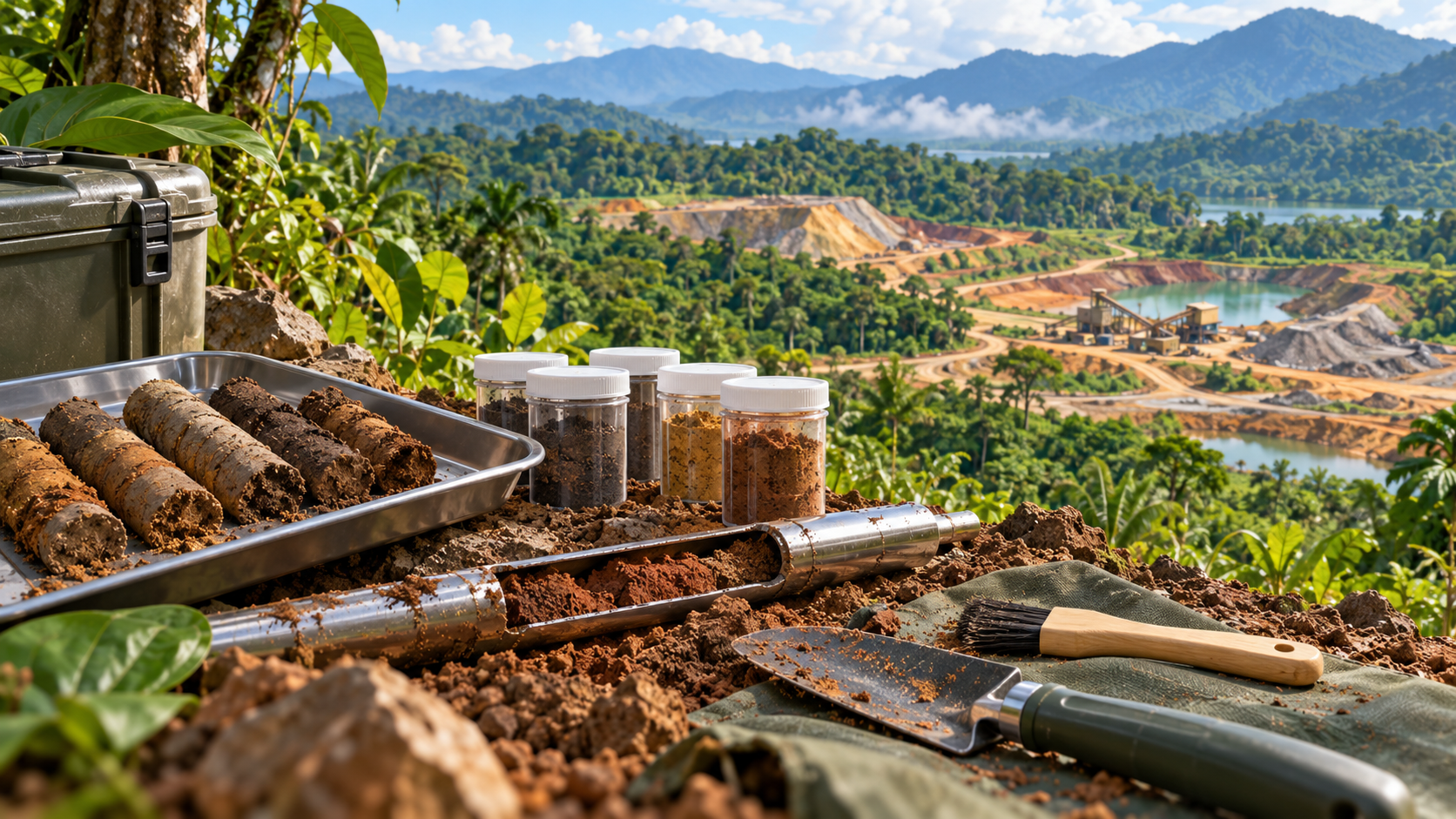
In eastern Ghana’s artisanal and small-scale gold mining areas, soil chemistry can reflect both underlying geology and human activity, making unusual combinations of elements difficult to interpret. A new study compared several statistical approaches for identifying multielement geochemical anomalies in soil samples, with the aim of helping prioritize locations for follow-up. The researchers analysed 665 B-horizon soil samples for 14 elements using X-ray fluorescence, then applied principal component analysis (PCA), two forms of Mahalanobis distance and spatial autocorrelation analysis.

The methods flagged different numbers of samples as anomalous. PCA retained three components that together explained 62.89% of the total variance and identified 60 samples, or 9.02%. Classical Mahalanobis distance identified 51 samples (7.67%), while robust Mahalanobis distance identified 120 (18.05%). Across the three detection methods, at least one method identified 164 samples (24.66%); 57 (8.57%) were identified by at least two methods, and 10 (1.50%) by all three. The differing totals show that the methods did not simply produce the same list of unusual samples.

The researchers also examined whether flagged samples had spatial patterns. PCA anomalies showed the strongest spatial dependence of the three approaches, with a Global Moran’s I of 0.1474 and p = 0.002. Local spatial analysis corroborated 25.00% of the PCA anomalies, 13.73% of those flagged by Classical Mahalanobis distance and 10.00% of robust-distance anomalies. In this analysis, spatial corroboration provides an additional way to assess whether detected anomalies are geographically patterned; it does not by itself establish why the element combinations occur.

The authors interpret the results as complementary strengths: PCA identified a more spatially coherent set of anomalies, while robust Mahalanobis distance detected a broader range of unusual multielement compositions. The overlap among methods was limited: only 10 of the 665 samples were flagged by all three. That pattern supports treating the outputs as different views of the same geochemical dataset rather than interchangeable counts. It also means the number of priority locations would depend in part on which method or combination of methods is used.

The study’s conclusion is that combining detection approaches can provide complementary evidence for prioritizing locations for field verification and environmental monitoring in mineralized and mining-affected areas. Its results come from soil sampling and statistical analysis in the study area; the abstract does not report field verification of the flagged locations or establish the source of each anomaly. A statistical anomaly is therefore a candidate for further investigation, not evidence on its own of contamination or mining impact.

Subject of Research: Statistical detection of multielement geochemical anomalies in soils from artisanal gold-mining areas in eastern Ghana

Article Title: Comparative detection of multielement geochemical anomalies using PCA and Mahalanobis distance in artisanal gold mining soils in eastern Ghana

Article References: Kazapoe, R. W., Kwaw, A. K., Sagoe, S. D., Sagru-Larr, P., Adam, A. B., Amoah, B. K., & Fynn, O. F. (2026). Comparative detection of multielement geochemical anomalies using PCA and Mahalanobis distance in artisanal gold mining soils in eastern Ghana. Scientific Reports. https://doi.org/10.1038/s41598-026-77993-6

Image Credits: AI Generated

DOI: 10.1038/s41598-026-77993-6

Keywords: soil geochemistry, Ghana, artisanal gold mining, geochemical anomalies, principal component analysis, Mahalanobis distance, spatial autocorrelation, environmental monitoring, Comparative, detection, multielement, geochemical

Cite Scienmag News

Bethany Barker. (October 29, 2026). Soil Anomaly Methods Flag Different Patterns in Ghana Mining Areas. Scienmag. https://scienmag.com/soil-anomaly-methods-flag-different-patterns-in-ghana-mining-areas/

Bethany Barker. "Soil Anomaly Methods Flag Different Patterns in Ghana Mining Areas." Scienmag, 29 October 2026, https://scienmag.com/soil-anomaly-methods-flag-different-patterns-in-ghana-mining-areas/. Accessed 5 November 2026.

Bethany Barker. "Soil Anomaly Methods Flag Different Patterns in Ghana Mining Areas." Scienmag. October 29, 2026. https://scienmag.com/soil-anomaly-methods-flag-different-patterns-in-ghana-mining-areas/

Tags: artisanal gold miningartisanal gold mining soil patternscomparativedetectionenvironmental impact of small-scale miningEnvironmental Monitoringgeochemicalgeochemical anomaliesgeochemical anomaly pattern recognitionGhanaidentifying mineralization zones in GhanaMahalanobis distanceMahalanobis distance for geochemical anomaly detectionmultielementmultielement soil analysis using X-ray fluorescencePrincipal Component Analysisprincipal component analysis in soil geochemistryrobust Mahalanobis distance comparisonSoil geochemical anomaly detection in Ghana mining areassoil geochemistryspatial autocorrelationspatial autocorrelation analysis in soil samplesspatial dependence of soil anomaliesstatistical methods for soil anomaly identification
Share26Tweet16
Previous Post

Mental Health Diagnoses Linked to Poorer HIV Treatment Outcomes in Rural Zimbabwe

Next Post

Experts Map a Five-Level Maturity Path for Digital Twins in Freeze-Drying

Related Posts

How a handful of WallStreetBets traders ignited the GameStop squeeze
Mathematics

How a handful of WallStreetBets traders ignited the GameStop squeeze

November 5, 2026
Climate-resilient livestock: welfare, technology and adaptation converge
Biology

Climate-resilient livestock: welfare, technology and adaptation converge

November 5, 2026
D-Cysteine Keeps Fresh-Cut Button Mushrooms White and Fresh by Triggering Internal Hydrogen Sulfide
Agriculture

D-Cysteine Keeps Fresh-Cut Button Mushrooms White and Fresh by Triggering Internal Hydrogen Sulfide

November 4, 2026
Mining soils in North China show high stomach solubility of cadmium and lead
Earth Science

Mining soils in North China show high stomach solubility of cadmium and lead

November 4, 2026
Chinese Philosophy of Engineering Puts Creation Before Science
Social Science

Chinese Philosophy of Engineering Puts Creation Before Science

November 4, 2026
Plants turn water into electricity as hydrovoltaic devices reach 1.2 volts
Chemistry

Plants turn water into electricity as hydrovoltaic devices reach 1.2 volts

November 4, 2026
Next Post
Experts Map a Five-Level Maturity Path for Digital Twins in Freeze-Drying

Experts Map a Five-Level Maturity Path for Digital Twins in Freeze-Drying

  • Mothers who receive childcare support from maternal grandparents show more optimized

    Mothers who receive childcare support from maternal grandparents show more parental warmth, finds NTU Singapore study

    27656 shares
    Share 11059 Tweet 6912
  • University of Seville Breaks 120-Year-Old Mystery, Revises a Key Einstein Concept

    1061 shares
    Share 424 Tweet 265
  • Bee body mass, pathogens and local climate influence heat tolerance

    682 shares
    Share 273 Tweet 171
  • Researchers record first-ever images and data of a shark experiencing a boat strike

    546 shares
    Share 218 Tweet 137
  • Groundbreaking Clinical Trial Reveals Lubiprostone Enhances Kidney Function

    531 shares
    Share 212 Tweet 133
Science

Embark on a thrilling journey of discovery with Scienmag.com—your ultimate source for cutting-edge breakthroughs. Immerse yourself in a world where curiosity knows no limits and tomorrow’s possibilities become today’s reality!

RECENT NEWS

  • How a handful of WallStreetBets traders ignited the GameStop squeeze
  • Climate-resilient livestock: welfare, technology and adaptation converge
  • D-Cysteine Keeps Fresh-Cut Button Mushrooms White and Fresh by Triggering Internal Hydrogen Sulfide
  • Mining soils in North China show high stomach solubility of cadmium and lead

Categories

  • Agriculture
  • Anthropology
  • Archaeology
  • Athmospheric
  • Biology
  • Biotechnology
  • Blog
  • Bussines
  • Cancer
  • Chemistry
  • Climate
  • Earth Science
  • Editorial Policy
  • Marine
  • Mathematics
  • Medicine
  • Pediatry
  • Policy
  • Psychology & Psychiatry
  • Science Education
  • Science News
  • Social Science
  • Space
  • Technology and Engineering

Subscribe to Blog via Email

Enter your email address to subscribe to this blog and receive notifications of new posts by email.

Join 5,149 other subscribers

© 2025 Scienmag - Science Magazine

Welcome Back!

Login to your account below

Forgotten Password?

Retrieve your password

Please enter your username or email address to reset your password.

Log In
No Result
View All Result
  • HOME
  • SCIENCE NEWS
  • CONTACT US

© 2025 Scienmag - Science Magazine

Discover more from Science

Subscribe now to keep reading and get access to the full archive.

Continue reading

