

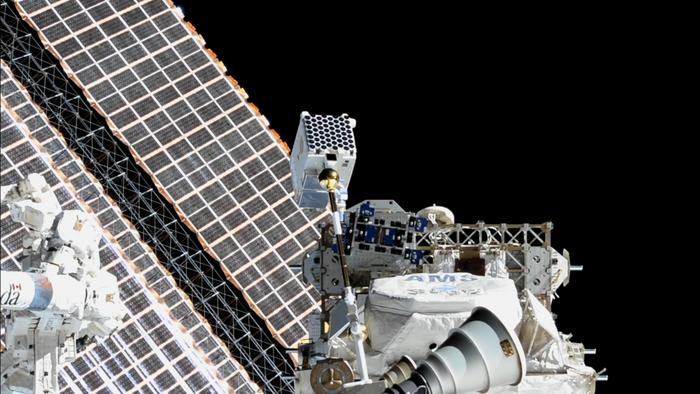
NASA is planning to repair NICER (Neutron star Interior Composition Explorer), an X-ray telescope on the International Space Station, during a spacewalk later this year. It will be the fourth science observatory in orbit serviced by astronauts.

Credit: NASA
NASA is planning to repair NICER (Neutron star Interior Composition Explorer), an X-ray telescope on the International Space Station, during a spacewalk later this year. It will be the fourth science observatory in orbit serviced by astronauts.
In May 2023, scientists discovered that NICER had developed a “light leak.” Unwanted sunlight was entering the instrument and reaching the telescope’s sensitive detectors. While the team took immediate steps to mitigate the impact on observations, they also began thinking about a potential repair.
“The sunlight interferes with NICER’s ability to collect viable X-ray measurements during the station’s daytime,” said Zaven Arzoumanian, NICER’s science lead at NASA’s Goddard Space Flight Center in Greenbelt, Maryland. “Nighttime observations are unaffected, and the telescope continues to produce incredible science. Hundreds of published papers have used NICER since the mission began. Blocking some of the light leaking in would allow us to return to more normal operations around the clock.”
Arzoumanian presented efforts to address the issue during a talk on Friday, April 12, at the 21st meeting of the High Energy Astrophysics Division of the American Astronomical Society in Horseshoe Bay, Texas.
NICER is located near the station’s inner starboard solar panels. From that perch, it looks out at the X-ray sky, collecting data on many cosmic phenomena, like regular pulses from superdense stellar remnants called neutron stars and “light echoes” from flaring black holes. Observing these objects helps answer questions about their nature and behavior and increases our understanding of matter and gravity. In 2017, NICER also demonstrated the use of pulsing neutron stars in our galaxy to serve as navigational beacons for future deep space exploration through a program called SEXTANT (Station Explorer for X-ray Timing and Navigation Technology).
The telescope has 56 aluminum X-ray concentrators. Each concentrator has a set of nested mirrors, designed to skip X-rays into a detector. In front of the concentrator lies a thin filter, called a thermal shield, that blocks out sunlight. The concentrator is topped by a hollow circular piece of carbon composite, called a sunshade, with six segments that resemble a sliced pie. The sunshade is designed to keep the concentrators cool in sunlight and protect the delicate thermal shields. After the light leak developed, photos revealed several small areas of damage in some of the shields, though what caused them is still unclear.
“We didn’t design NICER for mission servicing. It was installed robotically, and we operate it from the ground,” said Keith Gendreau, NICER’s principal investigator at Goddard. “The possibility of a repair has been an exciting challenge. We considered both spacewalk and robotic solutions, puzzling out how to install patches using what’s already present on the telescope and in space station toolkits.”
After many months of consideration, the spacewalk was selected as the path forward. NASA’s Hubble Space Telescope and Solar Maximum Mission, as well as AMS (Alpha Magnetic Spectrometer, also on the station) are the only other science observatories repaired by astronauts in orbit.
NICER’s solution is straightforward. Five pie piece-shaped wedges will slot into the sunshades above the areas with the greatest damage and lock into place. The patches are designed to take advantage of an existing piece of astronaut equipment, called a T-handle tool.
“While we worked hard to ensure the patches are mechanically simple, most repair activities in space are very complicated,” said Steve Kenyon, NICER’s mechanical lead at Goddard. “We’ve been conducting tests to confirm the repair work will be both an effective fix for NICER’s light leak and completely safe for the astronauts on the spacewalk and the space station.”
The patches are currently scheduled to launch to the space station aboard Northrop Grumman’s 21st commercial resupply services mission later this year. Astronauts will complete their installation during a spacewalk, along with other tasks.
NICER is an Astrophysics Mission of Opportunity within NASA’s Explorers Program, which provides frequent flight opportunities for world-class scientific investigations from space utilizing innovative, streamlined, and efficient management approaches within the heliophysics and astrophysics science areas. NASA’s Space Technology Mission Directorate supports the SEXTANT component of the mission, demonstrating pulsar-based spacecraft navigation.
NICER also collaborates in automated tandem with JAXA’s (Japan Aerospace Exploration Agency’s) experiment MAXI (Monitor of All-sky X-ray Image) to rapidly observe stars and other objects that flare unpredictably, advancing scientific understanding of our dynamic universe.

