Researchers in Iran are preparing to launch a randomized, double-blind controlled trial that will test whether two common kitchen spices — sumac (Rhus coriaria L.) and cinnamon (Cinnamomum verum J. Presl) — can improve cholesterol levels and quality of life in one of the highest-risk patient groups in medicine: people hospitalized with an acute myocardial infarction who also have type 2 diabetes and are overweight or obese. The study is a protocol, published in Cardiovascular Diabetology – Endocrinology Reports, meaning it describes planned methods rather than results. No efficacy findings exist yet, and the trial’s own authors stress that any findings in this specific population will be preliminary and will require confirmation in larger definitive studies.
The rationale rests on the enormous burden of cardiovascular disease. According to the protocol’s background section, cardiovascular diseases claimed approximately 17.9 million lives in 2019, representing roughly one-third of total global mortality, with ischemic heart disease, stroke, heart failure, cardiomyopathy, and atrial fibrillation collectively accounting for more than 95 percent of cardiovascular deaths. Risk factors such as unhealthy diet, physical inactivity, tobacco use, and disorders of lipid metabolism drive this toll, and elevated low-density lipoprotein cholesterol (LDL-C) remains a primary target for lipid-lowering therapy under the National Cholesterol Education Program. Atherosclerosis — a chronic process involving inflammation and plaque buildup within artery walls — underlies many of these events, and current treatment spans lifestyle modification, statins, antiplatelet agents, and invasive procedures such as percutaneous coronary intervention or coronary artery bypass grafting.
Why spices? Sumac, a member of the Anacardiaceae family used mainly in western Asia and the Mediterranean as a dried fruit powder, is a rich source of polyphenols including tannins, flavonoids, flavonols, anthocyanins, quercetins, and organic acids. Previous clinical trials have reported beneficial effects of sumac supplementation on metabolic markers in patients with type 2 diabetes, in overweight and obese individuals, and in patients with hyperlipidemia, and its blood pressure-lowering effect has been confirmed in existing reviews. However, the protocol is candid about the gaps: studies on sumac’s effects on blood lipids and obesity have yielded inconsistent results, and there is no conclusive evidence regarding its impact on lipid profiles. Cinnamon, meanwhile, has been examined in several clinical studies of lipid profiles, insulin sensitivity, systolic blood pressure, and blood antioxidant levels, and a meta-analysis combining data from ten randomized controlled trials found a consistent decrease in total cholesterol and triglyceride levels among supplemented subjects.
The trial will enroll 76 participants at Imam Sajad Hospital, under the authority of Yasuj University of Medical Sciences in Kohgiluyeh Va Boyerahmad province, in Yasuj city. Eligible patients must be between 20 and 75 years old, hospitalized in the cardiac intensive care unit with a definitive diagnosis of acute myocardial infarction, have physician-diagnosed type 2 diabetes, and have a body mass index above 25 kg/m². They must also read and write Persian and provide written informed consent. Exclusion criteria are extensive and include pregnancy and lactation, mental illness, stomach ulcers or digestive disorders, thyroid disorders affecting food metabolism, advanced liver disease, severe renal failure, uncontrolled inflammatory or autoimmune disease, known allergy to sumac or cinnamon, current use of psychotropic drugs, stage IV heart failure, acute infections or obstructive pulmonary disease at entry, ongoing sex hormone treatment, medications likely to substantially affect lipid metabolism or inflammatory markers, participation in another clinical study within the previous three months, and cognitive or communication difficulties.
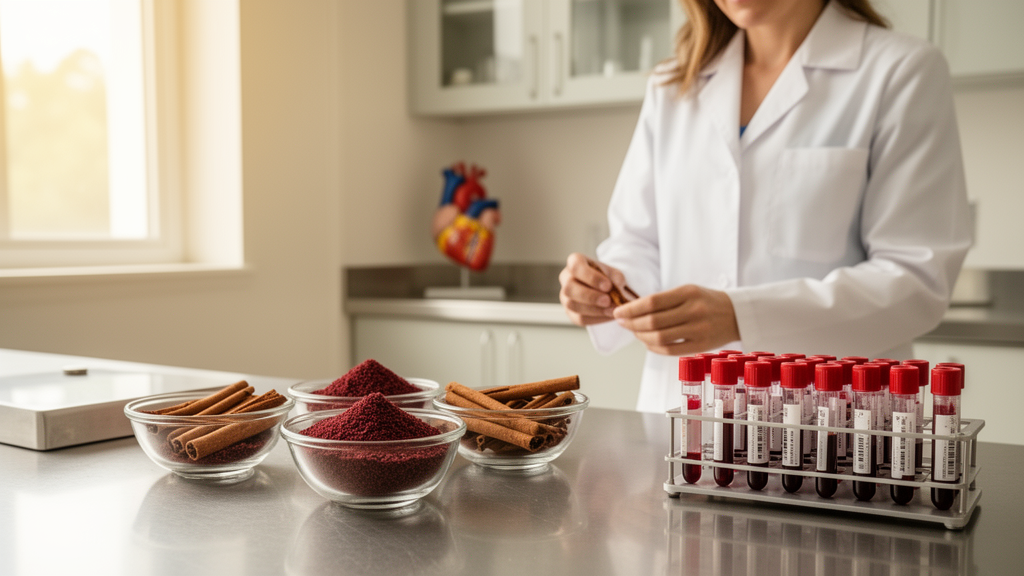
Participants will be randomly assigned in equal groups of 19 to one of four arms: sumac alone, cinnamon alone, a combination of both, or placebo, with an allocation ratio of 1:1:1:1. The intervention lasts eight weeks, with participants taking one film-coated tablet daily. The tablets are not simply ground spice: plant material was extracted using an aqueous–alcoholic maceration method with 70 percent ethanol in a Soxhlet-type apparatus for 48 hours at 40 °C, concentrated under vacuum, freeze-dried, mixed with permitted excipients such as starch and gelatin, and compressed into 1 g tablets that passed USP quality-control tests for weight uniformity, disintegration time, and dissolution. The single-extract groups receive extract equivalent to 3.0 g of raw sumac or 1.0 g of raw cinnamon per tablet; the combination group receives the equivalent of 2.0 g of raw sumac plus 1.0 g of raw cinnamon. The sumac was sourced from Sabzevar, Iran, and the cinnamon from India, and both passed microbial testing for E. coli, Salmonella, Pseudomonas, Streptococcus, and yeast.
The primary outcome is the change in serum LDL-C from baseline to week 8, measured with standard photometric and enzymatic methods on a biochemical auto-analyzer. Secondary outcomes include changes in HDL cholesterol, triglycerides, total cholesterol, and VLDL (calculated from triglyceride measurements), a Complete Blood Count performed on an automated hematology analyzer, inflammatory markers — interleukin-6 and high-sensitivity C-reactive protein assayed by ELISA, and erythrocyte sedimentation rate assessed by the Westergren-Katz method — plus quality of life measured with the World Health Organization Quality of Life-BREF questionnaire and pain intensity measured with the McGill Pain Questionnaire. Fasting blood samples of 5 cc will be drawn at baseline and at the end of treatment, and specimens will not be stored for future use.
The statistical plan is notably rigorous for a nutrition trial. Analysis with SPSS version 26 will use Analysis of Covariance adjusting for baseline values, with statin therapy categorized by intensity — low, moderate, or high — according to current clinical guidelines and included as a covariate, alongside other major lipid-lowering agents such as ezetimibe or PCSK9 inhibitors. The primary analysis will follow the intention-to-treat principle, with missing data handled through Multiple Imputation by Chained Equations generating at least 20 imputed datasets, and sensitivity analyses will exclude participants who undergo major lipid-lowering therapy changes and compare complete-case results. The sample size was calculated assuming a Type I error of 5 percent, 80 percent power, and standard deviations of LDL-C of 102 ± 24.3 in the intervention group versus 131 ± 31.9 in the placebo group, yielding 14 participants per group before inflating to 19 per group to account for a potential 30 percent dropout rate. No interim analyses are planned.
Blinding and safety receive detailed attention. Participants, care providers, outcome assessors, and data analysts will all be blinded, and blinding success will be formally quantified at study completion using the Bang Blinding Index, which asks participants and assessors to guess the treatment allocation. Tablets are packaged identically and opaquely by an external team, with contents confidential until the study’s completion. Adverse events will be actively monitored through weekly phone check-ins and a final clinic visit, documented and graded according to the Common Terminology Criteria for Adverse Events version 5.0, with the intervention discontinued immediately if a severe adverse reaction occurs. Given the low-risk nature of the nutritional intervention, no formal Data Monitoring Committee was established, but the Principal Investigator will conduct mandatory weekly safety reviews, and all serious adverse events must be reported to the Ethics Committee within 24 hours. Adherence will be tracked through weekly phone check-ins, three 24-hour dietary recalls, and tablet counting at the final visit.
The trial is registered with the Iranian Registry of Clinical Trials as IRCT20150711023153N5, registered on 6 December 2023, with recruitment set to commence on 10 February 2026 and the protocol at version 4.1, dated 10 June 2026. The authors acknowledge several limitations: the eight-week duration may not capture long-term quality-of-life changes, the natural recovery process after a heart attack may influence subjective pain outcomes, the study is single-center, and there are no biochemical adherence markers to objectively verify supplement intake. They also note that the reduced sumac dose in the combination arm — 2 g versus 3 g in the single-extract group — limits interpretation of true synergy. Until results are published in a future paper, the appropriate conclusion is that this is a carefully designed hypothesis-testing protocol, not evidence that sumac or cinnamon improves outcomes after a heart attack.
Subject of Research: A randomized controlled trial protocol testing sumac and cinnamon supplementation on lipid profile and quality of life in post-myocardial infarction patients with type 2 diabetes and overweight/obesity.
Article Title: The effect of sumac and cinnamon on lipid profile and quality of life in patients with acute myocardial infarction, type 2 diabetes, and overweight/obesity: study protocol for a randomized double-blind controlled trial
Article References: Golmohammadi, A., Peikar, A., Karimpour, F., Bagheri, F. Z., & Panahande, S. B. (2026). The effect of sumac and cinnamon on lipid profile and quality of life in patients with acute myocardial infarction, type 2 diabetes, and overweight/obesity: study protocol for a randomized double-blind controlled trial. Cardiovascular Diabetology – Endocrinology Reports, 12(1), Article 54. https://doi.org/10.1186/s40842-026-00326-z
Image Credits: AI Generated
DOI: 10.1186/s40842-026-00326-z
Keywords: sumac, cinnamon, randomized controlled trial, LDL cholesterol, myocardial infarction, type 2 diabetes, obesity, lipid profile, quality of life, inflammation, study protocol, cardiovascular disease
Cite Scienmag News
Ophelia Keating. (October 29, 2026). Sumac and Cinnamon Trial to Test Lipid Effects After Heart Attacks. Scienmag. https://scienmag.com/sumac-and-cinnamon-trial-to-test-lipid-effects-after-heart-attacks/
Ophelia Keating. "Sumac and Cinnamon Trial to Test Lipid Effects After Heart Attacks." Scienmag, 29 October 2026, https://scienmag.com/sumac-and-cinnamon-trial-to-test-lipid-effects-after-heart-attacks/. Accessed 29 October 2026.
Ophelia Keating. "Sumac and Cinnamon Trial to Test Lipid Effects After Heart Attacks." Scienmag. October 29, 2026. https://scienmag.com/sumac-and-cinnamon-trial-to-test-lipid-effects-after-heart-attacks/