A proteinaceous antibacterial substance produced by a marine-derived strain of Acinetobacter pittii has been isolated and characterized in a study published in Annals of Microbiology. The compound, designated PAM3-2, was recovered from the cell-free fermentation supernatant of strain AM3-2, which had previously been reported to display broad antibacterial activity. Using acid precipitation, chromatography and activity-guided fractionation, the researchers purified the active fraction and estimated its apparent molecular mass at about 25 kilodaltons by tricine-sodium dodecyl sulfate-polyacrylamide gel electrophoresis.
The study was framed against the growing problem of multidrug-resistant bacterial pathogens, which the authors note threaten public health, livestock production and food safety. Marine-derived bacteria, they argue, remain a potentially valuable but underexplored source of antimicrobial substances. The work was designed to isolate and characterize the antibacterial substance from A. pittii strain AM3-2 and to evaluate its antibacterial properties and preliminary mode of action.
In laboratory assays, PAM3-2 showed concentration-dependent inhibitory activity against both Gram-positive and Gram-negative indicator bacteria. The greatest susceptibility was observed for Salmonella enterica subsp. enterica serovar Paratyphi B, with a minimum inhibitory concentration of 20.45 micrograms per milliliter.
A central finding of the characterization work was the compound’s physicochemical stability. PAM3-2 retained more than 70 percent of its antibacterial activity after treatment at 121 degrees Celsius for 20 minutes, maintained substantial activity across a broad pH range from 2 to 8, and showed considerable resistance to proteolytic enzymes.
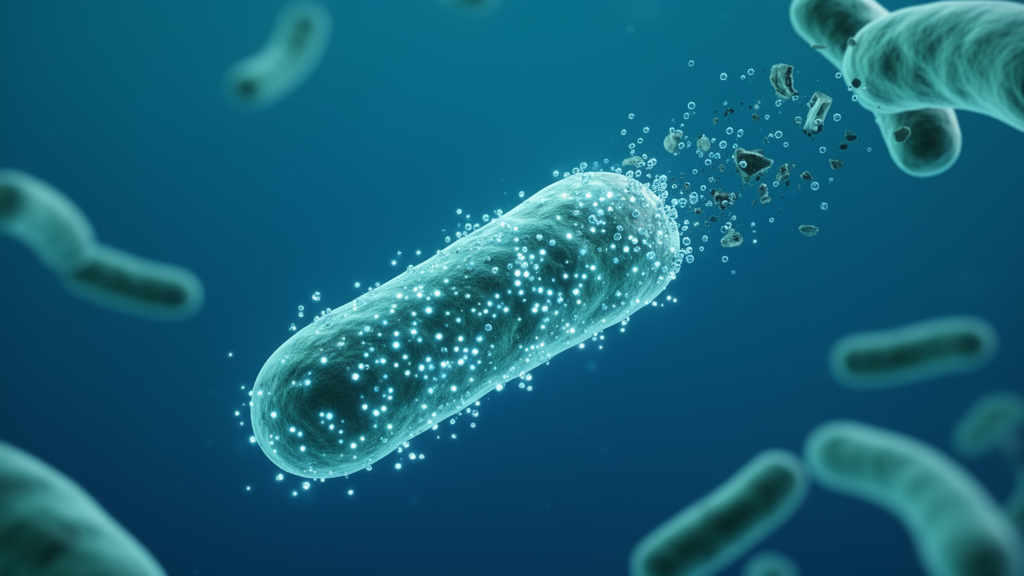
To probe how the substance kills bacteria, the researchers combined scanning electron microscopy with leakage assays. The observations were consistent with loss of membrane integrity in target cells. Accompanying this structural damage, the assays detected increased extracellular potassium, lactate dehydrogenase, nucleic acids and proteins, a pattern indicating that intracellular contents escape once the membrane barrier fails.
On this basis, the authors conclude that PAM3-2 is a proteinaceous bacteriocin-like antibacterial substance produced by marine-derived A. pittii with high physicochemical stability, exhibiting broad-spectrum antibacterial activity, particularly against S. Paratyphi B, and that its antibacterial effect is associated with disruption of membrane integrity. The membrane-disruptive mechanism is described as preliminary, resting on microscopy and leakage measurements rather than on a fully resolved molecular pathway.
Several scope limitations should be kept in view. The reported activity comes from in vitro assays against indicator bacterial strains, not from tests in animals or humans, so no clinical or field benefit can be inferred from these results. The compound is described as bacteriocin-like on the basis of its proteinaceous nature and behavior, and its precise identity, structure and genetic basis were not established in the reported characterization. The published version is also an early shared version of peer-reviewed, accepted research, subject to further edits before the final Version of Record.
Because resistance to conventional antibiotics continues to spread, screening underexplored environments such as marine microbial communities remains an active strategy for identifying candidate antibacterial molecules at an early research stage.
For follow-up work, the parameters reported here, including the roughly 25-kilodalton apparent size, the minimum inhibitory concentration against S. Paratyphi B, and the stability profile across heat, pH and proteases, provide measurable benchmarks against which any future purification, structural elucidation and safety testing of PAM3-2 would need to be compared.
Subject of Research: Isolation and characterization of the bacteriocin-like antibacterial substance PAM3-2 from marine-derived Acinetobacter pittii
Article Title: Isolation, characterization, and antibacterial activity of a novel bacteriocin-like substance (PAM3-2) produced by marine-derived Acinetobacter pittii
Article References: Zhen, Y., Ma, Y., Long, Y., Lin, Q., Wu, S., Xiang, Y., Tuo, J., Wang, X., & Guo, F. (2026). Isolation, characterization, and antibacterial activity of a novel bacteriocin-like substance (PAM3-2) produced by marine-derived Acinetobacter pittii. Annals of Microbiology. https://doi.org/10.1186/s13213-026-01872-8
Image Credits: AI Generated
DOI: 10.1186/s13213-026-01872-8
Keywords: Acinetobacter pittii, bacteriocin, PAM3-2, marine bacteria, antimicrobial, Salmonella Paratyphi B, membrane integrity, heat stability, minimum inhibitory concentration, multidrug resistance, Isolation, characterization
Cite Scienmag News
Morgan Morrow. (October 29, 2026). Marine Bacterium Yields Stable Bacteriocin-Like Compound Active Against Salmonella. Scienmag. https://scienmag.com/marine-bacterium-yields-stable-bacteriocin-like-compound-active-against-salmonella/
Morgan Morrow. "Marine Bacterium Yields Stable Bacteriocin-Like Compound Active Against Salmonella." Scienmag, 29 October 2026, https://scienmag.com/marine-bacterium-yields-stable-bacteriocin-like-compound-active-against-salmonella/. Accessed 29 October 2026.
Morgan Morrow. "Marine Bacterium Yields Stable Bacteriocin-Like Compound Active Against Salmonella." Scienmag. October 29, 2026. https://scienmag.com/marine-bacterium-yields-stable-bacteriocin-like-compound-active-against-salmonella/