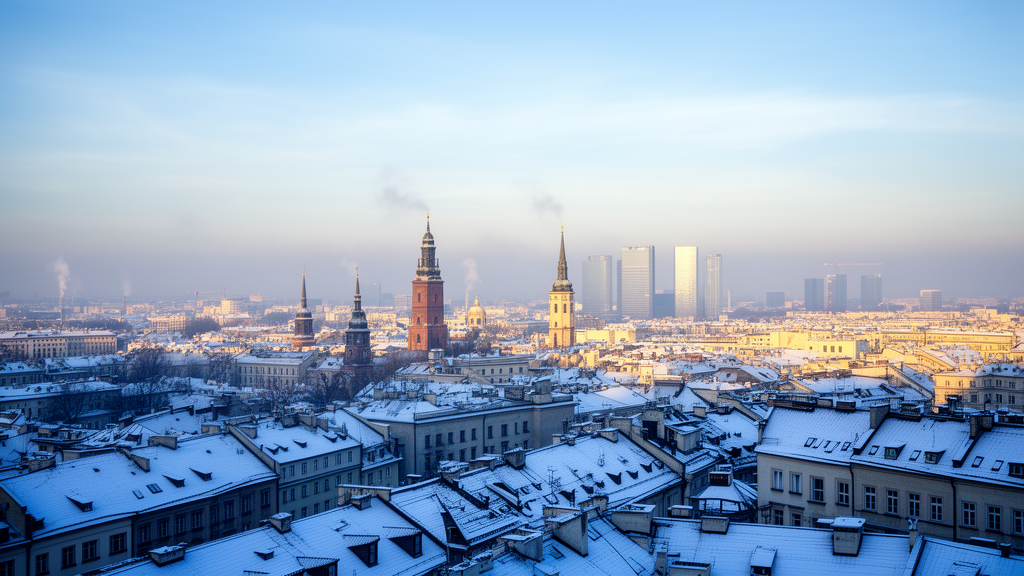
Winter air pollution in Warsaw has improved substantially over the past decade, according to an analysis of hourly measurements from nine CIEP monitoring stations covering 2016 to 2025. The study, which also drew on meteorological observations from the Okecie IMGW station, boundary layer heights from ERA5, and HYSPLIT backward trajectories, focused on PM10, PM2.5, NO2, and O3, with particular attention to black smog episodes. The findings indicate that both emission controls and atmospheric conditions contributed to cleaner winter air in Poland’s capital.
The scale of the improvement is evident in the frequency of good or very good conditions under Polish air quality index thresholds. For PM2.5, such conditions rose from 10 to 12 percent of hours in 2016–2018 to 30 to 32 percent in 2023–2025. For PM10, the share increased from 16 to 24 percent to 43 to 45 percent over the same period. NO2 also declined: very good conditions increased from 66 percent in urban areas and 88 percent in suburban areas to 84 percent and 95 percent, respectively.
Smog episodes occurred under a characteristic set of conditions. They were associated with low temperatures, averaging −3.3 °C, weak winds of up to 5 m/s, strong temperature inversions, and high humidity, with air masses arriving from local, northern, or western origins. The analysis quantified how strongly meteorology shapes pollution levels: PMx concentrations fell about 4 to 8 fold from the lowest temperature bin (−21 to −16 °C) to the 9–14 °C bin, dropped 4 to 6 fold as winds strengthened from 0–1 to 8–12 m/s, and decreased 7 to 11 fold as the boundary layer deepened from 0–100 to 1500–2500 m. In contrast, O3 increased under deeper boundary layers and cleaner air masses.
Crucially, the researchers compared pollution levels under similar meteorological conditions to separate genuine emission changes from weather-driven variability. Those comparisons confirmed a genuine downward trend in PM2.5, which the authors attribute to emission reductions from residential heating, stricter policies, and better alignment with EU standards. The results indicate that winter air quality in Warsaw has improved due to both emission control and favorable atmospheric conditions, with regional transport modulating urban pollution. The study is an open-access research article published in Aerosol and Air Quality Research, based on a decade of observational data from a single metropolitan area.
Subject of Research: Wintertime air quality trends and smog episodes in Warsaw, Poland, from 2016 to 2025
Article Title: Improvement in wintertime air quality in urban and suburban areas of Warsaw within 2016–2025
Article References: Szczepanik, D. M., Deptuła, K., Kłapiński, S., Rakowska, J., Maciejewska, K., Czaplicka, M., & Stachlewska, I. S. (2026). Improvement in wintertime air quality in urban and suburban areas of Warsaw within 2016–2025. Aerosol and Air Quality Research. https://doi.org/10.1007/s44408-026-00173-8
Image Credits: AI Generated
DOI: 10.1007/s44408-026-00173-8
Keywords: air quality, PM2.5, PM10, NO2, smog, Warsaw, boundary layer, meteorology, emission reductions, black smog, HYSPLIT, ERA5
Cite Scienmag News
Russell Cooper. (October 29, 2026). Warsaw’s Winter Air Quality Improved Markedly Over the Past Decade. Scienmag. https://scienmag.com/warsaws-winter-air-quality-improved-markedly-over-the-past-decade/
Russell Cooper. "Warsaw’s Winter Air Quality Improved Markedly Over the Past Decade." Scienmag, 29 October 2026, https://scienmag.com/warsaws-winter-air-quality-improved-markedly-over-the-past-decade/. Accessed 29 October 2026.
Russell Cooper. "Warsaw’s Winter Air Quality Improved Markedly Over the Past Decade." Scienmag. October 29, 2026. https://scienmag.com/warsaws-winter-air-quality-improved-markedly-over-the-past-decade/