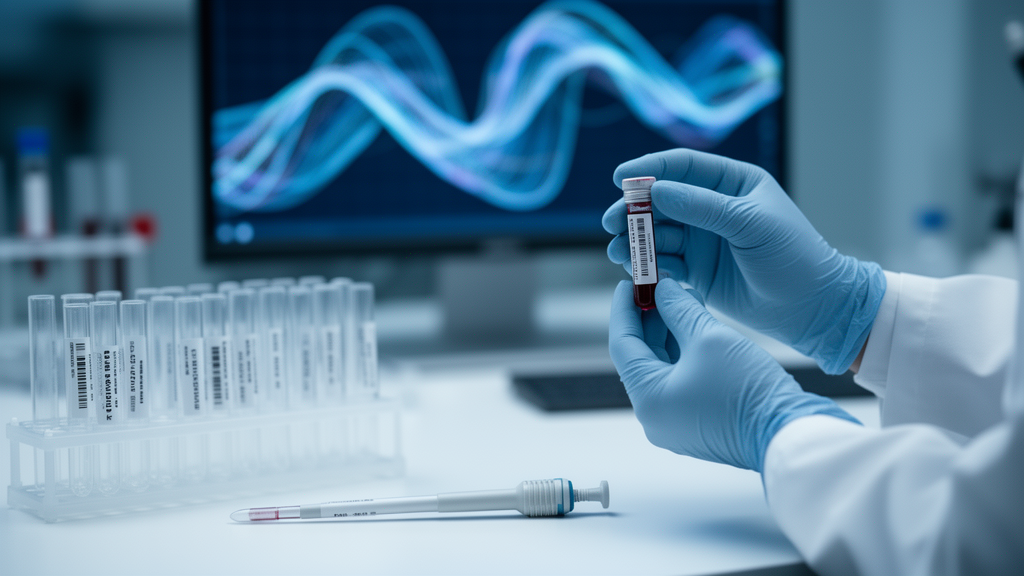
Routine blood chemistry results, the kind collected in nearly every hospital check-up, may help distinguish people experiencing a first episode of schizophrenia from healthy individuals, according to a new study published in BMC Psychiatry. Researchers at Shaoxing Seventh People’s Hospital in China developed a classification model that combines six everyday biochemical markers with machine learning algorithms, and they packaged the final model as a nomogram and an online probability calculator. The work is a single-center retrospective case-control study, and its authors are careful to note that external validation is still needed before any clinical diagnostic use can be inferred.
The study enrolled 316 first-episode schizophrenia patients diagnosed according to ICD-10 criteria at Shaoxing Seventh People’s Hospital between June and December 2025, along with 474 healthy controls who underwent routine health check-ups during the same period. All participants were Chinese individuals from the same regional medical setting, a scope the authors flag explicitly. Demographic characteristics and fasting peripheral blood biochemical parameters were extracted from the hospital information system, and the complete dataset contained no missing values for the included variables. The data were randomly split into a training set of 553 participants and a validation set of 237 in a 7:3 ratio, with feature screening and hyperparameter tuning performed only within the training set to keep the validation assessment honest.
Three feature-selection strategies were applied: univariate logistic regression with Benjamini-Hochberg false-discovery-rate correction, L1-regularized logistic regression, and recursive feature elimination. From this process, six predictors emerged for distinguishing schizophrenia patients from healthy controls: high-density lipoprotein (HDL), total bilirubin (T-Bil), blood glucose (GLU), the albumin-to-globulin ratio (A/G), total cholesterol (TC), and blood urea nitrogen (BUN). Eight machine learning algorithms were then trained on these features, and validation-set performance was evaluated using AUC, sensitivity, specificity, accuracy, precision, and F1 score.
In the validation set, the Gradient Boosting Machine achieved the highest AUC at 0.885. Yet the researchers did not choose it as the final model. They weighed the gap between training and validation performance, the potential for overfitting in more complex models, and the need for model transparency, and instead selected a multivariate logistic regression model as the final case-control classification model. That choice reflects a deliberate trade-off: a slightly less discriminative but fully interpretable equation, visualized as a nomogram and implemented as an online probability calculator, over a black-box algorithm whose internal reasoning is harder to audit.
The authors conclude that integrating machine learning algorithms with routine peripheral blood biochemical markers can establish an internally validated model for differentiating first-episode schizophrenia patients from healthy controls. The final logistic regression model showed good discrimination and calibration in internal validation. But the study’s own conclusion is equally clear about its limits: external validation and clinically realistic comparator groups are required before clinical diagnostic use can be inferred. The comparator group here consisted of healthy check-up attendees, not patients with other psychiatric or medical conditions, so the model’s ability to distinguish schizophrenia from competing diagnoses remains untested. As an early-access, peer-reviewed accepted article, the version is also subject to further edits before the final Version of Record.
Subject of Research: Machine learning classification of first-episode schizophrenia using routine blood biochemical markers
Article Title: A machine learning–based case-control classification model for first-episode schizophrenia using routine blood biochemical markers
Article References: Hu, L., Wang, X., Jin, W., & Ling, Y. (2026). A machine learning–based case-control classification model for first-episode schizophrenia using routine blood biochemical markers. BMC Psychiatry. https://doi.org/10.1186/s12888-026-08807-2
Image Credits: AI Generated
DOI: 10.1186/s12888-026-08807-2
Keywords: schizophrenia, machine learning, blood biomarkers, logistic regression, case-control study, nomogram, gradient boosting, psychiatry, diagnostic model, HDL, total bilirubin, internal validation
Cite Scienmag News
Glenn Wilkins. (October 29, 2026). Blood Test Model Built with Machine Learning Distinguishes First-Episode Schizophrenia from Healthy Controls. Scienmag. https://scienmag.com/blood-test-model-built-with-machine-learning-distinguishes-first-episode-schizophrenia-from-healthy-controls/
Glenn Wilkins. "Blood Test Model Built with Machine Learning Distinguishes First-Episode Schizophrenia from Healthy Controls." Scienmag, 29 October 2026, https://scienmag.com/blood-test-model-built-with-machine-learning-distinguishes-first-episode-schizophrenia-from-healthy-controls/. Accessed 29 October 2026.
Glenn Wilkins. "Blood Test Model Built with Machine Learning Distinguishes First-Episode Schizophrenia from Healthy Controls." Scienmag. October 29, 2026. https://scienmag.com/blood-test-model-built-with-machine-learning-distinguishes-first-episode-schizophrenia-from-healthy-controls/