


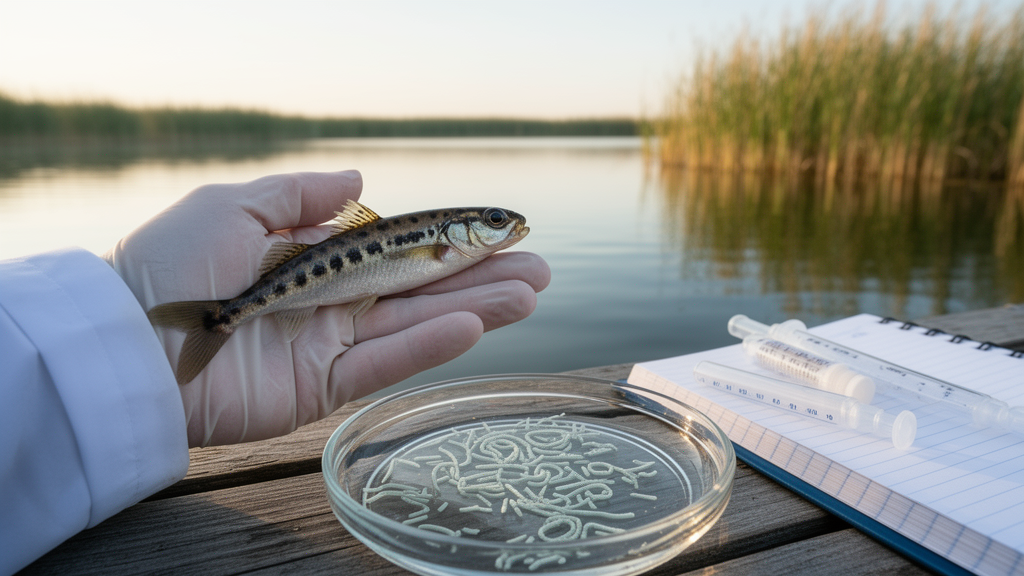
The size of an Alaskan lake appears to change how a fish’s own body relates to the bacteria living in its gut. In a study of 191 wild threespine stickleback (Gasterosteus aculeatus) from six lakes of varying surface area, researchers using 16S rRNA gene sequencing found that the association between fish mass and gut microbial alpha diversity shifted from strongly negative in the smallest lakes to strongly positive in the largest, with the relationship weakest at intermediate lake sizes. The work, published in Animal Microbiome, suggests that host-microbe interactions are not fixed within a species but depend on environmental conditions.
The team set out to test how gut microbiota varied across lakes that differ in surface area, since lake size is tied to ecological conditions such as diet and habitat characteristics that can shape a microbiome. Beyond lake size, they examined whether host ecotype and individual traits — sex, body mass, gravidity, and infection by the parasitic tapeworm Schistocephalus solidus — were associated with gut microbial composition across the gradient of lake sizes.
One of the clearest patterns emerged at the community level: fish from intermediate-sized lakes harbored significantly more diverse microbiota than fish from either small or large lakes, and this pattern held independently of stickleback ecotype. In other words, the mid-sized lakes in the study were not simply home to a particular ecotype with a distinctive microbiome; the diversity effect tracked lake size itself.
The mass-by-lake-size interaction was assessed through model-predicted marginal effects. These indicated that in the smallest lakes, heavier fish tended to have lower gut microbial alpha diversity, while in the largest lakes the association ran the other way, with heavier fish showing higher diversity. Intermediate lakes sat between these extremes, showing the weakest association. Because these are model-predicted associations from a cross-sectional survey of wild fish, they describe patterns rather than demonstrating causal mechanisms.
Differential abundance analysis extended the pattern to individual bacterial taxa, revealing lake size-dependent associations between body mass and specific gut microbes. This means the taxon-level consequences of being a larger or smaller fish were not uniform across the landscape but varied with the lake a fish inhabited.
Host traits mattered as well, though not equally. Sex and S. solidus infection were both significantly associated with gut microbial composition, whereas fibrosis and gravidity had minimal effects on the microbial communities. The inclusion of these traits allowed the authors to separate the influence of individual biology from the environmental gradient represented by lake size.
The authors conclude that linking environmental variation with individual traits highlights how gut microbiota diversity varies in natural ecosystems. Because lake size is associated with ecological conditions that affect hosts — including diet and habitat — the findings point to environment as a modifier of the relationship between host phenotype and its microbial community, rather than a backdrop that can be ignored.
The researchers frame the results as important for predicting how gut microbiota respond to environmental change and for disentangling the effects of habitat and host biology on gut microbial communities. They also suggest the insights improve understanding of how environmental differences shape animal health and ecosystem function across natural populations. As an observational study of wild fish at a single point in time, it documents associations across six Alaskan lakes; the mechanisms connecting lake size, body mass, and microbial diversity remain to be tested directly.
Subject of Research: How lake size modifies the relationship between body mass and gut microbiota diversity in wild threespine stickleback
Article Title: Lake size is associated with the relationship between body mass and gut microbiota alpha diversity in threespine stickleback (Gasterosteus aculeatus)
Article References: Bu, S., Chaudhary, S., Kramer-Earley, R., Ireland, K., Atwood, J., Bolnick, D. I., Hendry, A. P., Peichel, C. L., Steinel, N. C., Weber, J. N., Haines, G. E., Derry, A. M., & Milligan-McClellan, K. (2026). Lake size is associated with the relationship between body mass and gut microbiota alpha diversity in threespine stickleback (Gasterosteus aculeatus). Animal Microbiome. https://doi.org/10.1186/s42523-026-00640-y
Image Credits: AI Generated
DOI: 10.1186/s42523-026-00640-y
Keywords: threespine stickleback, gut microbiota, alpha diversity, lake size, 16S rRNA sequencing, Schistocephalus solidus, host-microbe interactions, Alaska, ecology, fish microbiome, Lake, size
Cite Scienmag News
Morgan Morrow. (October 29, 2026). Lake Size Flips the Link Between Body Mass and Gut Microbe Diversity in Stickleback. Scienmag. https://scienmag.com/lake-size-flips-the-link-between-body-mass-and-gut-microbe-diversity-in-stickleback/
Morgan Morrow. "Lake Size Flips the Link Between Body Mass and Gut Microbe Diversity in Stickleback." Scienmag, 29 October 2026, https://scienmag.com/lake-size-flips-the-link-between-body-mass-and-gut-microbe-diversity-in-stickleback/. Accessed 5 November 2026.
Morgan Morrow. "Lake Size Flips the Link Between Body Mass and Gut Microbe Diversity in Stickleback." Scienmag. October 29, 2026. https://scienmag.com/lake-size-flips-the-link-between-body-mass-and-gut-microbe-diversity-in-stickleback/




