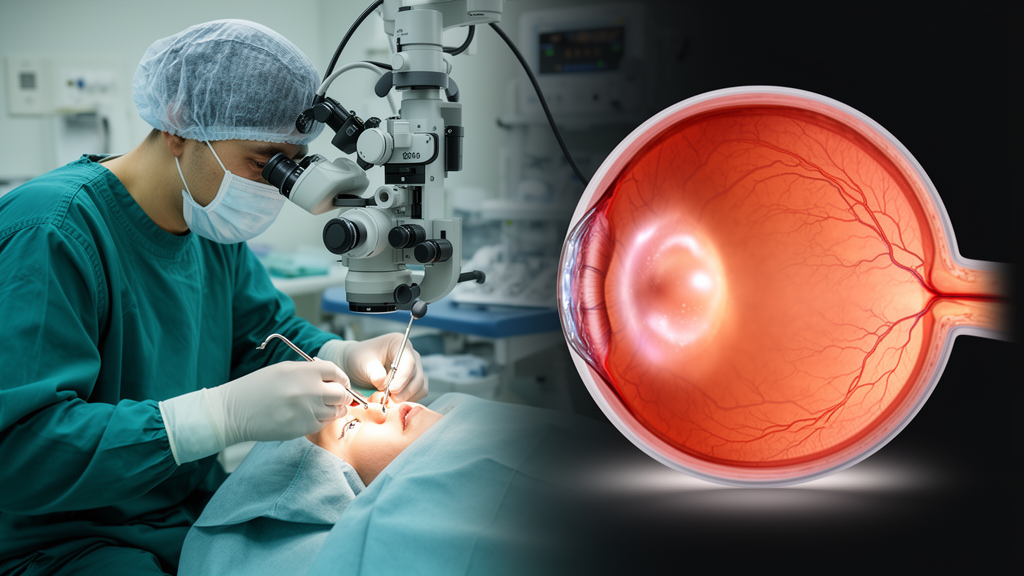
Researchers in China have developed and internally validated a compact five-variable model that estimates the one-year risk of new-onset macular oedema in patients with diabetic retinopathy undergoing vitrectomy, according to a single-centre retrospective cohort study conducted at Fuyang People’s Hospital.
The study included 650 recorded patients treated between January 2023 and April 2025. The primary analysis focused on 607 patients with ascertainable one-year outcomes, with one study eye per patient. The remaining 43 patients, who were lost to follow-up, were assessed separately.
New-onset macular oedema was defined strictly by optical coherence tomography criteria: the appearance of new intraretinal cystoid spaces and/or subretinal fluid during postoperative days 30 to 365, together with a central macular thickness of at least 300 micrometres or an increase of at least 30 micrometres from baseline. All predictors in the model were pre-incision measurements, meaning the risk estimate could in principle be calculated before surgery began.
The outcome was common in this cohort. New-onset postoperative macular oedema occurred in 207 of 607 patients, or 34.1 percent, underscoring why a reliable preoperative risk estimate could be clinically useful for this population.
The five-predictor logistic model was fitted in all 607 patients. Internal validation used 1,000 bootstrap resamples. The apparent area under the receiver operating characteristic curve was 0.823, and the optimism-corrected AUC was 0.818, indicating that the model’s discrimination held up well after accounting for the optimism introduced by fitting and evaluating on the same data.
Calibration was also assessed. The Brier scores were 0.159 apparent and 0.163 after correction, and the corrected calibration intercept and slope were −0.011 and 0.969 respectively, values close to the ideal of zero and one. The authors describe the corrected calibration as acceptable.
To illustrate how the model stratifies patients, the researchers applied an illustrative probability threshold of 0.30. Among patients placed in the lower-risk group, 40 of 323 (12.4 percent) developed the outcome, compared with 167 of 284 (58.8 percent) in the higher-risk group, a substantial separation in observed event rates between the two groups.
As a sensitivity analysis, the team also ran a separate least absolute shrinkage and selection operator (LASSO) procedure, using 32 candidate predictors and 10-fold cross-validation, with selection-inclusive bootstrap validation to assess the stability of that variable-selection approach. This sensitivity model yielded a corrected AUC of 0.805. Notably, systolic pressure was not statistically significant in the five-predictor model, with a P value of 0.329.
The authors caution that the model should be regarded as an internally validated risk-stratification tool that requires external and prospective validation before any clinical implementation. Because the cohort was drawn from a single centre, the findings may not generalise to other populations, and the retrospective design means the model’s performance in real-time clinical settings remains untested.
Within those limits, the study offers a quantified starting point for thinking about postoperative macular oedema risk in diabetic retinopathy patients scheduled for vitrectomy, with discrimination and calibration figures reported transparently and the need for further validation stated explicitly by the research team.
Subject of Research: A prediction model for new-onset macular oedema after vitrectomy in diabetic retinopathy
Article Title: Development and internal validation of a prediction model for new-onset macular oedema following vitrectomy for diabetic retinopathy: a single-centre retrospective analysis
Article References: Ma, J., Wang, J., Wang, Y., Yang, C., Li, J., & Li, Y. (2026). Development and internal validation of a prediction model for new-onset macular oedema following vitrectomy for diabetic retinopathy: a single-centre retrospective analysis. Frontiers in Ophthalmology, 6, Article 1932517. https://doi.org/10.3389/fopht.2026.1932517
Image Credits: AI Generated
DOI: 10.3389/fopht.2026.1932517
Keywords: diabetic retinopathy, macular oedema, vitrectomy, prediction model, nomogram, internal validation, bootstrap, LASSO, optical coherence tomography, retina, Development, internal
Cite Scienmag News
Ophelia Keating. (October 29, 2026). New Model Predicts One-Year Macular Oedema Risk After Vitrectomy in Diabetic Retinopathy. Scienmag. https://scienmag.com/new-model-predicts-one-year-macular-oedema-risk-after-vitrectomy-in-diabetic-retinopathy/
Ophelia Keating. "New Model Predicts One-Year Macular Oedema Risk After Vitrectomy in Diabetic Retinopathy." Scienmag, 29 October 2026, https://scienmag.com/new-model-predicts-one-year-macular-oedema-risk-after-vitrectomy-in-diabetic-retinopathy/. Accessed 29 October 2026.
Ophelia Keating. "New Model Predicts One-Year Macular Oedema Risk After Vitrectomy in Diabetic Retinopathy." Scienmag. October 29, 2026. https://scienmag.com/new-model-predicts-one-year-macular-oedema-risk-after-vitrectomy-in-diabetic-retinopathy/