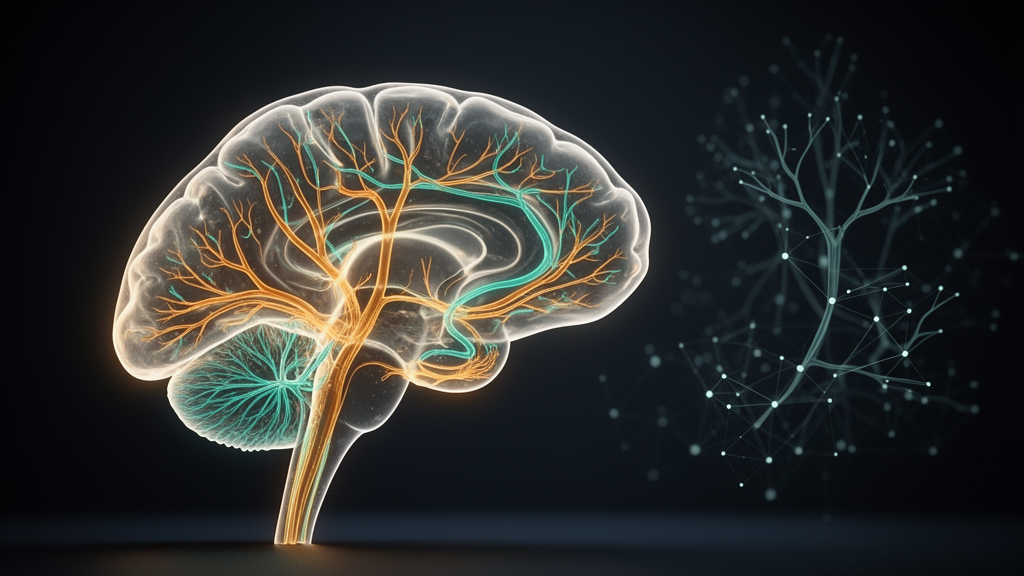
A detailed map of how individual neurons in the mouse cortex send their axons down into the brainstem has revealed a strikingly modular wiring scheme, and the researchers behind it have already borrowed that scheme to build an artificial neural network that trains better and recovers from errors more gracefully than conventional designs.
The cortex-to-brainstem connection is one of the major conduits for sensory and motor control in the mammalian brain, yet the authors of the new study, published in Brain Informatics, note that its connectional architecture and organizing principles remain incompletely characterized. To fill that gap, the team reconstructed the single-cell projectome of cortical neurons in the mouse brain and systematically mapped the axonal projection patterns of cortical pyramidal tract neurons into the brainstem.
What emerged from this cell-by-cell reconstruction was a parallel projection architecture. Distinct clusters of cortical neurons independently targeted specific brainstem nuclei, with limited overlap between their projection fields. In other words, rather than a single broadcast line carrying mixed commands, the cortex appears to run many dedicated channels in parallel, each aimed at its own downstream target.
One region stood out in the analysis. Neurons in the anterior cingulate area, a specialized cortical area, showed segment-specific projections to the reticular formation. According to the researchers, this arrangement supports a balance between specific and integrative motor control, allowing some pathways to carry precisely targeted commands while others contribute to broader, coordinated regulation.
The mapping also uncovered organization on the input side. In the midbrain, the team observed two segregated modules that separately receive somatosensory and exteroceptive sensory inputs from the mouse cortex. This separation suggests that different classes of sensory information remain partitioned as they descend through the brainstem circuitry, rather than being merged into a single stream.
The study is a descriptive connectomic effort in mice; it characterizes anatomical structure rather than testing behavior or clinical applications. Even so, the authors argue that the connectivity principles it reveals are useful beyond neuroscience, and they tested that claim directly by translating them into machine learning.
Using the parallel command architecture as a design blueprint, the researchers built a novel feedback architecture for artificial neural networks. In their reported benchmark, this brain-inspired design lowered the training loss by 21 percent compared with conventional feedforward models. It also improved robustness during error recovery, a property the authors link to the segregated, parallel channels observed in the biological data.
The comparison is a model-level result reported by the study’s authors, not an independent evaluation, and the abstract does not specify the tasks or datasets used in the benchmark. Still, the result illustrates the paper’s central argument: that mesoscale connectivity maps of the brain can serve as a practical reference for optimizing brain-inspired artificial intelligence through connectomic design principles.
For neuroscience, the work adds a mesoscale account of how the cortical pathway is organized at the level of individual neurons and their brainstem targets. For artificial intelligence, it offers an early example of wiring diagrams borrowed from biology being converted into network architectures with measurable performance differences. The full article is open access, and the published version is subject to further editorial updates, according to the journal’s notice accompanying the early-release text.
Subject of Research: Single-cell mapping of mouse cortical projections to the brainstem and its application to brain-inspired artificial neural network design
Article Title: Parallel command principle in sensorimotor control for brain-inspired AI design
Article References: Chen, X., Shi, X., Ren, B., Chen, Y., Chen, M., Zhao, Y., Wang, D., Chen, Z., Deng, L., Liu, D., Ding, X., Le, Z., Liu, Y., Du, Y., Wang, Q., Dou, Y., Huang, Y., Zhan, L., Lei, S., … Wang, X. (2026). Parallel command principle in sensorimotor control for brain-inspired AI design. Brain Informatics. https://doi.org/10.1186/s40708-026-00333-x
Image Credits: AI Generated
DOI: 10.1186/s40708-026-00333-x
Keywords: connectomics, brainstem, cortex, pyramidal tract neurons, projectome, mouse brain, neural networks, brain-inspired AI, sensorimotor control, reticular formation, anterior cingulate, error recovery
Cite Scienmag News
Cassandra Pierce. (October 29, 2026). Mouse Brainstem Wiring Map Inspires AI Networks With Better Error Recovery. Scienmag. https://scienmag.com/mouse-brainstem-wiring-map-inspires-ai-networks-with-better-error-recovery/
Cassandra Pierce. "Mouse Brainstem Wiring Map Inspires AI Networks With Better Error Recovery." Scienmag, 29 October 2026, https://scienmag.com/mouse-brainstem-wiring-map-inspires-ai-networks-with-better-error-recovery/. Accessed 30 October 2026.
Cassandra Pierce. "Mouse Brainstem Wiring Map Inspires AI Networks With Better Error Recovery." Scienmag. October 29, 2026. https://scienmag.com/mouse-brainstem-wiring-map-inspires-ai-networks-with-better-error-recovery/