Wednesday, November 4, 2026
Science
No Result
View All Result
  • Login
  • HOME
  • SCIENCE NEWS
  • CONTACT US
  • HOME
  • SCIENCE NEWS
  • CONTACT US
No Result
View All Result
Scienmag
No Result
View All Result
Home Science News Medicine

Lab-grown muscle bundles reveal weakness patterns in rare pediatric rheumatic diseases

October 28, 2026
in Medicine
Harold Sullivan
By Harold Sullivan Scienmag Editorial Profile - Maternal and Child Health
Reading Time: 2 mins read
0
Lab-grown muscle bundles reveal weakness patterns in rare pediatric rheumatic diseases

Lab-grown muscle bundles reveal weakness patterns in rare pediatric rheumatic diseases

65
SHARES
587
VIEWS
Share on FacebookShare on Twitter
ADVERTISEMENT

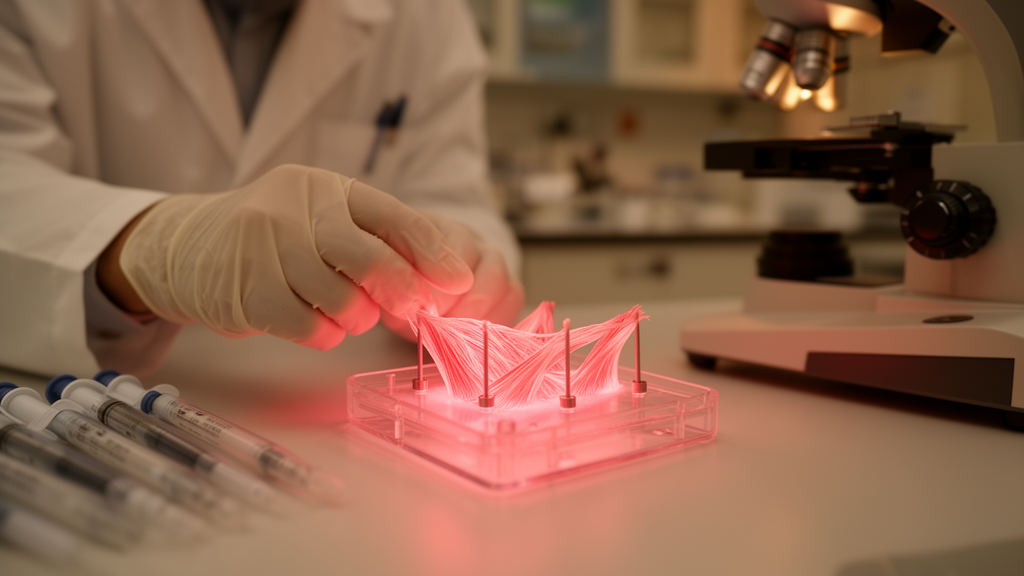
Researchers have grown functioning three-dimensional human muscle tissue from small muscle samples taken from children with rare rheumatic diseases, offering a new way to study muscle weakness in conditions that have been difficult to model in the laboratory. The proof-of-concept study, published in BMC Rheumatology, generated engineered muscle constructs known as myobundles from pediatric patients with juvenile dermatomyositis (JDM), immune-mediated necrotizing myopathy (IMNM), and inflammatory arthritis-related weakness.

Muscle weakness is a prominent feature of several rare pediatric rheumatic diseases, but the mechanisms behind the dysfunction remain poorly understood, partly because physiologically relevant laboratory models have been lacking. The new study set out to test whether meaningful muscle models could be built from the very limited tissue that clinicians can safely obtain from young patients with these conditions.

Myobundles were treated as technical replicates within each donor. Because the study included a single donor per condition, the results are presented descriptively, without inferential statistics.

Myoblast purity was high across all donors, ranging from 83 to 96 percent. The cells from the IMNM donor appeared elongated and spindle-shaped. The researchers assessed purity and morphology using desmin and vimentin co-staining, and evaluated the mature myobundles by measuring electrically evoked contractile force and twitch kinetics, alongside immunofluorescence for sarcomeric α-actinin and vimentin.

Compared with myobundles from the healthy pediatric donor, constructs from all three donors with weakness showed reduced contractility, altered striated myofiber organization, and decreased myofiber diameter.

Myobundles from the IMNM donor showed the most pronounced functional impairment, with markedly reduced force generation, slowed twitch kinetics, reduced sarcomeric α-actinin-positive area, and disrupted myofiber organization. In contrast, myobundles from the arthritis-related weakness donor exhibited faster twitch kinetics and greater fatigability than controls, even though this donor had the highest clinical strength scores of the three patients.

The findings demonstrate that functional myobundles can be generated from the limited muscle tissue available in rare pediatric rheumatic diseases, and that donor-specific functional and structural differences are measurable in vitro.

The authors caution that the study is a proof of concept with a single donor per condition. Confirmation that the observed differences represent reproducible disease-associated phenotypes will require additional donors within each condition. The article was published on 8 October 2026 as an open-access Research article in BMC Rheumatology.

Subject of Research: Patient-derived engineered muscle models for studying muscle weakness in rare pediatric rheumatic diseases

Article Title: Patient-derived myobundles as a platform for modeling muscle weakness in rare pediatric rheumatic diseases: a proof-of-concept study

Article References: Simon, A., Covert, L. T., Kandil, S., Chen, J., Dvergsten, J. A., Ardalan, K., Jones, K. A., & Truskey, G. A. (2026). Patient-derived myobundles as a platform for modeling muscle weakness in rare pediatric rheumatic diseases: a proof-of-concept study. BMC Rheumatology. https://doi.org/10.1186/s41927-026-00701-4

Image Credits: AI Generated

DOI: 10.1186/s41927-026-00701-4

Keywords: juvenile dermatomyositis, immune-mediated necrotizing myopathy, myobundles, muscle weakness, pediatric rheumatology, engineered muscle tissue, type I interferon, proof-of-concept study, myogenic progenitor cells, contractile force, BMC Rheumatology, Patient-derived

Cite Scienmag News

Harold Sullivan. (October 28, 2026). Lab-grown muscle bundles reveal weakness patterns in rare pediatric rheumatic diseases. Scienmag. https://scienmag.com/lab-grown-muscle-bundles-reveal-weakness-patterns-in-rare-pediatric-rheumatic-diseases/

Harold Sullivan. "Lab-grown muscle bundles reveal weakness patterns in rare pediatric rheumatic diseases." Scienmag, 28 October 2026, https://scienmag.com/lab-grown-muscle-bundles-reveal-weakness-patterns-in-rare-pediatric-rheumatic-diseases/. Accessed 4 November 2026.

Harold Sullivan. "Lab-grown muscle bundles reveal weakness patterns in rare pediatric rheumatic diseases." Scienmag. October 28, 2026. https://scienmag.com/lab-grown-muscle-bundles-reveal-weakness-patterns-in-rare-pediatric-rheumatic-diseases/

Tags: 3D human muscle tissue engineeringBMC Rheumatologycontractile forceelectrically stimulated muscle contractility testingengineered muscle tissueimmune-mediated necrotizing myopathyimmune-mediated necrotizing myopathy muscle studiesinflammatory arthritis-related muscle weaknessjuvenile dermatomyositisjuvenile dermatomyositis muscle researchlab-grown muscle bundles for disease modelinglaboratory models for pediatric muscle diseasesmuscle tissue regeneration from pediatric samplesmuscle weaknessmuscle weakness mechanisms in juvenile myopathiesmyobundlesmyogenic progenitor cellsPatient-derivedpediatric rheumatologyproof-of-concept studyrare pediatric rheumatic diseasestissue engineering in pediatric rheumatologyType I interferonunderstanding muscle dysfunction in rare diseases
Share26Tweet16
Previous Post

Five years of roundtable dialogue chart a responsible path for Urban AI

Next Post

Research report: Sickle cell disease in Germany – trends in epidemiology, healthcare utilization and disease burden from 2015 to 2024: a claims data analysis

Related Posts

Men and women fare similarly after catheter clot removal for lung embolism
Medicine

Men and women fare similarly after catheter clot removal for lung embolism

November 4, 2026
Tryptanthrin from Yinhuang Gargle Emerges as Anti-Inflammatory Candidate Against Periodontitis
Medicine

Tryptanthrin from Yinhuang Gargle Emerges as Anti-Inflammatory Candidate Against Periodontitis

November 4, 2026
Engineered Bacteria Pill Cuts Bloodstream Infections in Stem Cell Transplant Patients
Cancer

Engineered Bacteria Pill Cuts Bloodstream Infections in Stem Cell Transplant Patients

November 4, 2026
NIH-Funded $4 Million Study Will Test Whether Prefilled Online Grocery Carts Improve Family Diets
Medicine

NIH-Funded $4 Million Study Will Test Whether Prefilled Online Grocery Carts Improve Family Diets

November 4, 2026
Carbon-Ion Radiotherapy Before Surgery Yields Strong Tumor Response in Advanced Pancreatic Cancer
Medicine

Carbon-Ion Radiotherapy Before Surgery Yields Strong Tumor Response in Advanced Pancreatic Cancer

November 4, 2026
Simulation setting may not shape emergency team nontechnical skills
Science Education

Simulation setting may not shape emergency team nontechnical skills

November 4, 2026
Next Post
Research report: Sickle cell disease in Germany – trends in epidemiology, healthcare utilization and disease burden from 2015 to 2024: a claims data analysis

Research report: Sickle cell disease in Germany – trends in epidemiology, healthcare utilization and disease burden from 2015 to 2024: a claims data analysis

  • Mothers who receive childcare support from maternal grandparents show more optimized

    Mothers who receive childcare support from maternal grandparents show more parental warmth, finds NTU Singapore study

    27656 shares
    Share 11059 Tweet 6912
  • University of Seville Breaks 120-Year-Old Mystery, Revises a Key Einstein Concept

    1061 shares
    Share 424 Tweet 265
  • Bee body mass, pathogens and local climate influence heat tolerance

    682 shares
    Share 273 Tweet 171
  • Researchers record first-ever images and data of a shark experiencing a boat strike

    546 shares
    Share 218 Tweet 137
  • Groundbreaking Clinical Trial Reveals Lubiprostone Enhances Kidney Function

    531 shares
    Share 212 Tweet 133
Science

Embark on a thrilling journey of discovery with Scienmag.com—your ultimate source for cutting-edge breakthroughs. Immerse yourself in a world where curiosity knows no limits and tomorrow’s possibilities become today’s reality!

RECENT NEWS

  • Historic redlining tied to 86% higher opioid overdose death rates in Massachusetts neighborhoods
  • Hydrogel-and-membrane patch eases ureteral scarring in rabbits after thermal injury
  • Men and women fare similarly after catheter clot removal for lung embolism
  • Microbiomes must sit at the heart of EU rules for modified microbes, scientists tell Brussels

Categories

  • Agriculture
  • Anthropology
  • Archaeology
  • Athmospheric
  • Biology
  • Biotechnology
  • Blog
  • Bussines
  • Cancer
  • Chemistry
  • Climate
  • Earth Science
  • Editorial Policy
  • Marine
  • Mathematics
  • Medicine
  • Pediatry
  • Policy
  • Psychology & Psychiatry
  • Science Education
  • Science News
  • Social Science
  • Space
  • Technology and Engineering

Subscribe to Blog via Email

Enter your email address to subscribe to this blog and receive notifications of new posts by email.

Join 5,149 other subscribers

© 2025 Scienmag - Science Magazine

Welcome Back!

Login to your account below

Forgotten Password?

Retrieve your password

Please enter your username or email address to reset your password.

Log In
No Result
View All Result
  • HOME
  • SCIENCE NEWS
  • CONTACT US

© 2025 Scienmag - Science Magazine

Discover more from Science

Subscribe now to keep reading and get access to the full archive.

Continue reading