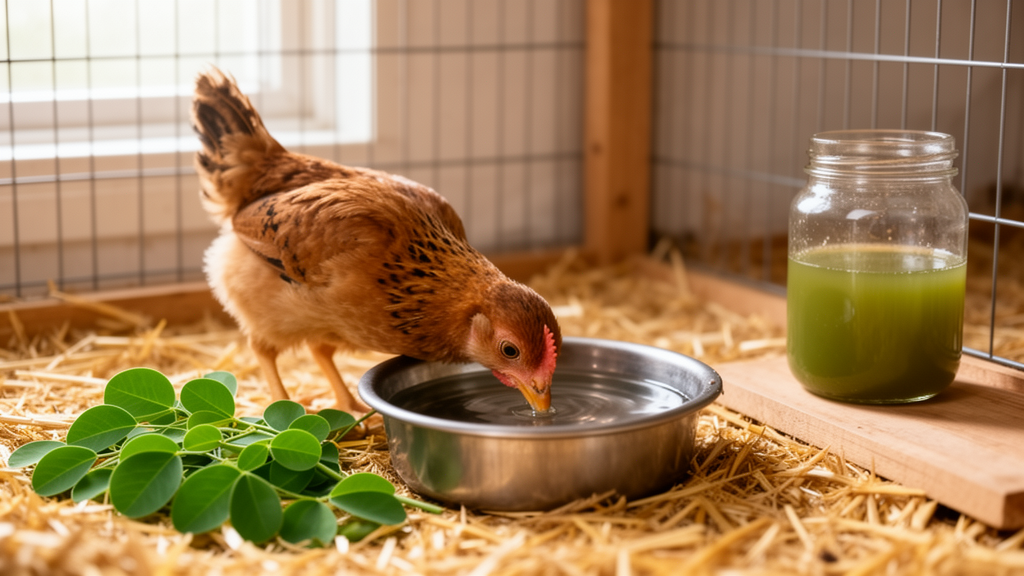
A drinking-water supplement made from the leaves of Moringa oleifera, the so-called miracle tree, improved feed conversion, intestinal structure, antioxidant status, and cecal fermentation in an indigenous Chinese chicken breed, according to a new randomized feeding trial published in Frontiers in Animal Science. In 192 female Chahua chickens, the intermediate dose of the ethanolic leaf extract, 30.0 milliliters per liter of drinking water, produced the most favorable overall balance across the measured outcomes, lowering the feed conversion ratio from 3.56 in controls to 3.37 and shifting cecal fermentation away from protein breakdown products toward beneficial short-chain fatty acids.
The trial, conducted by researchers at the Yunnan Institute of Tropical Crops, targeted the Chahua chicken, a locally valued breed in southwestern China prized for its distinctive meat flavor and environmental adaptability but hampered by slow growth and poor feed efficiency. Fourteen-day-old birds were randomly assigned to four groups of six replicate pens with eight chickens each. The control group received purified water alongside a corn- and soybean-meal-based basal diet, while the three treatment groups received the Moringa oleifera ethanolic extract, abbreviated MOE, at 20.0, 30.0, or 40.0 milliliters per liter of drinking water. All birds were reared to 56 days of age, or eight weeks, on the same basal diet formulated to National Research Council requirements.
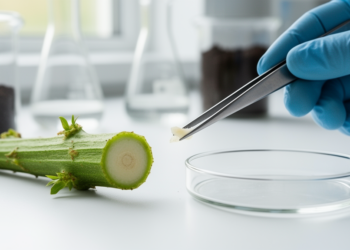
The extract itself was prepared from shade-dried leaves collected at the institute’s Moringa demonstration base, ground, sieved, and extracted with 70 percent ethanol under ultrasonication at 50 degrees Celsius. Targeted metabolomic profiling of the preparation identified 2,233 metabolites, including 348 phenolic acids, 337 flavonoids, 276 amino acids and derivatives, and 238 alkaloids, a chemical repertoire consistent with the antioxidant and antimicrobial properties often attributed to moringa leaves.
Growth performance told a nuanced story. Initial body weights did not differ among groups, and while the 30.0 milliliter-per-liter group achieved the numerically highest final body weight at 1,082.5 grams versus 1,034.2 grams in controls, that difference fell just short of statistical significance with a P value of 0.060. Average daily gain likewise did not differ significantly. What did change decisively was efficiency: feed conversion ratio dropped significantly in all treated groups, falling progressively with dose to its lowest value of 3.37 in the 30.0 milliliter-per-liter group, compared with 3.56 in controls. Average daily feed intake showed only a marginal group effect.
Carcass measurements at slaughter revealed a similar pattern of selective improvement. Live weight, slaughter weight, and slaughter rate were unaffected by supplementation. However, semi-eviscerated and eviscerated weights, along with the corresponding yield rates, rose significantly in all treatment groups, with evisceration rate climbing from 62.83 percent in controls to roughly 68 to 69 percent in the treated groups. The authors interpret this as preferential deposition of edible carcass tissue rather than visceral mass, though the mechanism remains to be established.
The gut showed marked structural and functional responses. In the duodenum, jejunum, and ileum, treated birds displayed significantly taller villi, shallower crypts, and elevated villus-height-to-crypt-depth ratios, a morphology generally associated with greater absorptive surface area. Digestive enzyme activity shifted in parallel: trypsin activity rose significantly in every treated group, peaking in the 30.0 milliliter-per-liter group, while duodenal lipase activity increased with dose and reached significance only at the highest concentration. Duodenal and cecal weights also increased in supplemented birds. The authors suggest these digestive changes may partly underlie the improved feed conversion, though the study design cannot prove causation.
Serum biochemistry and antioxidant markers added further support. Aspartate aminotransferase, triglycerides, and lactate dehydrogenase all fell significantly in treated groups, while alkaline phosphatase rose. In the 20.0 and 30.0 milliliter-per-liter groups, superoxide dismutase and glutathione peroxidase activities increased significantly and malondialdehyde, a marker of lipid peroxidation, declined, although total antioxidant capacity did not differ among groups. Notably, the antioxidant benefit did not extend to the highest dose, and the authors caution that individual bioactive compounds were not measured, so the link between specific moringa constituents and the observed antioxidant shifts remains correlational.
Cecal microbiota analysis by 16S rRNA gene sequencing showed that community structure differed significantly among the four groups, with a PERMANOVA R-squared of 0.4061 and a P value of 0.001. Microbial richness, measured by observed OTUs and the Chao1 index, peaked in the 20.0 milliliter-per-liter group. The 30.0 milliliter-per-liter group was instead enriched for taxa flagged as potentially beneficial short-chain-fatty-acid producers, including the family Lachnospiraceae, the genus Methanobrevibacter, and the Ruminococcus torques group, and showed the broadest set of differential biomarkers in LEfSe analysis. The control group, by contrast, carried higher relative abundances of Desulfovibrio and Helicobacter, taxa the authors associate with inflammatory activity.
The fermentation chemistry reinforced the microbial picture. In the 30.0 milliliter-per-liter group, cecal butyric, propionic, and valeric acid concentrations rose significantly, while the branched-chain fatty acids isobutyric and isovaleric acid, products of protein fermentation, fell significantly, by 48.9 percent for isobutyric acid relative to controls. Because branched-chain fatty acids can accumulate when protein ferments excessively and may promote mucosal inflammation, the authors read this shift as a move from protein putrefaction toward carbohydrate and fiber fermentation. But because 16S sequencing yields only relative abundances and no absolute bacterial quantification was performed, these associations await confirmation.
The authors are careful to frame their conclusion narrowly. Only three concentrations were tested, daily water intake was not monitored, and no histopathological or toxicological evaluations were carried out, so the 30.0 milliliter-per-liter level should be considered optimal within this study rather than a universally applicable dose. Under the present experimental conditions, however, the intermediate dose of moringa leaf extract delivered the most consistent improvements in feed efficiency, carcass yield, gut morphology, digestive enzyme activity, antioxidant markers, and cecal fermentation in Chahua chickens, with no significant adverse effects observed on organ weights or serum indices.
Subject of Research: Effects of Moringa oleifera ethanolic extract in drinking water on growth, gut health, and cecal fermentation in Chahua chickens
Article Title: Effects of Moringa oleifera ethanolic extract administered through drinking water on growth performance, carcass traits, intestinal morphology, digestive enzyme activity, serum biochemical and antioxidant indices, cecal microbiota, and short-chain fatty acid profiles in Chahua chickens
Article References: Lei, F., Wang, F., Long, J., Zhao, C., Ma, Z., Li, H., Wang, L., Ren, B., Liu, Y., Xiao, M., & Zhang, Z. (2026). Effects of Moringa oleifera ethanolic extract administered through drinking water on growth performance, carcass traits, intestinal morphology, digestive enzyme activity, serum biochemical and antioxidant indices, cecal microbiota, and short-chain fatty acid profiles in Chahua chickens. Frontiers in Animal Science, 7, Article 1977918. https://doi.org/10.3389/fanim.2026.1977918
Image Credits: AI Generated
DOI: 10.3389/fanim.2026.1977918
Keywords: Moringa oleifera, Chahua chickens, feed conversion ratio, cecal microbiota, short-chain fatty acids, intestinal morphology, antioxidant status, poultry nutrition, drinking water supplement, randomized feeding trial, digestive enzymes, carcass traits
Cite Scienmag News
Daisy Hatcher. (October 28, 2026). Moringa Leaf Extract in Drinking Water Boosts Feed Efficiency in Chahua Chickens. Scienmag. https://scienmag.com/moringa-leaf-extract-in-drinking-water-boosts-feed-efficiency-in-chahua-chickens/
Daisy Hatcher. "Moringa Leaf Extract in Drinking Water Boosts Feed Efficiency in Chahua Chickens." Scienmag, 28 October 2026, https://scienmag.com/moringa-leaf-extract-in-drinking-water-boosts-feed-efficiency-in-chahua-chickens/. Accessed 30 October 2026.
Daisy Hatcher. "Moringa Leaf Extract in Drinking Water Boosts Feed Efficiency in Chahua Chickens." Scienmag. October 28, 2026. https://scienmag.com/moringa-leaf-extract-in-drinking-water-boosts-feed-efficiency-in-chahua-chickens/