


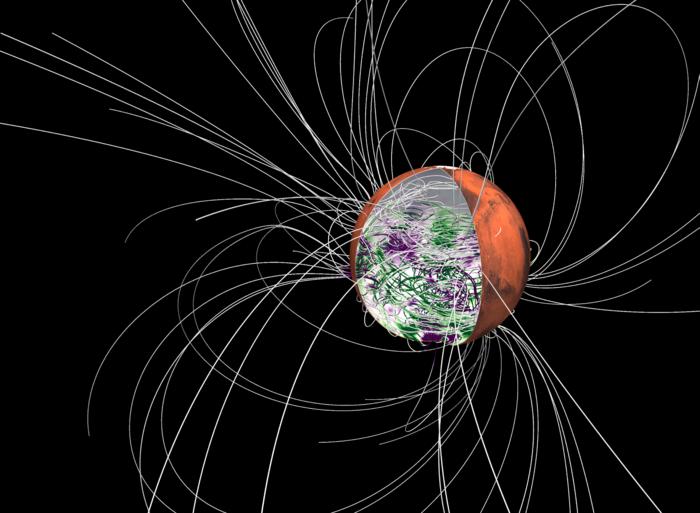
Mars, the fourth planet from the Sun, has captivated our imagination for centuries. Its enigmatic surface, with features similar yet bizarrely different from Earth, has long instigated a flurry of scientific inquiries. A groundbreaking study conducted by researchers at the University of Texas Institute for Geophysics (UTIG) has unveiled new insights into the ancient magnetic field of Mars, providing a clearer understanding of why this red planet exhibits such a peculiar hemispheric magnetic imprint. Much like Earth’s magnetic field, which acts as a protective shield against solar wind, Mars once boasted a robust magnetic field. However, unlike Earth’s magnetic field, which extends uniformly across the entire globe, recent findings suggest that Mars’ magnetic field has a distinct lopsidedness, predominantly manifesting in the southern hemisphere.
This disparity raises a pivotal question: what led to the formation of a hemispheric magnetic field on Mars? The study published in the prestigious journal Geophysical Research Letters presents compelling evidence that the ancient magnetic field of Mars was concentrated only in its southern hemisphere. This peculiar one-sided magnetic field model significantly diverges from previous theories, which often assumed a solid inner core akin to that of Earth. The lead author of the study, Chi Yan, a UTIG research associate, posits that this configuration hints at a different geophysical process at work on Mars. Essentially, if the Martian inner core remains in a liquid state, it could potentially explain the mechanisms that generated this offset magnetic field.
The implications of a hemispherically located magnetic field on Mars are profound. The existence of a liquid inner core, as proposed by this study, could reveal not only the planet’s magnetic history but also its capacity to sustain an atmosphere. It suggests that without a solid inner core, Mars could better exhibit lopsided magnetic fields—a phenomenon not readily present on Earth. The research team utilized advanced computer simulations to explore this issue, running numerous trials on some of the most powerful supercomputers available. In these simulations, they varied the temperatures of the Martian mantle. This adjustment created a significant temperature gradient between the northern and southern hemispheres, causing heat to escape primarily from the southern end. This vigorous heat flow led to the generation of a dynamo effect, producing a strong magnetic field concentrated in the southern hemisphere.
The study’s conclusions further suggest that earlier approaches to Mars’ magnetic field modeling may have been overly simplistic. Previous hypotheses orbited around the idea of a solid inner core encircled by molten iron. However, NASA’s InSight lander provided groundbreaking evidence indicating that Mars’ core comprises lighter elements than initially anticipated, suggesting a melting temperature that differs significantly from that of Earth. This revelation inspired the research team to explore the possibility of a fully liquid core, a premise that they perceived could yield more accurate insights into Mars’ magnetic history.
Chi Yan articulated the excitement of the research findings, underscoring the revelation that a planetary dynamo can, indeed, exist under conditions that align with Mars’ present-day interior structure. The research echoes a broader implication regarding the planet’s ability to generate magnetic fields, signaling a departure from the common narrative that asteroid impacts led to the obliteration of evidence for a planet-wide magnetic field in the northern realm. Instead, the simulation outcomes provide an alternative perspective, fostering a more nuanced understanding of how the differing terrains and magnetic signatures of Mars’ hemispheres have developed over eons.
Doug Hemingway, a planetary researcher at UTIG, also weighed in on this groundbreaking study. While emphasizing Mars’ unique geological and magnetic dichotomy, he acknowledged the significance of unraveling the enigmas presented by the northern and southern hemispherical contrasts. Hemingway noted the intriguing possibility that understanding the asymmetric features of Mars could uncover insights into our neighboring planet, which bears many similarities to Earth yet remains shrouded in mystery.
The discoveries stemming from this study not only refine our comprehension of Mars’ geophysical history but also deepen the allure of further exploration. They reignite the conversation surrounding humanity’s potential future settlement on Mars, offering clues that might enlighten our efforts in understanding how life could one day thrive on this Martian landscape. Moreover, as we venture into an unprecedented era of interplanetary exploration, the relationship between a planet’s magnetic field and its capacity to support life remains of utmost significance.
Ultimately, this study represents a compelling chapter in the saga of Martian research, epitomizing the innovative spirit that drives scientific inquiry. As researchers uncover more about Mars’ tumultuous geophysical history, the prospect of reigniting interest in the celestial neighbor is likely to grow, lending insight into our own planet’s evolution and the broader cosmic tapestry of planetary formation. With NASA’s increasing investment in Mars exploration, and as technology advances, future research may offer even more revelations about the fourth rock from the Sun, propelling us closer to unraveling the ultimate mysteries of our universe.
Keywords
Mars, magnetic field, planetary dynamo, University of Texas Institute for Geophysics, Geophysical Research Letters, NASA InSight, liquid core, hemispheric magnetic field.
Cite Scienmag News
Grant Pearson. (April 15, 2025). New Insights into Mars’ Magnetic Mysteries: A Molten Core May Hold the Key. Scienmag. https://scienmag.com/new-insights-into-mars-magnetic-mysteries-a-molten-core-may-hold-the-key/
Grant Pearson. "New Insights into Mars’ Magnetic Mysteries: A Molten Core May Hold the Key." Scienmag, 15 April 2025, https://scienmag.com/new-insights-into-mars-magnetic-mysteries-a-molten-core-may-hold-the-key/. Accessed 1 September 2026.
Grant Pearson. "New Insights into Mars’ Magnetic Mysteries: A Molten Core May Hold the Key." Scienmag. April 15, 2025. https://scienmag.com/new-insights-into-mars-magnetic-mysteries-a-molten-core-may-hold-the-key/


