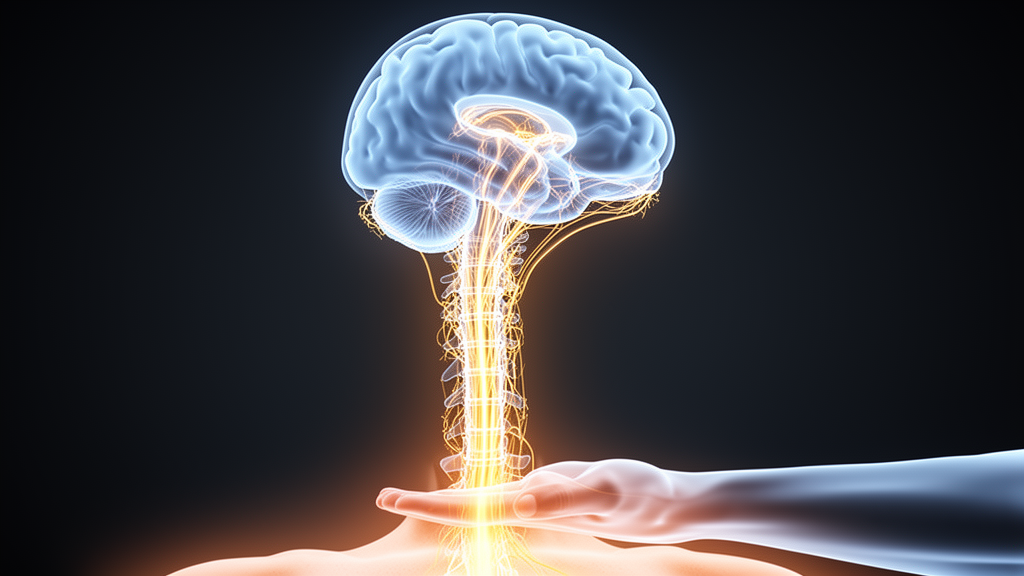
For more than half a century, the dominant explanation for why touch eases pain has been a spinal one. The gate control theory, proposed by Melzack and Wall in 1965, holds that tactile stimuli activate large-diameter A-beta afferents, which synapse onto inhibitory interneurons in the substantia gelatinosa of the spinal dorsal horn. These interneurons were proposed to modulate transmission cells that carry nociceptive information upward, so that touch effectively closes the gate on pain signals at the spinal level. A new Commentary in Anesthesiology and Perioperative Science by Hao-Di Tang, Hong-Bin Wang and Ruotian Jiang argues that this spinal picture, however influential, has overshadowed another possibility: that the brain itself actively participates in touch-induced analgesia through supraspinal and descending pathways that complement, rather than replace, classical spinal gating.
The authors point to evidence that pain signals can be modulated even after they have reached the cortex. They cite work by Inui and colleagues showing that tactile stimuli delivered as late as 60 milliseconds after a noxious volley, a time point at which the pain signal has demonstrably reached the cortex, could still powerfully suppress cortical pain responses. Converging evidence from human neuroimaging studies, they note, shows that transcutaneous electrical nerve stimulation reduces pain-evoked responses in supraspinal regions. Together, these findings suggest that touch-induced analgesia cannot be fully explained by events confined to the spinal cord, and that higher-order brain networks may contribute to how tactile input dampens pain.
The Commentary proposes that touch-induced analgesia emerges from a dynamic brain-spinal cord network in which supraspinal and descending pathways interact with spinal gating mechanisms. Rather than functioning as an isolated mechanism, the authors hypothesize, spinal gating operates within a network where descending influences from supraspinal structures continuously shape spinal processing, while tactile inputs simultaneously engage spinal pathways that regulate ascending nociceptive transmission and influence supraspinal networks involved in both sensory and affective pain processing. The authors are explicit that this is a hypothesis-generating framework intended to extend the traditional gate control theory, not a settled mechanism.
Much of the supporting evidence comes from rodent studies. The gracile nucleus, a brainstem relay for hindlimb tactile signals, emerges as a key node. Liu and colleagues showed that repeated transcutaneous electrical nerve stimulation activates a pathway from the gracile nucleus to the ventral posterolateral thalamus and then to the hindlimb region of primary somatosensory cortex, and that this pathway contributes to the analgesia produced by the stimulation. The Commentary is careful to note a limitation: repeated transcutaneous electrical nerve stimulation is a useful experimental model, but it is not a direct surrogate for natural touch, because it synchronously and nonphysiologically recruits A-beta afferents. Nevertheless, the authors write, evidence from other tactile paradigms supports a similar role for gracile nucleus-dependent supraspinal processing.
Two further rodent studies extend the picture to natural behaviors and to different body regions. Tang and colleagues found that licking behavior alleviates both the sensory and aversive components of pain through gracile nucleus projections to the zona incerta, which can influence pain processing through projections toward the hindlimb somatosensory cortex and the ventral tegmental area. Lu and colleagues demonstrated that self-generated whisking in mice suppresses facial nociception by transmitting vibrotactile signals through a trigeminal pathway to the ventral posteromedial thalamus and the barrel field of primary somatosensory cortex. A common theme, the authors argue, is that somatosensory relay nuclei and their thalamocortical pathways, traditionally viewed as simple conduits for touch and proprioception, actively integrate tactile signals to modulate pain through distinct ascending routes. The result is a set of parallel and partly overlapping supraspinal pathways, body-region-specific in their organization, that contribute to tactile modulation of pain.
The Commentary also highlights pharmacological evidence implicating the endogenous opioid system. In two independent studies, naloxone, an opioid receptor antagonist, interfered with touch-related analgesia: Liu and colleagues found that systemic naloxone almost completely abolished the analgesic effect elicited by optogenetic activation of the gracile nucleus-thalamus-cortex pathway, and Tang and colleagues reported that naloxone treatment significantly attenuated licking-induced pain relief. Anatomically, the hindlimb somatosensory cortex has been reported to send descending projections to the periaqueductal gray and the rostral ventromedial medulla, components of the descending pain modulatory system. The authors stress, however, that direct evidence linking cortex neurons activated by the gracile-thalamocortical pathway to descending inhibition mediated by these brainstem structures remains lacking, and that the framework is a hypothesis to be tested rather than a demonstrated circuit.
To move the hypothesis toward a mechanistically informed framework, the authors lay out a research program. Anatomical tracing of candidate connections linking the gracile-thalamocortical pathway to the periaqueductal gray, the rostral ventromedial medulla and the spinal cord could first clarify the precise subregions and neuronal populations involved. In vivo recordings during touch-induced analgesia could then determine whether tactile signals engage specific periaqueductal gray subregions and modulate the activity of ON and OFF cells in the rostral ventromedial medulla. Pharmacological or genetic blockade of individual opioid receptor subtypes could identify which endogenous opioid systems contribute to the effect. Ultimately, the authors write, direct validation would require simultaneous manipulation of the pathway and recordings from spinal dorsal horn nociceptive transmission neurons, to determine whether pathway activation produces inhibitory or facilitatory effects on spinal nociceptive processing.
The framework also reaches beyond circuit anatomy to the circumstances that shape touch analgesia. The Commentary emphasizes that the effect of touch is not determined solely by its physical parameters but also by contextual, social and biological factors. In humans, handholding with a romantic partner produces greater analgesia than holding an inert device, and the degree of pain relief correlates with perceived relationship quality and emotional comfort. In rodents, social licking toward the injured site of a conspecific in pain may also alleviate pain, suggesting that social touch can exert analgesic effects in non-human species. The authors note that these forms of gentle, affective and social touch recruit C-tactile afferents and C-low-threshold mechanoreceptors, a parallel system that may modulate affective-motivational aspects of pain processing and complement A-beta-mediated tactile analgesic mechanisms. They add that the efficacy of touch-induced analgesia may vary substantially across populations and pain conditions, and that sex differences, species differences and maladaptive plasticity associated with chronic pain could all alter supraspinal responses to tactile input.
Several testable predictions follow from the framework. The authors suggest that the gracile-thalamocortical pathway may represent a potential therapeutic target, and that developing noninvasive approaches capable of engaging analogous tactile modulatory systems may offer new avenues for pain relief in humans, although they caution that whether rodent-defined pathways can be directly translated to clinical pain remains an important challenge. They also flag a cautionary note: although gracile-mediated pathways contribute to touch-induced analgesia in early-stage pain conditions, maladaptive changes in these pathways may contribute to tactile hypersensitivity and mechanical allodynia during chronic neuropathic pain states, and the balance between excitation and inhibition within the gracile nucleus may influence the behavioral consequences of tactile stimulation under neuropathic conditions. The efficacy of touch analgesia, they write, is likely shaped by biological and contextual factors including timing, anatomical location, social context and sex, and systematic investigation of these moderators will be essential for optimizing touch-based interventions.
The Commentary closes with a translational outlook. Supraspinal touch-induced analgesia, the authors suggest, may provide new perspectives for perioperative pain management: non-pharmacological tactile interventions including massage, therapeutic touch, social touch and repeated transcutaneous electrical nerve stimulation have been associated with pain modulation, and in the perioperative setting such approaches may have potential as adjunctive strategies to contribute to opioid-sparing approaches, alleviate postoperative anxiety, mitigate pain-related distress and improve clinical recovery. The authors are careful to state that it remains unclear whether these interventions engage descending pain modulatory systems and influence supraspinal networks involved in affective pain processing, and that future clinical studies and controlled trials should clarify the neurobiological mechanisms, optimal delivery protocols and patient characteristics associated with the greatest therapeutic benefit. More than half a century after the gate control theory, they conclude, understanding how the brain transforms tactile input into pain relief may illuminate fundamental principles of sensory integration and help open new avenues for safe, accessible non-pharmacological pain therapies that harness the body’s own resources.
Subject of Research: Supraspinal brain pathways that may contribute to touch-induced analgesia
Article Title: Beyond the gate: supraspinal pathways for touch-induced analgesia
Article References: Tang, H.-D., Wang, H.-B., & Jiang, R. (2026). Beyond the gate: supraspinal pathways for touch-induced analgesia. Anesthesiology and Perioperative Science, 4(1), Article 47. https://doi.org/10.1007/s44254-026-00195-w
Image Credits: AI Generated
DOI: 10.1007/s44254-026-00195-w
Keywords: touch-induced analgesia, gate control theory, gracile nucleus, somatosensory cortex, descending pain modulation, endogenous opioids, naloxone, periaqueductal gray, rostral ventromedial medulla, social touch, C-tactile afferents, perioperative pain management
Cite Scienmag News
Cassandra Pierce. (October 28, 2026). Touch May Ease Pain Through Brain Pathways Beyond the Spinal Gate. Scienmag. https://scienmag.com/touch-may-ease-pain-through-brain-pathways-beyond-the-spinal-gate/
Cassandra Pierce. "Touch May Ease Pain Through Brain Pathways Beyond the Spinal Gate." Scienmag, 28 October 2026, https://scienmag.com/touch-may-ease-pain-through-brain-pathways-beyond-the-spinal-gate/. Accessed 28 October 2026.
Cassandra Pierce. "Touch May Ease Pain Through Brain Pathways Beyond the Spinal Gate." Scienmag. October 28, 2026. https://scienmag.com/touch-may-ease-pain-through-brain-pathways-beyond-the-spinal-gate/