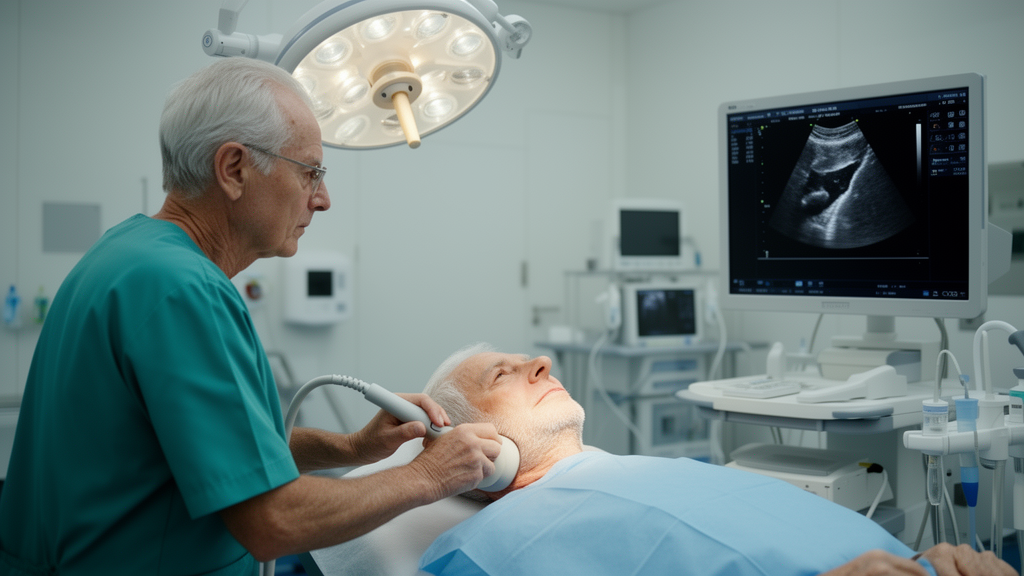
A simple ultrasound measurement of a large neck vein taken before spinal anesthesia may help anesthesiologists identify which patients are most likely to experience a dangerous drop in blood pressure during surgery, according to a prospective observational study published in BMC Anesthesiology. The research focused on patients undergoing transurethral resection procedures, a family of operations performed through the urethra that includes transurethral resection of the prostate and transurethral resection of bladder tumors.
Hypotension is one of the most common consequences of spinal anesthesia. The technique, which injects local anesthetic around the spinal nerves in the lower back, blocks the sympathetic nervous system in the lower half of the body. That blockade causes blood vessels to dilate and blood to pool in the venous system, reducing the amount of blood returning to the heart. The result can be a significant fall in systolic blood pressure, sometimes severe enough to require urgent treatment with fluids or vasopressor drugs. Predicting which patients will develop this complication before it happens has long been a goal of perioperative research, because anticipatory measures such as fluid loading or preventive vasopressors could be targeted at those who need them most.
The study team, led by Cansu Atlas Çalışkan with colleagues Bülent Atik and Özlem Sağır, enrolled 60 patients aged 18 to 65 years with American Society of Anesthesiologists physical status I or II who were scheduled for elective transurethral resection surgery under spinal anesthesia. Before any intravenous fluid was given and before the spinal anesthetic was administered, the researchers used M-mode ultrasonography to measure the diameter of the right internal jugular vein, a large vessel in the neck that carries blood from the head back to the heart. They recorded the vein’s diameter during inspiration and during expiration while the patients breathed spontaneously.
From those two measurements, the team calculated the right internal jugular vein collapsibility index, or RIJV-CI, using the formula [(dE − dI) / dE] × 100, where dE is the expiratory diameter and dI is the inspiratory diameter. The logic behind the measurement is straightforward: a vein that collapses substantially with each breath is relatively underfilled, reflecting lower venous filling and less reserve volume. When sympathetic blockade from spinal anesthesia causes further venous pooling, a patient whose neck vein was already highly collapsible may be less able to compensate, making a blood pressure drop more likely.
Hypotension in the study was defined as a decrease in systolic blood pressure of at least 20 percent from the patient’s baseline value. Using that threshold, the researchers found that hypotension occurred in 30 of the 60 patients, exactly half of the cohort. This high incidence underscores why the complication matters in this surgical population and why a reliable preoperative predictor would be clinically valuable.
The key finding was that patients who developed hypotension had a significantly higher preoperative RIJV-CI than those who did not. The mean collapsibility index was 37.7 percent with a standard deviation of 9.5 in the hypotension group, compared with 27.5 percent with a standard deviation of 6.7 in patients whose blood pressure remained stable. The difference was statistically significant, with a p value below 0.001, indicating it is very unlikely to be due to chance alone.
To quantify how well the measurement distinguished between the two groups, the researchers performed receiver operating characteristic curve analysis, a standard statistical technique for evaluating diagnostic tests. The area under the curve, or AUC, was 0.826 with a 95 percent confidence interval of 0.724 to 0.929 and a p value below 0.001. An AUC of 0.826 is generally interpreted as good discrimination, meaning the measurement separated patients who developed hypotension from those who did not considerably better than random chance, which would yield an AUC of 0.5.
From the same cohort data, the researchers derived a cutoff value of 32.5 percent for the collapsibility index. Using this threshold, the measurement showed 80 percent sensitivity, meaning it correctly identified four out of five patients who went on to develop hypotension, and 70 percent specificity, meaning it correctly cleared seven out of ten patients who did not. In an exploratory multivariable model that accounted for other factors, a higher RIJV-CI remained significantly associated with hypotension, with an odds ratio of 1.239 for each one-percentage-point increase in the index and a 95 percent confidence interval of 1.075 to 1.428, with a p value of 0.003.
The authors concluded that higher preoperative RIJV-CI was associated with hypotension after spinal anesthesia in patients undergoing transurethral resection surgery and that the measurement demonstrated good discriminative performance in this cohort. They suggested that RIJV-CI may have potential as a simple, non-invasive bedside marker for identifying patients at increased risk, since the ultrasound assessment requires only standard equipment and can be performed quickly before anesthesia begins.
However, the researchers were explicit about the limits of their findings. The cutoff value of 32.5 percent was derived from this same cohort of 60 patients and is preliminary; it requires validation in larger, independent cohorts before it can be applied clinically. Because the study was observational and single-cohort in design, it demonstrates an association rather than proving that the measurement will perform identically in other hospitals, other patient populations, or other types of surgery. The published version is also an early-release, peer-reviewed accepted article that is citable and carries a permanent DOI but remains subject to further edits before the final version of record replaces it. Until larger validation studies are completed, the collapsibility index should be viewed as a promising research signal rather than a ready-made clinical decision tool.
Subject of Research: Prediction of spinal anesthesia–induced hypotension using preoperative right internal jugular vein collapsibility measured by ultrasound in transurethral resection surgery
Article Title: Prediction of spinal anesthesia–induced hypotension using the internal jugular vein collapsibility index in transurethral resection surgery
Article References: Atlas Çalışkan, C., Atik, B., & Sağır, Ö. (2026). Prediction of spinal anesthesia–induced hypotension using the internal jugular vein collapsibility index in transurethral resection surgery. BMC Anesthesiology. https://doi.org/10.1186/s12871-026-04381-y
Image Credits: AI Generated
DOI: 10.1186/s12871-026-04381-y
Keywords: spinal anesthesia, hypotension, internal jugular vein, collapsibility index, ultrasound, transurethral resection, TUR-P, anesthesiology, ROC analysis, venous return, perioperative risk, BMC Anesthesiology
Cite Scienmag News
Ophelia Keating. (October 28, 2026). Neck vein ultrasound before spinal anesthesia may flag hypotension risk in prostate surgery patients. Scienmag. https://scienmag.com/neck-vein-ultrasound-before-spinal-anesthesia-may-flag-hypotension-risk-in-prostate-surgery-patients/
Ophelia Keating. "Neck vein ultrasound before spinal anesthesia may flag hypotension risk in prostate surgery patients." Scienmag, 28 October 2026, https://scienmag.com/neck-vein-ultrasound-before-spinal-anesthesia-may-flag-hypotension-risk-in-prostate-surgery-patients/. Accessed 28 October 2026.
Ophelia Keating. "Neck vein ultrasound before spinal anesthesia may flag hypotension risk in prostate surgery patients." Scienmag. October 28, 2026. https://scienmag.com/neck-vein-ultrasound-before-spinal-anesthesia-may-flag-hypotension-risk-in-prostate-surgery-patients/