A kappa opioid receptor agonist can raise the stress hormone corticosterone and trigger water diuresis in mice without requiring the receptor phosphorylation step long thought to route the receptor onto a distinct β-arrestin signaling pathway, according to a brief research report published in Advances in Drug and Alcohol Research. The finding comes from a team at Temple University Lewis Katz School of Medicine that compared normal mice with animals engineered to carry a phosphorylation-deficient version of the kappa opioid receptor.
The kappa opioid receptor, a G protein-coupled receptor coupled to Gi/o proteins, mediates analgesia, anti-itch effects and water diuresis when activated. Kappa agonists have been considered as candidates for treating substance use disorders, but their development has been limited by side effects that include sedation, dysphoria, psychotomimetic effects and elevated corticosteroid levels. Understanding which intracellular signaling pathway drives each effect is central to the idea of biased agonism, in which drugs designed to favor one pathway might retain therapeutic actions while shedding adverse ones.
When G protein-coupled receptors are activated, they trigger G protein signaling, phosphorylation by G protein-coupled receptor kinases, and recruitment of arrestins, which regulate the receptor and initiate their own signaling. For the kappa opioid receptor, analgesic and anti-scratching effects are generally attributed to G protein signaling, while the roles of G protein versus β-arrestin signaling in dysphoria, hypolocomotion and motor impairment remain debated. The Temple group had previously identified the phosphorylation sites on the receptor’s C-terminal tail that respond to the agonist U50,488H: serine 356, threonine 357, threonine 363 and serine 369.
Using homologous recombination, the researchers generated a knock-in mouse line in which those four residues were mutated to alanine, a mutant designated K4A. In these animals, U50,488H no longer induces receptor phosphorylation in the brain, which eliminates the associated arrestin-mediated signaling. Earlier work from the same laboratory showed that the K4A mutation reduced U50,488H-induced tolerance to the anti-scratching effect in males and reduced conditioned place aversion in females, while leaving the acute anti-pruritic and hypo-locomotor effects unchanged. Whether receptor phosphorylation contributed to corticosterone elevation or diuresis, however, was unknown until now.
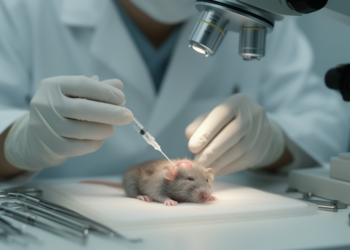
In the new experiments, adult male and female wildtype C57BL/6N mice and homozygous K4A mice on the same background, aged five to eight months, received U50,488H at 5 mg/kg subcutaneously or saline. That dose was chosen because it produces maximal analgesic and anti-scratch effects in mice and had shown similar potency in wildtype and K4A animals in prior testing. Blood was drawn from the submandibular vein one hour after injection, and serum corticosterone was measured with a commercial ELISA kit. In a separate protocol, mice were placed on pre-weighed filter papers beginning ten minutes after injection, and urine output over one hour was determined by filter paper weight gain after feces were removed, normalized to body weight.
The corticosterone results were unambiguous. Two-way analysis of variance revealed a significant main effect of treatment but no effect of genotype and no treatment-by-genotype interaction, meaning U50,488H significantly increased corticosterone levels in male and female mice of both genotypes to a similar degree. When basal levels after saline were compared, females showed higher corticosterone than males regardless of genotype, consistent with earlier reports that the authors attribute to reduced negative regulation of the hypothalamic-pituitary-adrenal axis and higher corticosteroid-binding globulin concentrations in females. Notably, when the net increases induced by the drug were analyzed, neither sex nor genotype showed a significant effect, indicating that the magnitude of the drug-induced rise was comparable across groups.
The urine output data followed a parallel pattern with one striking sex difference. U50,488H significantly increased urine output in both sexes regardless of genotype, with no genotype or interaction effects. However, when net increases were calculated by subtracting mean saline values, a significant main effect of sex emerged: males produced a greater drug-induced increase in urine output than females, independent of genotype. The authors state that this is the first demonstration that kappa opioid receptor activation produces greater diuresis in male than female mice when normalized to body weight, a contrast they note differs from a previous rat study that reported similar responses in both sexes.
To probe the signaling question further, the team compared U50,488H with nalfurafine, another kappa agonist, in adult male CD-1 mice. At 20 μg/kg subcutaneously, a dose that produces maximal analgesic and anti-scratch effects, nalfurafine raised corticosterone to a similar extent as U50,488H at 5 mg/kg. This comparison matters because previous work from the group showed that U50,488H, but not nalfurafine at this dose, promotes kappa receptor phosphorylation in the mouse brain and receptor internalization in the ventral tegmental area, both proxies of β-arrestin-mediated signaling. Since both drugs elevated corticosterone equally, and the phosphorylation-deficient mutant responded normally, the authors conclude that receptor phosphorylation and β-arrestin signaling are unlikely to be required, and that the effects are likely mediated by G protein signaling.
The diuresis findings align with earlier rat work showing that U50,488H and nalfurafine increase urine output dose-dependently with similar maximal responses at anti-scratch-effective doses. The authors acknowledge a complication: triazole 1.1 and triazole 187, compounds demonstrated to be G protein-biased in vitro, produced diuresis with lower maximal effects than U50,488H, which could suggest β-arrestin involvement, though differences in experimental approaches may explain the discrepancy. The team also explains why they did not directly test G protein involvement in vivo: pertussis toxin causes vascular permeability changes, blood-brain barrier disruption and intense systemic endoplasmic reticulum stress that would confound results, while most small-molecule G protein inhibitors do not readily cross the blood-brain barrier, and intracerebroventricular or site-specific injections introduce surgical manipulations that disturb behavioral and endocrine baselines.
One theoretical expectation was not met: if receptor phosphorylation drives desensitization, K4A mice might have shown heightened responses to U50,488H, but they did not for either outcome. The authors suggest that a single acute exposure to 5 mg/kg may simply be insufficient to cause receptor desensitization, noting that in their previous work only five repeated exposures to 80 mg/kg, not 5 mg/kg, produced tolerance to the anti-scratch effect. Kappa agonists have been explored as water diuretics for water retention associated with edema, elevated intracranial pressure and liver cirrhosis, and unlike traditional diuretics they cause little or no loss of potassium and sodium in urine. The authors note that potential sex differences in humans warrant further investigation, and that the study, approved by the Temple University Institutional Animal Care and Use Committee, extends previous findings from males to females and from rats, dogs, monkeys and humans to mice.
Subject of Research: The role of kappa opioid receptor phosphorylation and β-arrestin signaling in U50,488H-induced serum corticosterone elevation and diuresis in mice
Article Title: Studies on U50,488H-induced increases in serum corticosterone level and diuresis in wildtype and mutant mice expressing phosphorylation-deficient kappa opioid receptor
Article References: Zhao, P., Huang, P., Bland, K., Khandeshi, S., & Liu-Chen, L.-Y. (2026). Studies on U50,488H-induced increases in serum corticosterone level and diuresis in wildtype and mutant mice expressing phosphorylation-deficient kappa opioid receptor. Advances in Drug and Alcohol Research, 6, Article 17289. https://doi.org/10.3389/adar.2026.17289
Image Credits: AI Generated
Keywords: kappa opioid receptor, U50,488H, corticosterone, diuresis, β-arrestin, G protein signaling, receptor phosphorylation, K4A mutant mice, nalfurafine, sex differences, biased agonism, pharmacology
Cite Scienmag News
Drew Townsend. (October 28, 2026). Kappa Opioid Receptor Phosphorylation Not Needed for Stress Hormone and Diuresis Effects in Mice. Scienmag. https://scienmag.com/kappa-opioid-receptor-phosphorylation-not-needed-for-stress-hormone-and-diuresis-effects-in-mice/
Drew Townsend. "Kappa Opioid Receptor Phosphorylation Not Needed for Stress Hormone and Diuresis Effects in Mice." Scienmag, 28 October 2026, https://scienmag.com/kappa-opioid-receptor-phosphorylation-not-needed-for-stress-hormone-and-diuresis-effects-in-mice/. Accessed 28 October 2026.
Drew Townsend. "Kappa Opioid Receptor Phosphorylation Not Needed for Stress Hormone and Diuresis Effects in Mice." Scienmag. October 28, 2026. https://scienmag.com/kappa-opioid-receptor-phosphorylation-not-needed-for-stress-hormone-and-diuresis-effects-in-mice/