A thin sandwich panel built from an expanded polystyrene core and cementitious facings reinforced with woven jute fabric has shown a combination of mechanical strength and thermal insulation that its developers say makes it a credible candidate for non-load-bearing vertical sealing systems in buildings. The panel, described in an open-access study published in October 2026, reached a direct compressive strength of 4.53 MPa and a diagonal compression shear strength of 2.34 MPa in wall prism tests, while its measured thermal transmittance of 1.33 W/m²K fell within the limits specified for external walls under the Brazilian standard NBR 15220-3. The work was carried out by a research team led by Sasha K. S. Botelho and Paulo R. L. Lima, who set out to replace the metallic or polymeric reinforcements typically used in cementitious sandwich panels with a renewable natural fiber.
The motivation rests on a well-known weakness of conventional panels. Cement-based sandwich panels usually pair stiff faces with an insulating lightweight core, and in thin cementitious faces the long-term performance of steel reinforcement depends heavily on concrete cover, crack control, moisture ingress and environmental exposure. Because these faces are only a few millimeters thick, the authors note, they fail to protect steel bars from corrosion by external agents within the expected service life of the building. Corrosion-resistant textile reinforcements made of glass, basalt, aramid or carbon fibers are one established alternative, but the team turned instead to jute, a bast lignocellulosic natural fiber with moderate mechanical strength, low density, broad commercial availability, low cost, biodegradability and renewability. The authors acknowledge that jute’s hydrophilic character, dimensional response to moisture, natural variability and susceptibility to alkaline degradation can reduce reinforcement efficiency and durability, and they addressed this with physical treatment and matrix modification.
The cementitious matrix itself was engineered for textile impregnation. It used a 1:1:0.40 binder-to-fine-aggregate-to-water-to-binder ratio by mass, with high-early-strength Portland cement partially replaced by 40 percent fly ash and 10 percent silica fume. These pozzolanic additions served three purposes: densifying the matrix, adjusting rheology and mitigating the alkaline degradation of the vegetable fibers. The fine aggregate was quartz river sand with a maximum particle size of 1.2 mm, and a polycarboxylate ether superplasticizer was dosed to achieve a flow-table spread of 384 mm, which the researchers judged sufficient for effective impregnation of the fabric layers. After 28 days of water-immersed curing, the matrix reached a compressive strength of 45.5 ± 0.4 MPa and a flexural tensile strength of 6.6 ± 0.3 MPa.
Before the jute fabric ever touched mortar, it was washed and hornified. Because jute fibers are moisture sensitive, the fabric underwent an initial wash in warm water at 50 °C to remove surface impurities, followed by five hornification cycles, each consisting of three hours of immersion in water and sixteen hours of drying in an oven at 80 °C. Hornification is a physical treatment that reduces the high water absorption of vegetable fibers by subjecting them to wetting and drying cycles that reduce volume variation. In direct tension, the treated fabric showed a tensile strength of 61.0 ± 2.8 MPa and an initial stiffness of 2.27 ± 0.2 GPa across fifteen specimens, values somewhat lower than those reported in a prior study, which found around 66.0 MPa and 4.83 GPa. The stress-strain curve unfolded in four phases, from initial fiber accommodation within the yarns, through rising stress and stiffness, to fiber failure and finally slippage between fibers in the bundles, with the average specific strain at failure of individual fibers measured at 0.014 mm/mm.
The team then laminated composites containing one, two and three layers of jute fabric into 10 mm thick plates, designated TRCC-J1, TRCC-J2 and TRCC-J3, and broke them in four-point bending over a 300 mm span. All composites behaved as textile-reinforced cementitious composites typically do: a linear stage up to first cracking, a minor load drop as the crack opened, and then mobilization of the fabric, which prevented brittle failure and allowed the load to hold or rise as displacement increased, accompanied by a multiple cracking process. Counterintuitively, adding more fabric layers reduced maximum stress. The three-layer composite lost roughly 19 percent of maximum stress relative to the one-layer version and 7 percent relative to the two-layer version, an effect the authors attribute to the proliferation of fiber-matrix interfacial transition zones acting as weak links, and possibly to fabric position within the cross-section. Toughness moved the other way: the I10 toughness index of the three-layer composite rose about 32 percent above the one-layer and 10 percent above the two-layer version.
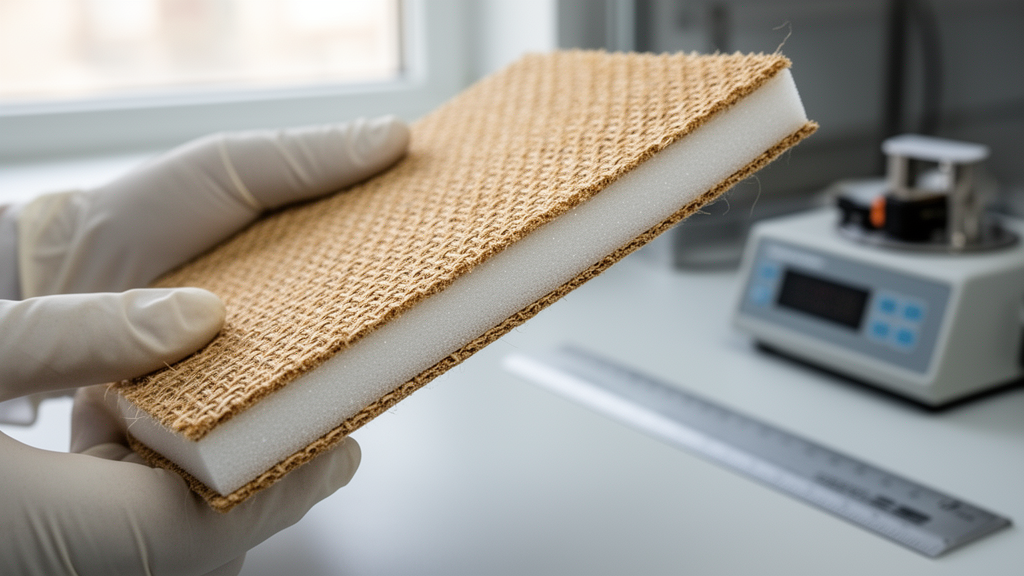
That trade-off drove the selection of the two-layer configuration for the panel facings. The researchers judged TRCC-J2 the optimal balance between post-cracking toughness, flexural performance, textile consumption and fabrication complexity, since the three-layer version offered higher toughness but lower first-cracking stress and greater fabric demand, while the single layer delivered insufficient post-cracking energy absorption. The finished panel consisted of two TRCC facings roughly 6 ± 2 mm thick, each reinforced with two jute fabric layers, sandwiching a 22 mm expanded polystyrene core. To maximize mechanical interlocking and stress transfer between facings and core, parallel 2 x 2 mm grooves spaced every 20 mm were cut into both surfaces of the EPS. Panels were cast by hand lay-up on a vibrating table, demolded after 72 hours and water-cured to 28 days, reaching a total thickness of approximately 35 mm.
Flexural testing followed two ASTM standards with different objectives. Under ASTM D7249, which probes the facings, the stress on the bottom face reached about 1.0 MPa at cracking and 1.1 MPa at the deflection limit of span/250, climbing to a maximum of approximately 1.82 MPa, a deflection-hardening response the authors credit to the fabric’s stress transfer after matrix cracking. Under ASTM C393, whose shorter span induces higher shear in the core, the core shear stress was roughly 0.1 MPa at first cracking and 0.2 MPa at peak load, with an ultimate value of 0.190 MPa. The dominant failure mode was core shear, preceded by face-to-core debonding at the crack initiation sites and at the free ends, which the authors suggest could be mitigated by mechanical connectors or optimized core surface grooving. They also note that their load-displacement behavior, with strength gain after cracking, differs from the deflection-softening reported for sandwich panels with short-fiber reinforced faces.
Wall prism tests extended the picture to full panel behavior. In direct compression on 1000 x 400 mm prisms loaded along the top edge, with only the facings counted as load-bearing elements in the strength calculation, the panels reached 4.53 ± 0.18 MPa, a value the authors describe as compatible with concrete masonry prisms reported in the literature at 2.5 to 6.5 MPa, and above the minimums of 1.5 and 3.0 MPa that NBR 15270 sets for structural ceramic blocks with horizontal and vertical cores respectively. Failure began with multiple cracks at the top of the panel, indicating face buckling that mobilized the fabrics, a pattern typical of slender layered panels in which lateral deflection generates bending moments and walls can fail by buckling before compressive stress reaches yield. In diagonal compression-shear tests on 400 x 400 mm prisms following ASTM E519, the shear strength was 2.34 ± 0.37 MPa, exceeding the 0.41 to 0.58 MPa reported for ceramic block masonry walls with or without short jute fiber reinforcement. The authors stress that these prism results rest on only two specimens per configuration.
The thermal evaluation used a sealed chamber simulating one-dimensional heat transfer, with a 24-hour protocol of eight hours of heating by a 1500 W source followed by sixteen hours of natural cooling. The heated chamber’s air temperature peaked at 51.3 °C, the panel’s hot face reached 44.3 °C, and the cold face stayed at 27.5 °C, a maximum face-to-face differential of 16.8 °C representing 37.9 percent thermal attenuation. Solving a one-dimensional transient inverse heat transfer problem with an implicit finite difference scheme and Monte Carlo optimization, the team estimated thermal conductivity of 1.05 W/(m·K) and specific heat of 1000 J/(kg·K) for the facings, and 0.030 W/(m·K) and 1450 J/(kg·K) for the EPS core, with the numerical cold-face curve matching experiment to within 0.343 °C. The resulting thermal resistance of 0.75 m²K/W and transmittance of 1.33 W/m²K compare favorably with the 1.9 to 3.5 W/m²K typical of conventional ceramic block masonry walls and the 4.4 W/m²K of 100 mm concrete walls, which NBR 15220-3 classifies as poorly insulated, all achieved at a panel thickness the authors give as only 40 mm, far below the 65 to 310 mm range of sandwich panels in the literature.
The authors are explicit about what the study does not establish. Long-term durability assessments, acoustic insulation testing, fire resistance evaluation and full-scale structural validation were not performed, and they identify these as key limitations that future research must address before the panel can move to practical implementation. Within those bounds, the findings support a specific claim: an EPS-core panel with jute-textile-reinforced cementitious facings, at roughly 35 to 40 mm thick, achieved post-cracking load transfer and deflection-hardening in flexure, compressive and shear strengths adequate for non-structural infill masonry, and a thermal transmittance that satisfies building energy code requirements for thermal comfort, while substituting a renewable, low-cost plant fiber for the non-renewable metallic or polymeric reinforcements that conventional cementitious sandwich panels rely on.
Subject of Research: Development and testing of a lightweight sandwich panel with an expanded polystyrene core and jute-textile-reinforced cementitious facings for non-load-bearing building enclosures.
Article Title: Thermal and mechanical behavior of sandwich panel with lightweight core and jute textile reinforced concrete faces
Article References: Botelho, S. K. S., Sena, M. S., Ribeiro, L. C., Arruda Filho, A. B., Santos, G. J. B., Cordeiro, C. C. C., & Lima, P. R. L. (2026). Thermal and mechanical behavior of sandwich panel with lightweight core and jute textile reinforced concrete faces. Discover Concrete and Cement, 2(1), Article 88. https://doi.org/10.1007/s44416-026-00127-8
Image Credits: AI Generated
DOI: 10.1007/s44416-026-00127-8
Keywords: sandwich panels, jute fiber, textile-reinforced concrete, expanded polystyrene core, thermal transmittance, building insulation, natural fiber reinforcement, flexural testing, compressive strength, non-load-bearing walls, sustainable construction materials, hornification
Cite Scienmag News
Denise Maddox. (October 28, 2026). Jute Fabric and EPS Core Yield Thin Sandwich Panel With Strong Thermal and Mechanical Results. Scienmag. https://scienmag.com/jute-fabric-and-eps-core-yield-thin-sandwich-panel-with-strong-thermal-and-mechanical-results/
Denise Maddox. "Jute Fabric and EPS Core Yield Thin Sandwich Panel With Strong Thermal and Mechanical Results." Scienmag, 28 October 2026, https://scienmag.com/jute-fabric-and-eps-core-yield-thin-sandwich-panel-with-strong-thermal-and-mechanical-results/. Accessed 28 October 2026.
Denise Maddox. "Jute Fabric and EPS Core Yield Thin Sandwich Panel With Strong Thermal and Mechanical Results." Scienmag. October 28, 2026. https://scienmag.com/jute-fabric-and-eps-core-yield-thin-sandwich-panel-with-strong-thermal-and-mechanical-results/