Pharmaceutical residues keep turning up in rivers, lakes and drinking-water sources around the world, and the conventional treatment plants that were never designed to catch them often let large fractions slip through into the environment. A new study reports that pellets grown from grain spawn of the white-rot fungus Pleurotus ostreatus can strip a substantial share of eleven common pharmaceuticals from wastewater, in some cases within minutes of contact. The work, published as a brief report in the journal Fungal Biology and Biotechnology, combined laboratory removal experiments with a preliminary life cycle assessment of the treatment process, an unusual pairing that allows the efficiency of the biological method to be weighed against its environmental price.
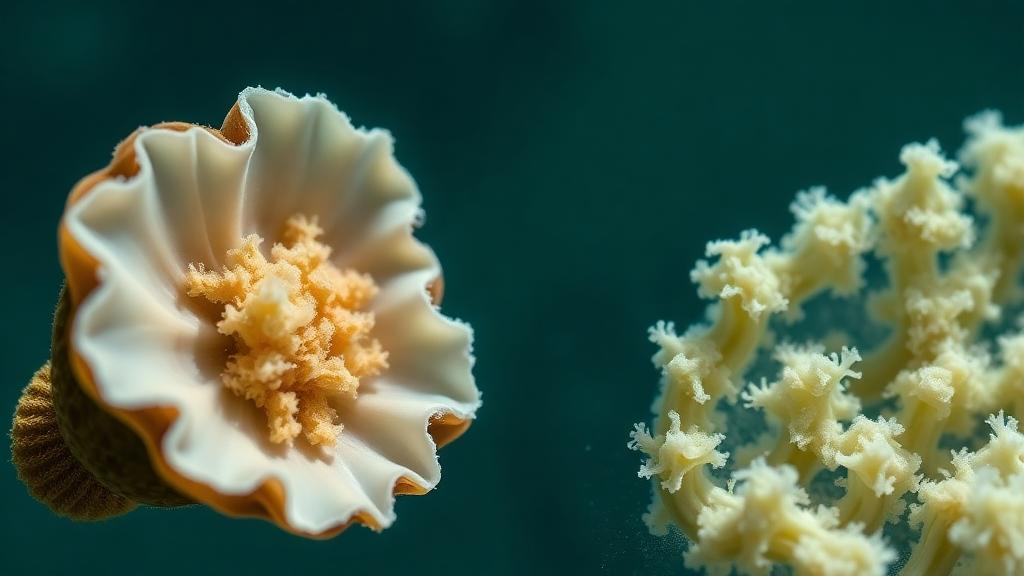
The pellets at the heart of the study are not free-floating mycelial fragments but structured objects built from grain, fungal hyphae growing out of that grain, and particles of kraft lignin deliberately added to induce the production of ligninolytic enzymes. The researchers used the strain P. ostreatus M2191, mixing grain spawn at 40 grams per litre with lignin at 4 grams per litre. Lignin is included because it prompts the fungus to secrete laccases and peroxidases, the broad-substrate enzymes that white-rot fungi use to dismantle lignocellulose in nature and that can also act on a wide range of man-made molecules. The finished pellets measure roughly half a centimetre to two centimetres across, a size that matters practically because it allows the biomass to be harvested afterwards by simple coarse filtration rather than more demanding separation steps.
In the first experiment, the pellets were cultivated for four days in flasks of synthetic wastewater until laccase activity reached 425 units per litre, then challenged with a mixture of eleven target compounds at a nominal concentration of 10 micrograms per litre of each. The list covered azithromycin, erythromycin, sulfamethoxazole, caffeine, fluconazole, tramadol, trimethoprim, metoprolol, lidocaine, venlafaxine and desvenlafaxine, all selected for their documented ubiquity in aquatic environments and high levels of human use. After just ten minutes of exposure on an orbital shaker, the living fungal pellets had reduced the total pharmaceutical concentration in the water phase to 85.7 micrograms per litre, compared with 134.7 micrograms per litre in a control treated with autoclaved pellets whose enzymatic activity had been destroyed. That difference corresponds to a reduction of more than 30 percent relative to the control within ten minutes.
The short exposure window was a deliberate design choice. By limiting contact to ten minutes, the researchers aimed to distinguish adsorption onto the fungal matrix from degradation by extracellular enzymes, although they note that metabolism-linked mechanisms cannot be entirely excluded even at such short times. The results were strikingly compound-specific. Concentrations of the antibiotics azithromycin, erythromycin, sulfamethoxazole and trimethoprim each fell by more than 50 percent relative to the control, and nine of the eleven target compounds showed statistically significant reductions overall. Only caffeine and fluconazole were untouched by the treatment, a pattern the authors attribute to the physicochemical properties of individual molecules, since laccase-mediated oxidation is favoured by electron-donating substituents and hindered by electron-withdrawing groups, while predominantly anionic compounds may be repelled by the negatively charged fungal surface at neutral pH.
Crucially, the experiment also quantified how much of the removed pharmaceutical actually ended up inside the pellets. Biosorption was significantly higher with living fungi, which accumulated 165.5 micrograms per kilogram dry weight of pharmaceuticals in their biomass compared with 71.3 micrograms per kilogram in the autoclaved control. Erythromycin, tramadol and metoprolol showed the greatest tendency to accumulate in living pellets, while azithromycin, fluconazole and trimethoprim remained below the detection limit in the biomass. Yet when these sorbed amounts were scaled to the biomass concentration in the flasks, only about 4 micrograms per litre of pharmaceuticals were removed by sorption in the living treatment, and about 2 micrograms per litre in the control. Against the much larger quantities disappearing from the water phase, sorption accounted for only a minor fraction, pointing firmly to extracellular enzymatic degradation as the dominant removal mechanism.
The second experiment moved from synthetic mixtures to real-world conditions, using secondary effluent collected from a municipal wastewater treatment plant serving 200,000 population equivalents. The effluent, which received no pretreatment before inoculation, contained all eleven target compounds except azithromycin, with concentrations ranging from roughly 6 nanograms per litre for erythromycin to almost 2 micrograms per litre for the antidepressant desvenlafaxine. Treatment with fungal pellets reduced the total pharmaceutical concentration by 51 percent after two hours, 58 percent after six hours and 66 percent after 24 hours, with no statistically significant difference among the three treatment times when the total sum was considered. For individual compounds the picture differed: tramadol, trimethoprim, metoprolol, lidocaine and venlafaxine showed significantly greater degradation with increasing treatment time, while the others did not. The authors explain this apparent contradiction by the dominance of desvenlafaxine, which was present at such high concentration and degraded so slowly that it masked time-dependent effects in the total sum.
The confirmation of high removal for sulfamethoxazole and trimethoprim, at 70 to 80 percent relative to initial concentrations in the real effluent, strengthened the case for the technology against antibiotics specifically. However, the capacity to remove azithromycin and erythromycin could not be verified in the municipal wastewater, because azithromycin was not detected there at all and erythromycin, present at very low concentration, showed no significant removal. Fluconazole again proved resistant, unaffected in both experiments, a reminder that azole compounds are known for their low biodegradability. The authors also caution that enzymatic degradation raises the question of transformation products, which this study did not examine, and that while white-rot fungal treatment is often reported to render pollutants less toxic, a recent study of fungal degradation of organophosphate flame retardants reported increased toxicity after treatment, so no general conclusions on toxicity can yet be drawn.
To assess the environmental footprint of the process, the team performed a preliminary life cycle assessment following the ISO 14040 and 14044 standards, using one litre of simulated secondary effluent as the functional unit and a cradle-to-gate system boundary. Two scenarios for disposing of the spent biomass were compared: incineration and landfill. Incineration proved environmentally advantageous in most impact categories, reducing impacts by 103 percent in the global warming category, 43 percent in fossil resource scarcity and 49 percent in mineral resource scarcity, with the largest reduction, exceeding 160 percent, seen in ozone formation. These credits arise mainly from heat recovery during incineration, which offsets emissions associated with combustion and avoids the greenhouse gases that biowaste fermentation would produce during landfilling.
The assessment also exposed where the environmental burden of the treatment itself originates. Electricity consumption for preparing the grain spawn, particularly the boiling and sterilisation steps, was the main contributor in the most significant impact categories, followed by the electricity needed for aeration during pellet production, with power drawn from the Swedish grid. Grain spawn production was also the dominant contributor in the ecotoxicity and human toxicity-related categories. Notably, the impact values obtained at this laboratory scale were generally one order of magnitude higher than those reported for larger-scale, more consolidated treatment technologies, a difference the authors attribute mainly to specific electric energy consumption, since larger processes benefit from greater efficiency. This gap, they stress, suggests a margin for improvement that remains to be demonstrated, and future process development should focus on optimising grain spawn production, for example by exploring less energy-demanding pretreatments of the grain before fungal inoculation.
Overall, the study positions spawn-based fungal pellets as a biologically based treatment technology with demonstrated potential to lower pharmaceutical concentrations in water, while being explicit about its open questions. The harvested biomass carries sorbed compounds and therefore requires appropriate post-treatment and disposal, with incineration suggested as preferable to landfilling and biochar production flagged as a possible avenue worth exploring. Beyond process optimisation, the authors identify the fate of transformation products, the toxicity of treated water, and the effects of high laccase activity on aquatic ecosystems as issues that still need investigation, noting that studies on the latter topic have been called for previously but remain lacking. The technique builds on earlier work showing that spawn-based pellets of white-rot fungi can remove pharmaceuticals from various wastewaters, and the present findings, with living fungi clearly outperforming autoclaved biomass and enzymatic degradation outweighing biosorption, provide a foundation for developing the approach toward practical application at scale.
Subject of Research: Use of spawn-based pellets of the white-rot fungus Pleurotus ostreatus to remove pharmaceuticals from wastewater, with a preliminary life cycle assessment of the treatment process.
Article Title: Removal of selected pharmaceuticals from wastewater using spawn-based pellets of Pleurotus ostreatus: efficiency and environmental implications
Article References: Hultberg, M., Surra, E., & Golovko, O. (2026). Removal of selected pharmaceuticals from wastewater using spawn-based pellets of Pleurotus ostreatus: efficiency and environmental implications. Fungal Biology and Biotechnology, 13(1), Article 16. https://doi.org/10.1186/s40694-026-00221-3
Image Credits: AI Generated
DOI: 10.1186/s40694-026-00221-3
Keywords: Pleurotus ostreatus, white-rot fungi, pharmaceuticals, wastewater treatment, antibiotics, biosorption, laccase, secondary effluent, life cycle assessment, bioremediation, micropollutants, spent biomass
Cite Scienmag News
Roger Howard. (October 28, 2026). Oyster Fungus Pellets Strip Antibiotics from Wastewater in Minutes. Scienmag. https://scienmag.com/oyster-fungus-pellets-strip-antibiotics-from-wastewater-in-minutes/
Roger Howard. "Oyster Fungus Pellets Strip Antibiotics from Wastewater in Minutes." Scienmag, 28 October 2026, https://scienmag.com/oyster-fungus-pellets-strip-antibiotics-from-wastewater-in-minutes/. Accessed 28 October 2026.
Roger Howard. "Oyster Fungus Pellets Strip Antibiotics from Wastewater in Minutes." Scienmag. October 28, 2026. https://scienmag.com/oyster-fungus-pellets-strip-antibiotics-from-wastewater-in-minutes/