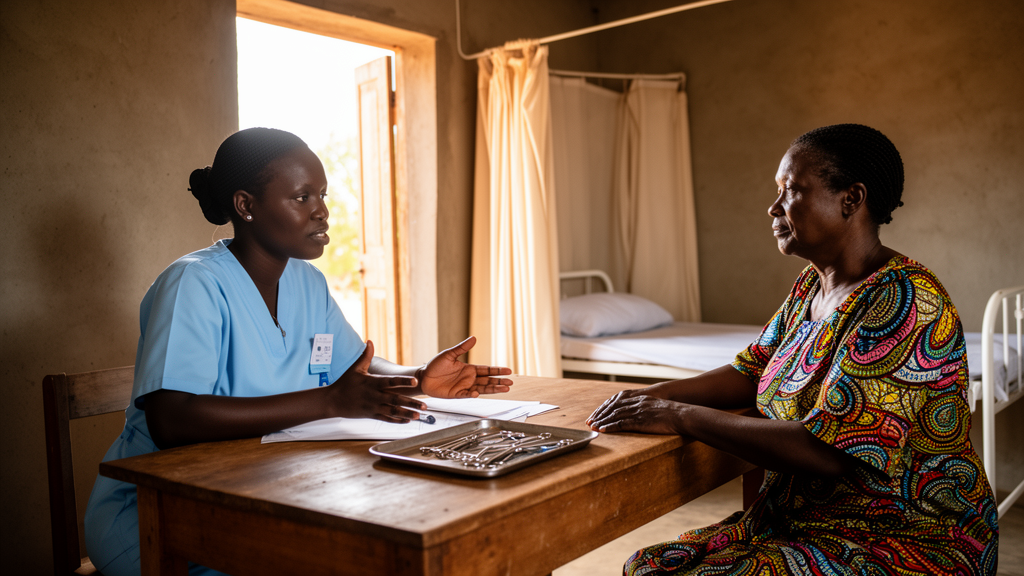
Frontline healthcare workers in Greater Hoima, Uganda, have described a health system so constrained that cervical cancer screening is reliably available at only one facility in the entire region, leaving most women who seek the service turned away and sent on journeys they often cannot afford. The account comes from a qualitative exploratory study in which researchers conducted key informant interviews with 45 healthcare workers, including nurses, midwives, clinical officers and general doctors, drawn from 20 public and private not-for-profit health facilities across Hoima District, Kikuube District and Hoima City. The interviews were analyzed using inductive thematic analysis, with two researchers coding independently and resolving discrepancies through consensus, and four major themes emerged from the data.
Participants from Health Centre IIIs and IVs reported uniformly that cervical cancer screening was, in their experience, reliably accessible only at Hoima Regional Referral Hospital. Women regularly presented at lower-level facilities asking to be screened, only to be directed to the regional hospital, a journey that for most residents of a region where an estimated 66.8 percent of the population is rural involved substantial transport costs, time away from household responsibilities and, for many, an insurmountable obstacle. One midwife at a Health Centre III explained the dilemma plainly: “We always refer them to the regional referral hospital or to Reproductive Health Uganda clinic, but many cannot go because of the costs.” A nurse at another Health Centre III said, “Everything is concentrated at the regional hospital. At our level, we only identify the need but cannot provide the service.”
The study’s authors argue that this centralization functions as a de facto rationing mechanism. Because the regional hospital is effectively the sole access point, geographic and financial distance from it concentrates screening uptake among women who are urban, better resourced or already living near Hoima town. For the rural majority, participants repeatedly described awareness and willingness as present; the barrier was structural, an inability to reach the point of service. The equity implications are considerable, since women in the most remote and lowest-resourced areas are systematically excluded from early detection, a pattern the authors suggest is likely to translate into later-stage presentation and higher mortality in precisely the sub-population least able to absorb that cost. Several Health Centre IV facilities had previously offered screening through Visual Inspection with Acetic Acid, or VIA, via NGO-supported outreach programmes, but those services ceased when partner funding was withdrawn, leaving no government-supported alternative.
The second theme was a critical shortage of trained and skilled personnel, particularly in VIA. The majority of nurses, midwives and clinical officers reported receiving no formal training in the technique, neither through pre-service education nor through any in-service opportunity, a deficit consistent across public and private not-for-profit facilities and across both Health Centre III and IV levels. “In my training we never covered VIA, so even if I want to help, I don’t know how to do it,” one nurse reported. Another midwife said, “We need training. We are willing, but no one has ever come here to teach us.” Participants described formal training requests made through district health management channels that went unanswered, and training opportunities offered to colleagues at other facilities but never communicated to their own. Because VIA competency was concentrated among a small number of staff at higher-tier facilities, most lower-level facilities functioned as identification points rather than service delivery points, regardless of client demand or staff willingness.
The third theme concerned inadequate equipment, supplies and infrastructure. Nearly all participants outside the regional referral hospital reported severe shortages spanning three categories: consumables such as acetic acid and cotton swabs were consistently unavailable at most Health Centre IIIs and IVs; vaginal specula were absent or in critically short supply at almost all lower-level facilities; and private examination rooms with adequate lighting and space for gynecological examinations were largely absent, compromising patient dignity. “Even if I was trained, I would still be stuck because we don’t have speculums or acetic acid here,” one clinical officer said. A nurse noted, “The rooms we have cannot ensure privacy. You cannot examine a woman with other patients walking in and out.” Participants framed training and equipment deficits as mutually reinforcing: even the few staff who had received some VIA training could not use their skills without basic instruments, and supply interruptions were described as the norm rather than occasional events.
The fourth theme was weak health system support and referral pathways. Participants described an absence of structured supervisory mechanisms, district-level coordination and quality assurance processes, and, most consequentially, no clear functional pathway for women with positive or suspicious screening results. Cryotherapy, the first-line treatment for precancerous lesions, was not available locally, and health workers expressed uncertainty about where to refer women requiring treatment, what the waiting times would be, and whether referred women would actually be seen. This raised an ethical concern that several participants articulated independently: screening without a guaranteed care continuum could be harmful rather than beneficial. “It is not fair to screen women when you cannot guarantee treatment. We end up doing more harm than good,” one midwife said. A doctor at a Health Centre IV asked, “If we screen and find a positive case, where do we send her? There is no clear pathway.” Health workers also reported rarely or never receiving feedback on the outcomes of women they referred, and some women returned having not been seen at the referral facility at all.
The study’s context makes the findings significant. Uganda is among the countries most severely affected by cervical cancer, with an age-standardized incidence rate of 56.2 per 100,000 women and a mortality rate of 41.4 per 100,000 women, rates well above the East African regional average. Cervical cancer is the leading cancer among women in Uganda across all age groups, and screening uptake remains critically low: an estimated 10 percent of women aged 30 to 49 have ever been screened, with fewer than 10 percent screened in the last five years. Globally, cervical cancer caused an estimated 661,044 new cases and 348,186 deaths in 2022, and it is the leading cause of female cancer death in 21 of the 48 countries of Sub-Saharan Africa.
Important limitations shape how these findings should be read. The data were collected in July and August 2011 through key informant interviews, and the barriers described reflect healthcare workers’ perceptions and experiences rather than objectively verified facility conditions, since the study relied exclusively on participant reports without independent facility observation. Purposive sampling may have favoured participants more forthcoming about institutional failures, specialists at the regional referral hospital were excluded, and social desirability bias may have influenced responses about conditions in participants’ own workplaces. The authors also note that at the time of data collection VIA was the primary recommended screening method for low-resource settings, whereas WHO has since moved toward recommending HPV-based testing as the preferred primary modality, so the framing of VIA reflects guidance current at the time of the study. They add, however, that the structural barriers documented, including centralization, workforce training deficits, equipment shortages and fragmented referral pathways, remain consistently reported in more recent qualitative studies from Uganda and comparable settings.
On the basis of the findings, the researchers recommend decentralizing screening services by training and equipping staff at Health Centre IIIs and IVs to provide VIA and, in time, HPV-based screening; procuring essential equipment and establishing reliable supply chains for consumables including vaginal specula and acetic acid; integrating cervical cancer screening competencies covering both methods into health professional training curricula; and establishing clear, functional referral systems between primary care facilities and treatment centres. The discussion also points to complementary strategies, including task-shifting to supervised nurses and midwives, community-based outreach coordinated through district health offices, integration of screening into antenatal, postnatal and HIV services, and pooled procurement mechanisms, while cautioning that technology-based interventions alone would be insufficient given the breadth of the gaps described.
The study’s central conclusion is that demand-stimulation strategies such as awareness campaigns are unlikely to yield sustained improvements in screening coverage unless the underlying supply-side deficiencies are addressed. The four themes converge, in the authors’ words, on a single systemic diagnosis: screening in Greater Hoima is constrained not by one easily remedied gap but by the simultaneous absence of trained personnel, essential equipment, accessible service delivery points and functional referral pathways. As one clinical officer at a Health Centre IV put it, “The gap between the community and where screening is offered is too wide. Many women are lost along the way.”
Subject of Research: Institutional and health system barriers to cervical cancer screening in Greater Hoima, Uganda
Article Title: Healthcare workers’ perspectives on institutional and health system barriers to cervical cancer screening in Greater Hoima, Uganda
Article References: Kibonire, R. A., & Mphuthi, D. D. (2026). Healthcare workers’ perspectives on institutional and health system barriers to cervical cancer screening in Greater Hoima, Uganda. Discover Health Systems, 5(1), Article 83. https://doi.org/10.1007/s44250-026-00424-w
Image Credits: AI Generated
DOI: 10.1007/s44250-026-00424-w
Keywords: cervical cancer, cancer screening, Uganda, health systems, VIA, HPV, healthcare workers, qualitative research, sub-Saharan Africa, referral pathways, health workforce, supply chain
Cite Scienmag News
Nathaniel Bowman. (October 28, 2026). Health Workers Reveal Why Cervical Cancer Screening Fails in Rural Uganda. Scienmag. https://scienmag.com/health-workers-reveal-why-cervical-cancer-screening-fails-in-rural-uganda/
Nathaniel Bowman. "Health Workers Reveal Why Cervical Cancer Screening Fails in Rural Uganda." Scienmag, 28 October 2026, https://scienmag.com/health-workers-reveal-why-cervical-cancer-screening-fails-in-rural-uganda/. Accessed 28 October 2026.
Nathaniel Bowman. "Health Workers Reveal Why Cervical Cancer Screening Fails in Rural Uganda." Scienmag. October 28, 2026. https://scienmag.com/health-workers-reveal-why-cervical-cancer-screening-fails-in-rural-uganda/