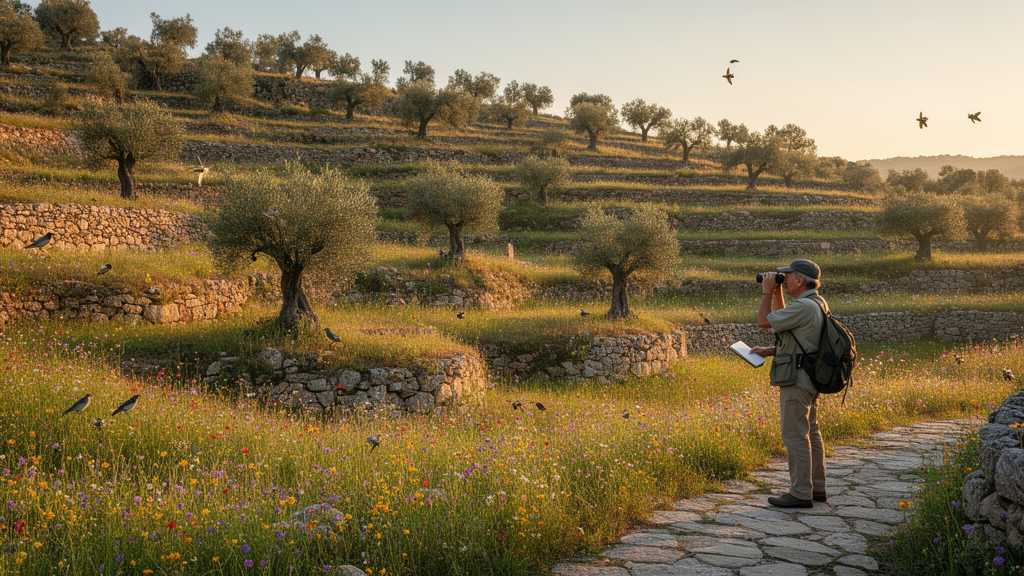
Biodiversity is usually measured with ecological indicators and scientific monitoring schemes, while cultural heritage is assessed separately through value-based approaches. A new research article argues that this separation is failing cultural landscapes, where biodiversity is often sustained by everyday practices, local knowledge systems, and historically embedded land-use patterns. The study, published in the journal Built Heritage, develops a conceptual framework for identifying biocultural indicators of biodiversity and tests it on two contrasting sites: the Alhambra-Generalife-Albaicín World Heritage Site in Granada, Spain, and the rural landscape of Connemara in County Galway, Ireland.
The research, led by Samantha Tobiáš with Aliza Sovani and Marta García-Casasola, addresses a gap the authors identify in existing scholarship. Although the heritage field has widely criticised the separation of nature and culture, the cultural dimensions of biodiversity and the ecological significance of heritage remain insufficiently operationalised in practice, according to the paper. Practical tools for identifying biodiversity through the relationships between people and their environments, the authors write, remain underdeveloped despite considerable conceptual discussion of cultural landscapes, biocultural heritage, and biodiversity monitoring.
The proposed framework consists of four interlinked layers of inquiry. The first identifies the landscape assemblage, meaning the fundamental ecological and cultural elements of the actor-network structure that forms the cultural landscape. The second identifies key species within that assemblage, including domesticated species such as livestock. The third examines socio-ecological relationships with those key species, including land management strategies, agricultural techniques, and conservation methods. The fourth layer is the analytical output: biocultural indicator relationships that translate these practices into biodiversity-relevant meaning. An example given in the paper is that grazing combined with haymaking indicates the maintenance of species-rich grassland.
According to the framework, biocultural indicator relationships are characterised by continuity of practice, observable ecological effects resulting from applied knowledge or land-use patterns, an ongoing relationship to key species or habitats, and the transmission of knowledge or stewardship. The authors stress that the framework does not assume linear causality between practices and biodiversity outcomes. Instead, multiple practices may contribute to multiple ecological effects within the same landscape assemblage, and the indicator relationships function as interpretive summaries rather than exhaustive inventories or one-to-one causal mappings.
Theoretically, the paper adopts a post-human perspective inspired by Actor-Network Theory, treating cultural landscapes as dynamic assemblages of human and non-human actors such as objects, places, plants, and animals. Agency is seen as emergent through relational networks and material co-productions rather than residing solely in humans. The authors draw on the concept of biocultural heritage, which they define as inherited knowledge, skills, and practices co-produced through long-standing relationships with land, plants, animals, and ecosystems. They note that UNESCO’s definition of biocultural heritage as living organisms or habitats whose features result from cultural action frames it as a unilateral result of human activity, and they argue that the mutual interdependence between communities and their environments must instead be taken into account.
The methodology is a comparative qualitative case study design drawing on existing research by the authors rather than new fieldwork. For Connemara, the evidence base included archaeological records, ecological surveys related to Natura 2000 designations, land cover surveys, grey literature from local authorities, interviews with local farmers, fishermen, and conservation and heritage professionals, landscape observation, and GIS analysis. For the Alhambra-Generalife-Albaicín, the study relied on desk-based methods, integrating historical and architectural scholarship, heritage planning reports, and landscape theory grounded in Islamic environmental ethics, cross-referenced with UNESCO documentation and conservation plans. The authors explicitly state that no new fieldwork was undertaken in Granada for this paper and that the case studies are not intended to provide exhaustive empirical accounts or generate new site-specific findings.
The two case studies illustrate how the same categories of indicators take different forms. At the Alhambra-Generalife-Albaicín, designated a UNESCO World Heritage Site in 1984 and expanded in 1994, biodiversity emerges through intentional environmental design rooted in Islamic environmental ethics. The 13th-century Acequia Real still diverts water from the Darro River across terraces to irrigate gardens and forest slopes, and this hydraulic network formed the foundational infrastructure of the site, with palaces and gardens emerging only after it was established. Symbolic plantings of myrtle, cypress, orange, and pomegranate offer shade, fragrance, and pollinator habitat while performing ecological functions such as moderating microclimates. The authors caution that the current gardens should not be equated with direct continuations of medieval Nasrid gardens, as they reflect a layered history of maintenance, restoration, and reinterpretation. The Plan Director de la Alhambra y Generalife identifies the site as a landscape of exceptional heritage value and outlines biodiversity-based practices including biological pest control and protection of native species such as nesting birds and bats. The site also faces pressure from mass tourism, with more than 2.5 million annual visitors and a recently introduced daily cap of 8,100 visitors.
Connemara, by contrast, is described as an agro-ecological mosaic formed through low-intensity farming. The case study focused on a 1000 square kilometre area in north-west Connemara encompassing coastal, freshwater, upland, and bog habitats within the EU Natura 2000 network. Black-faced sheep and cattle have grazed the peaty hills for generations, and dry-stone walls, recently recognised by UNESCO as Intangible Cultural Heritage, manage livestock while providing biodiversity habitats. The paper states that these low-intensity mixed-farming practices maintain semi-natural habitats that would otherwise decline. Seasonal rhythms such as haymaking actively maintain species-rich grasslands, with the timing of hay cutting supporting wildflower diversity and pollinators by aligning with natural growth cycles. Spiritual traditions also play a role: Gaelic and Christian folklore prompts ongoing care for holy wells and fairy trees, often native species such as hawthorn, which serve as small-scale biodiversity hotspots. Community-driven stewardship includes collective grazing on commonage and voluntary rhododendron removal, while state-supported efforts such as peatland rewetting further support biodiversity.
The comparison reveals what the authors call an inverse logic: the Alhambra-Generalife-Albaicín is protected primarily for its culture, while Connemara is protected primarily for its nature, yet both are hybrid landscapes where biodiversity emerges through ongoing biocultural practice. At the Spanish site, heritage recognition has centred on architectural and artistic value while hydrological infrastructure and microhabitats remain marginal in conservation narratives. In Connemara, natural heritage frameworks have preserved habitats but often overlook the cultural practices, including seasonal grazing and dry-stone walling, that actively sustain biodiversity, creating tensions for local farms operating within protected areas. The paper also notes that climate change introduces pressures at both sites: drought risk and visitor pressure challenge the Alhambra-Generalife, while increasing year-round wetness in Connemara threatens traditional seasonal farming practices, although peatlands there hold significant potential for carbon storage through rewetting.
The authors acknowledge limitations. The framework necessarily simplifies complex socio-ecological dynamics and cannot account for the full range of experiences, meanings, or ecological relationships within a given landscape. The current application focused on tangible and spatial practices such as grazing regimes, water infrastructure, and conservation governance, and the authors suggest that a more holistic approach could consider a wider range of intangible heritage including language, oral histories, music, and ritual. They also warn that biocultural frameworks must resist romanticising tradition or assuming consensus, navigating contested terrains of value, diverse voices, and uneven power. The framework is not offered as a prescriptive solution or an exhaustive assessment tool, but as a way to make biocultural relationships to biodiversity analytically legible within heritage landscapes. Since its development, its principles have informed the design of an interdisciplinary capacity-building workshop on heritage and climate change. The authors conclude that caring for biodiversity also means caring for the ways people live with it.
Subject of Research: A conceptual framework for identifying biocultural indicators of biodiversity in cultural landscapes, applied in Spain and Ireland
Article Title: A conceptual biocultural indicator framework for biodiversity in cultural landscapes: development and application in the Alhambra-Generalife-Albaicín (Spain) and Connemara (Ireland)
Article References: Tobiáš, S., Sovani, A., & García-Casasola, M. (2026). A conceptual biocultural indicator framework for biodiversity in cultural landscapes: development and application in the Alhambra-Generalife-Albaicín (Spain) and Connemara (Ireland). Built Heritage, 10(1), Article 74. https://doi.org/10.1186/s43238-026-00311-6
Image Credits: AI Generated
DOI: 10.1186/s43238-026-00311-6
Keywords: biocultural heritage, biodiversity, cultural landscapes, Alhambra, Connemara, heritage management, post-humanism, socio-ecological relationships, Natura 2000, UNESCO World Heritage, traditional ecological knowledge, conservation
Cite Scienmag News
Courtney Benton. (October 28, 2026). New framework makes biodiversity visible through cultural heritage landscapes. Scienmag. https://scienmag.com/new-framework-makes-biodiversity-visible-through-cultural-heritage-landscapes/
Courtney Benton. "New framework makes biodiversity visible through cultural heritage landscapes." Scienmag, 28 October 2026, https://scienmag.com/new-framework-makes-biodiversity-visible-through-cultural-heritage-landscapes/. Accessed 28 October 2026.
Courtney Benton. "New framework makes biodiversity visible through cultural heritage landscapes." Scienmag. October 28, 2026. https://scienmag.com/new-framework-makes-biodiversity-visible-through-cultural-heritage-landscapes/