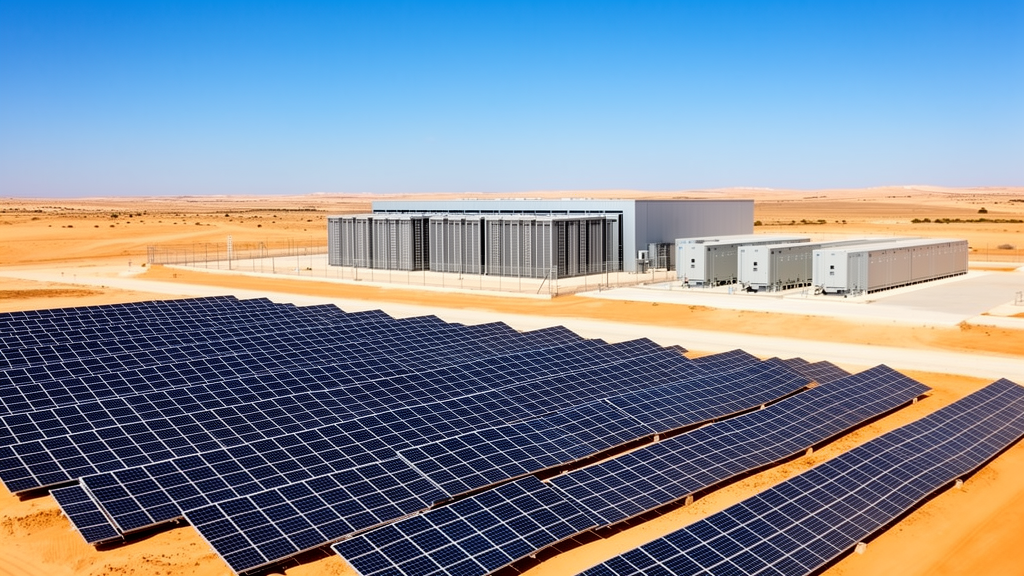
Data centers are among the fastest-growing consumers of electricity in the digital economy, and their reliance on diesel generators for backup power has long been a sticking point for climate goals. A new study from Tunisia now offers a detailed techno-economic and reliability assessment of an alternative: data centers powered by solar photovoltaic panels paired with battery storage. The research, published as an open-access article in Discover Sustainability, models how such a green data center would perform over a long operational lifetime, measuring not just cost and emissions but also the uptime metrics that matter most to operators.
The study, led by Hedi Trabelsi and colleagues, used reliability simulations to evaluate energy availability and downtime, supplemented by indicators such as capacity shortage and unmet load. Rather than relying on a single performance measure, the team compared their proposed photovoltaic-battery model against conventional designs and assessed it using established level reliability standards. This approach allowed them to quantify how often the system would fail to meet demand and for how long, which are critical figures for any facility that must keep servers running around the clock.
The headline results are striking. According to the abstract, integrating the photovoltaic-battery system reduced greenhouse gas emissions by 45 percent compared with conventional diesel backup. On the economic side, the system lowered the Net Present Cost by 15 to 18 percent and decreased the Levelized Cost of Energy by up to 12 percent over the project's lifetime.
These figures suggest that the green configuration is not merely an environmental gesture but a financially competitive option over the long term. Reliability, often the weakest argument for renewable-powered infrastructure, also held up well in the simulations. The modeled system achieved annual availability surpassing 99.98 percent, with downtime limited to under 1.5 hours per year.
The authors report that the photovoltaic-battery combination could maintain high reliability while delivering stable and affordable energy costs over time. The findings are framed within a broader sustainable development context. The authors note that the proposed strategy aligns with several United Nations Sustainable Development Goals, including SDG 7 on affordable and clean energy, SDG 9 on industry, innovation and infrastructure, SDG 11 on sustainable cities and communities, and SDG 13 on climate action.
They argue that the approach contributes to cleaner energy use, lower carbon emissions, improved infrastructure resilience, and more sustainable digital service delivery. Several caveats are worth keeping in mind when interpreting these numbers. The results come from modeling and simulation rather than from a built and monitored facility, so real-world performance in Tunisia's climate and grid conditions would need to be verified through actual deployment.
The abstract also describes the published version as an early release subject to further edits, meaning some figures could be refined in the final Version of Record. The comparison baseline, conventional diesel backup, is a specific reference point, and outcomes against other hybrid configurations might differ. The authors conclude that operational durability and reliability can be achieved without compromising conventional performance standards, and they suggest their results point toward a policy shift in favor of renewable energy-based reliability solutions.
For data center operators and policymakers watching the intersection of digital growth and climate commitments, the Tunisian case offers a quantified template: a modeled 45 percent emissions cut, double-digit reductions in lifetime cost metrics, and downtime measured in minutes rather than days. Whether those simulated advantages translate into practice will depend on deployment, but the study provides a concrete benchmark against which future green data center projects in the region can be measured.
Subject of Research: Techno-economic and reliability modeling of solar photovoltaic and battery storage systems for green data centers in Tunisia
Article Title: Techno-economic and reliability assessment of photovoltaic-battery-supported green data centers in Tunisia
Article References: Trabelsi, H., Belgaroui, R., Kacem, H. H., & Boujelbene, Y. (2026). Techno-economic and reliability assessment of photovoltaic-battery-supported green data centers in Tunisia. Discover Sustainability. https://doi.org/10.1007/s43621-026-04562-2
Image Credits: AI Generated
DOI: 10.1007/s43621-026-04562-2
Keywords: green data centers, solar photovoltaics, battery storage, reliability, levelized cost of energy, net present cost, greenhouse gas emissions, Tunisia, renewable energy, sustainable development goals, diesel backup, energy availability
Cite Scienmag News
Faith Mcneil. (October 28, 2026). Solar and Battery Power Could Keep Tunisian Data Centers Running with 99.98% Uptime. Scienmag. https://scienmag.com/solar-and-battery-power-could-keep-tunisian-data-centers-running-with-99-98-uptime/
Faith Mcneil. "Solar and Battery Power Could Keep Tunisian Data Centers Running with 99.98% Uptime." Scienmag, 28 October 2026, https://scienmag.com/solar-and-battery-power-could-keep-tunisian-data-centers-running-with-99-98-uptime/. Accessed 29 October 2026.
Faith Mcneil. "Solar and Battery Power Could Keep Tunisian Data Centers Running with 99.98% Uptime." Scienmag. October 28, 2026. https://scienmag.com/solar-and-battery-power-could-keep-tunisian-data-centers-running-with-99-98-uptime/