As cities heat up and their populations grow older, a new review argues that the two crises compound each other — and that ordinary planting design, from street trees to therapeutic gardens, may be one of the most practical tools for protecting the health of older residents. The review, published in the journal City and Built Environment, pulls together hundreds of studies to trace how urban plant landscapes influence the bodies and minds of people in later life, and to translate that evidence into concrete design criteria.
The authors, Yahui Cheng, Junwei Pei and Meiyan Wang, analysed 221 Chinese-language articles from the Chinese Science and Technology Journal Database and 379 English-language articles from the Web of Science Core Collection, all published between 2000 and 2024. They combined CiteSpace bibliometric mapping with structured content analysis, coding each study for exposure type, plant configuration, outcome indicators, effect magnitude and study setting. The Chinese-language keyword network contained 316 nodes and 646 links, while the English-language network held 384 nodes and 1,487 links, with both exceeding conventional thresholds for cluster reliability.
The bibliometric mapping reveals a field that has moved from the margins to the interdisciplinary mainstream. Publication was sparse from 2000 to 2012, turned upward after 2013 and accelerated sharply thereafter; English-language output exceeded 60 articles per year between 2020 and 2024. In the English-language literature, Sun Yat-sen University leads institutional output with 21 publications, followed by the Chinese University of Hong Kong with 14 and the University of California System with 12. Burst detection shows research priorities shifting over time: early bursts centred on walking and the built environment, a middle phase turned to self-rated health and care provision, and the most recent phase is dominated by residential greenness — the strongest burst in the series — along with risk factors and vulnerable subgroups.
The two corpora diverge in orientation as much as in language. Chinese-language research clusters around landscape architecture, humanized design and built environment, with thermal comfort appearing only as one of the smallest clusters. The English-language literature is organised around physical activity, accessibility, urban heat island and blue space, tracing a progression from describing settings, through behavioural participation, to questions of who can reach green space and with what health consequence. The authors describe the central divide as substantive: design knowledge concentrated in the Chinese literature and mechanism-and-exposure evidence concentrated in the English literature remain largely unconnected.
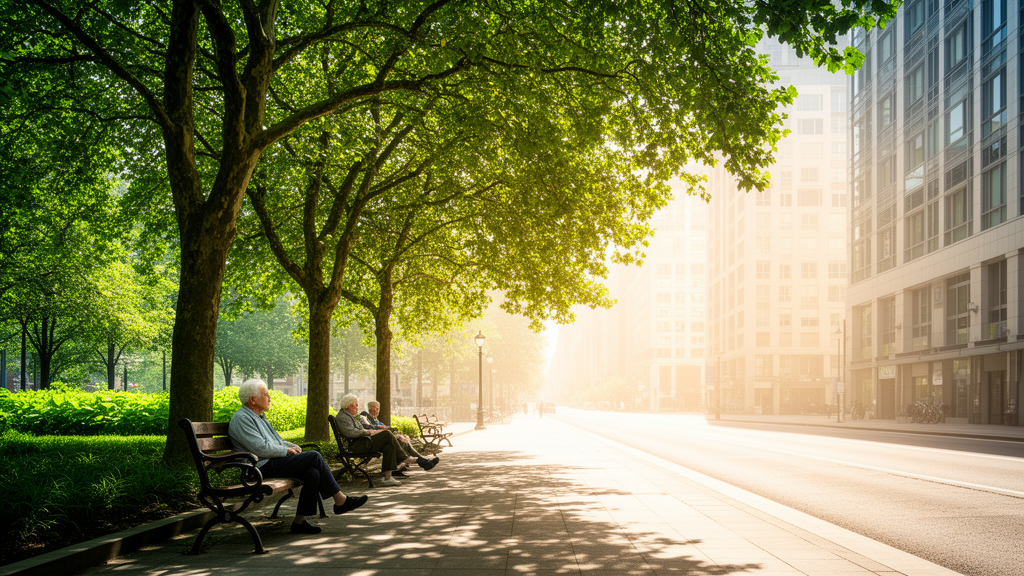
On the physiological side, the review quantifies how vegetation moderates the thermal and air-quality environment. A 10% increase in green space area lowers ambient temperature by 0.2 to 0.9 degrees Celsius, with trees producing the largest reduction at a mean of 2.8 degrees. Large parks exceeding 10 hectares achieve mean temperature reductions of 1 to 2 degrees extending up to 350 metres beyond their boundaries. Tree belts at least 40 metres wide between roads and nursing homes reduce PM2.5 concentrations by up to 67%, and the close coupling of indoor and outdoor particulate levels — a correlation of 0.85 to 0.93 — carries that gain indoors, lowering cardiopulmonary risk. Green roofs, meanwhile, produce surface temperature differences of up to 18 degrees relative to conventional roofs and block roughly 60% of heat flux.
The psychological evidence rests on different foundations across three domains. Cognitive protection draws on large longitudinal cohorts: in the Whitehall II cohort of 6,506 participants, each interquartile-range increase in surrounding greenness was associated with a modestly slower rate of global cognitive decline over ten years. In a population-based cohort, an interquartile-range increase in residential greenness was associated with approximately 5% lower incidence of non-Alzheimer’s dementia, although the reduction for Parkinson’s disease did not reach statistical significance. Using nationally representative Chinese CHARLS data covering 16,337 adults aged 45 and over across 448 communities, each 1% increase in green-space coverage was associated with a 0.05-point higher baseline cognitive score and a 0.01-point slower annual rate of decline, with effects more robust for episodic memory than for mental status. Notably, neither physical activity nor social engagement significantly mediated that association, suggesting restorative pathways extend beyond behaviour.
Stress-relief evidence comes from smaller, mechanistically specified experiments. A healing-garden activity programme lowered physiological stress in older adults, with large effect sizes on heart-rate-variability indices in a sample of just 11 participants per group. A systematic review of 16 controlled studies of therapeutic gardens for people with dementia found that 14 reported significant psychophysiological improvement, with the largest effects on agitation, mood, stress and medication use; representative figures included a 46.7% reduction in agitation and, in a randomized controlled trial, an indoor therapeutic garden that lowered salivary cortisol, reduced systolic and diastolic blood pressure by 2.6 mmHg each and cut antipsychotic dosage by 150 mg relative to controls. Subjective well-being, by contrast, rests chiefly on cross-sectional and perception-based measures, including a controlled winter field experiment with 345 community-dwelling older adults in a cold-climate city in which green settings lowered negative mood and raised recovery-experience scores relative to street environments.
The review’s central conceptual contribution is a single mechanism chain — environmental comfort leading to behavioural participation leading to psychological restoration. Vegetation cools and cleans the air, which makes older adults willing to stay outdoors; staying outdoors promotes walking and social contact; and those behaviours and experiences feed psychological restoration. In the winter field experiment, structural-equation modelling showed that psychological mediation accounted for 56.3% of the total effect of environmental exposure on blood pressure, with the emotional-state pathway dominant and the mediation markedly stronger in women than in men. Physical activity mediated 47.5% of the total indirect effect on subjective well-being in one cited study, while neighbourhood social cohesion mediated 5.6% of the effect reducing loneliness.
Preference studies identify three consistent dimensions that design must meet. Older adults favour plants with bright colours and marked seasonal variation, particularly warm hues such as red and yellow, along with aromatic species such as lavender and stock, and safe, touchable textures such as thornless roses. Safety dominates functional concerns, requiring non-toxic, thornless plants free of allergenic fluff or pollen, with shade-providing species such as ginkgo also valued. Spatially, activity areas call for open layouts with large-canopy shade trees, resting areas need semi-private enclosure from small to medium shrubs, and transition spaces require unobstructed passage with clear trunk heights keeping branches above head level. The authors frame these preferences as compensatory responses to declining vision and olfaction, arguing that age-friendly design should shift from a universal to a compensatory paradigm.
The review is candid about its limits and about the field’s blind spots. Record screening was conducted by a single reviewer, so no inter-rater reliability statistic is reported; the Chinese corpus came from a single database; and the quantitative findings come from individual primary studies rather than pooled estimates, with formal meta-analysis awaiting comparable outcome data. More fundamentally, research concentrates on parks and residential areas used by healthy, ambulant older adults, while the needs of the oldest-old, functionally impaired and bedridden residents in care settings remain largely unexamined. The authors propose human-scale responses — raised planters at 0.7 metres for seated gardening, wheelchair turning spaces of at least 1.5 metres integrated with planting beds, window views using red and yellow species, and misting installations cooling rest areas by 3 to 5 degrees during extreme heat. Their aim is to reposition planting from decorative backdrop to active medium of health intervention, giving landscape architecture a substantive role in the response to population ageing.
Subject of Research: How urban plant landscapes affect the physical and mental health of older adults and inform age-friendly design
Article Title: Research on the mechanisms of urban plant landscapes on older adults’ physical and mental health and age-friendly design responses
Article References: Cheng, Y., Pei, J., & Wang, M. (2026). Research on the mechanisms of urban plant landscapes on older adults’ physical and mental health and age-friendly design responses. City and Built Environment, 4(1), Article 20. https://doi.org/10.1007/s44213-026-00086-7
Image Credits: AI Generated
DOI: 10.1007/s44213-026-00086-7
Keywords: urban greenery, ageing, thermal comfort, air quality, dementia, therapeutic gardens, green space, older adults, planting design, urban heat island, psychological restoration, age-friendly cities
Cite Scienmag News
Beatrice Stafford. (October 28, 2026). Urban Greenery Cools Cities and May Protect Aging Minds, Review Finds. Scienmag. https://scienmag.com/urban-greenery-cools-cities-and-may-protect-aging-minds-review-finds/
Beatrice Stafford. "Urban Greenery Cools Cities and May Protect Aging Minds, Review Finds." Scienmag, 28 October 2026, https://scienmag.com/urban-greenery-cools-cities-and-may-protect-aging-minds-review-finds/. Accessed 29 October 2026.
Beatrice Stafford. "Urban Greenery Cools Cities and May Protect Aging Minds, Review Finds." Scienmag. October 28, 2026. https://scienmag.com/urban-greenery-cools-cities-and-may-protect-aging-minds-review-finds/