Thursday, October 29, 2026
Science
No Result
View All Result
  • Login
  • HOME
  • SCIENCE NEWS
  • CONTACT US
  • HOME
  • SCIENCE NEWS
  • CONTACT US
No Result
View All Result
Scienmag
No Result
View All Result
Home Science News Biotechnology

Deep learning reads EEG spectrograms to sort seizure types

October 28, 2026
in Biology, Biotechnology, Technology and Engineering
Blake Davidson
By Blake Davidson Scienmag Editorial Profile - Data Science
Reading Time: 2 mins read
0
Deep learning reads EEG spectrograms to sort seizure types

Deep learning reads EEG spectrograms to sort seizure types

65
SHARES
587
VIEWS
Share on FacebookShare on Twitter
ADVERTISEMENT

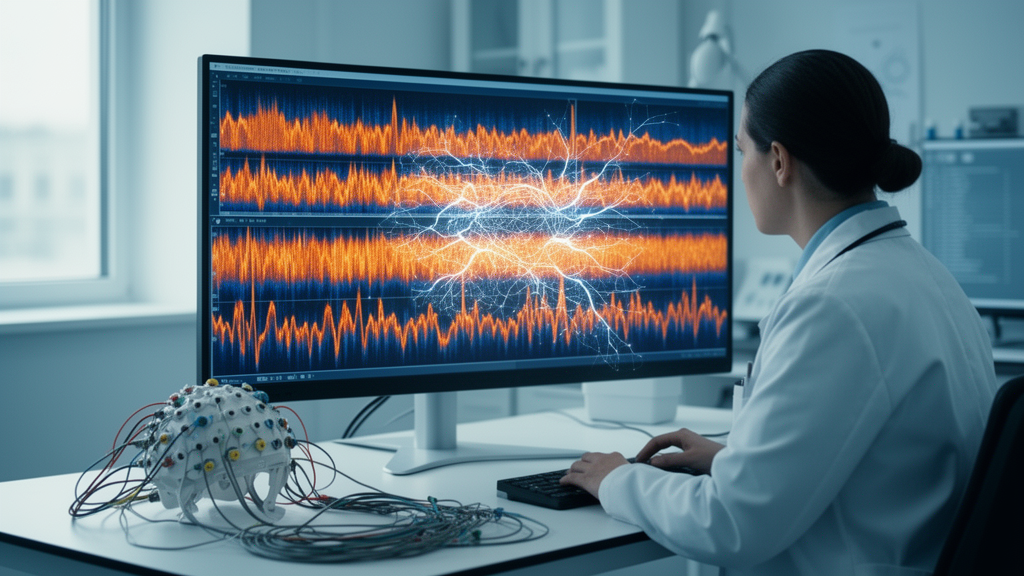
Automated seizure classification from electroencephalography (EEG) has long been hampered by the complexity of brain signals and the way seizure patterns differ from one patient to another. A new study reports that converting EEG recordings into two-dimensional time-frequency images and feeding them to deep learning models can improve the classification of seizure types, with the best configurations reaching accuracies of roughly 78 to 80 percent.

The research, published in BioData Mining, used EEG data from the Temple University Hospital (TUH v2.0.1) dataset covering three signal categories: background activity, focal seizures, and generalized seizures. The signals were first pre-processed and segmented, and each segment was then transformed into a two-dimensional time-frequency image using one of three techniques: the Short-Time Fourier Transform (STFT), the Mel-spectrogram, and the Continuous Wavelet Transform (CWT).

This allows architectures designed for image recognition, such as convolutional neural networks, to be applied directly to EEG data.

The team developed and evaluated nine deep learning architectures for the classification task. The list included AlexNet, VGGNet, a configurable Convolutional Neural Network (cCNN), a configurable Recurrent Neural Network, a configurable Long Short-Term Memory (LSTM) network, a CNN-LSTM hybrid, a CNN with Bidirectional LSTM, a Residual Bidirectional LSTM model, and the Swin Transformer.

Performance was reported across standard metrics including accuracy, precision, recall, F1-score, false positive rate, and area under the curve, together with standard deviations and 95 percent confidence intervals.

Continuous wavelet transform images classified by the configurable CNN achieved an accuracy of 77.22 percent, with a standard deviation of 5.68 percent and a 95 percent confidence interval of 73.32 to 80.55. Mel-spectrogram images classified by AlexNet performed slightly better, reaching 79.83 percent accuracy with a standard deviation of 2.81 percent and a 95 percent confidence interval of 78.20 to 81.41.

The authors conclude that the combination of Mel-based time-frequency features with AlexNet, and of CWT representations with the cCNN model, proved most effective for distinguishing seizure types in this dataset. They suggest that deep learning combined with time-frequency analysis can contribute to the development of reliable EEG-based seizure classification systems.

The study’s scope is worth keeping in mind. The work was conducted on a single hospital dataset with three signal classes, and the reported accuracies, while consistent across the cross-validation folds, still leave room for error in clinical settings. The published version is an early-release, peer-reviewed accepted manuscript that remains subject to further editorial edits before the final version of record appears. The authors present the approach as a step toward automated tools that could eventually assist clinicians in interpreting EEG recordings, rather than as a system ready for immediate diagnostic use.

Subject of Research: Deep learning classification of seizure types from time-frequency representations of EEG signals

Article Title: Deep learning-based EEG seizure classification using comparative time–frequency spectral representations

Article References: Mewada, P., Siddartha, K. M., Kumar, P. S., Gabriel, R., Sainidhi, V. V. S. N., Yuvaraj, R., Thomas, J., Karthik, P. A., & Ronickom, J. F. A. (2026). Deep learning-based EEG seizure classification using comparative time–frequency spectral representations. BioData Mining. https://doi.org/10.1186/s13040-026-00613-6

Image Credits: AI Generated

DOI: 10.1186/s13040-026-00613-6

Keywords: EEG, seizure classification, deep learning, time-frequency analysis, Mel spectrogram, continuous wavelet transform, AlexNet, convolutional neural network, Swin Transformer, Temple University Hospital dataset, epilepsy, cross-validation

Cite Scienmag News

Blake Davidson. (October 28, 2026). Deep learning reads EEG spectrograms to sort seizure types. Scienmag. https://scienmag.com/deep-learning-reads-eeg-spectrograms-to-sort-seizure-types/

Blake Davidson. "Deep learning reads EEG spectrograms to sort seizure types." Scienmag, 28 October 2026, https://scienmag.com/deep-learning-reads-eeg-spectrograms-to-sort-seizure-types/. Accessed 29 October 2026.

Blake Davidson. "Deep learning reads EEG spectrograms to sort seizure types." Scienmag. October 28, 2026. https://scienmag.com/deep-learning-reads-eeg-spectrograms-to-sort-seizure-types/


Tags: AlexNetBidirectional LSTM and Residual Bidirectional LSTM in EEG analysiscontinuous wavelet transformContinuous Wavelet Transform for seizure pattern recognitionconvolutional neural networkconvolutional neural networks for seizure detectioncross-validationdeep learningdeep learning architectures for EEG classificationdeep learning in epileptologyEEGEEG spectrogram analysis for seizure classificationepilepsyhybrid CNN-LSTM models for seizure type identificationmachine learning models for EEG-based seizure typingMel-spectrogramMel-spectrogram application in seizure diagnosisseizure classificationShort-Time Fourier Transform in EEG analysisswinSwin TransformerTemple University Hospital datasettime-frequency analysistime-frequency transformation of EEG signals
Share26Tweet16
Previous Post

Research report: Automated phase recognition in the cardiac catheterization laboratory with deep learning

Next Post

Immune-boosted boron neutron capture therapy shows striking tumor targeting in early study

Related Posts

Radar Point Clouds Get a Reality Check: YOLOv3 Beats Rivals in Landmark Detection Study
Technology and Engineering

Radar Point Clouds Get a Reality Check: YOLOv3 Beats Rivals in Landmark Detection Study

October 29, 2026
Three Decades of Plant Discoveries Reveal Ukraine’s Flora Is Far From Fully Known
Biology

Three Decades of Plant Discoveries Reveal Ukraine’s Flora Is Far From Fully Known

October 29, 2026
Tag arrays bring lossless indexing to large human pangenome graphs
Biotechnology

Tag arrays bring lossless indexing to large human pangenome graphs

October 29, 2026
Javanese coastal joglo houses reveal the spatial secrets of living and working at home
Technology and Engineering

Javanese coastal joglo houses reveal the spatial secrets of living and working at home

October 29, 2026
Neural Stem Cells May Rewire the Immune Response After Spinal Cord Injury
Biology

Neural Stem Cells May Rewire the Immune Response After Spinal Cord Injury

October 29, 2026
Hybrid bee–genetic algorithm tames power flow in renewable and EV grids
Climate

Hybrid bee–genetic algorithm tames power flow in renewable and EV grids

October 29, 2026
Next Post
Immune-boosted boron neutron capture therapy shows striking tumor targeting in early study

Immune-boosted boron neutron capture therapy shows striking tumor targeting in early study

  • Mothers who receive childcare support from maternal grandparents show more optimized

    Mothers who receive childcare support from maternal grandparents show more parental warmth, finds NTU Singapore study

    27656 shares
    Share 11059 Tweet 6912
  • University of Seville Breaks 120-Year-Old Mystery, Revises a Key Einstein Concept

    1061 shares
    Share 424 Tweet 265
  • Bee body mass, pathogens and local climate influence heat tolerance

    682 shares
    Share 273 Tweet 171
  • Researchers record first-ever images and data of a shark experiencing a boat strike

    546 shares
    Share 218 Tweet 137
  • Groundbreaking Clinical Trial Reveals Lubiprostone Enhances Kidney Function

    531 shares
    Share 212 Tweet 133
Science

Embark on a thrilling journey of discovery with Scienmag.com—your ultimate source for cutting-edge breakthroughs. Immerse yourself in a world where curiosity knows no limits and tomorrow’s possibilities become today’s reality!

RECENT NEWS

  • Organic molecular qubit joins photonic chip in push toward scalable quantum computing
  • Science Advances Issues Editorial Expression of Concern Over CNS Injury Paper’s Figures
  • Breathing by the numbers: bedside lung mechanics reshape ARDS ventilation
  • Trial to Test Whether Interactive Exercise Eases Autism Symptoms in Children

Categories

  • Agriculture
  • Anthropology
  • Archaeology
  • Athmospheric
  • Biology
  • Biotechnology
  • Blog
  • Bussines
  • Cancer
  • Chemistry
  • Climate
  • Earth Science
  • Editorial Policy
  • Marine
  • Mathematics
  • Medicine
  • Pediatry
  • Policy
  • Psychology & Psychiatry
  • Science Education
  • Science News
  • Social Science
  • Space
  • Technology and Engineering

Subscribe to Blog via Email

Enter your email address to subscribe to this blog and receive notifications of new posts by email.

Join 5,151 other subscribers

© 2025 Scienmag - Science Magazine

Welcome Back!

Login to your account below

Forgotten Password?

Retrieve your password

Please enter your username or email address to reset your password.

Log In
No Result
View All Result
  • HOME
  • SCIENCE NEWS
  • CONTACT US

© 2025 Scienmag - Science Magazine

Discover more from Science

Subscribe now to keep reading and get access to the full archive.

Continue reading