
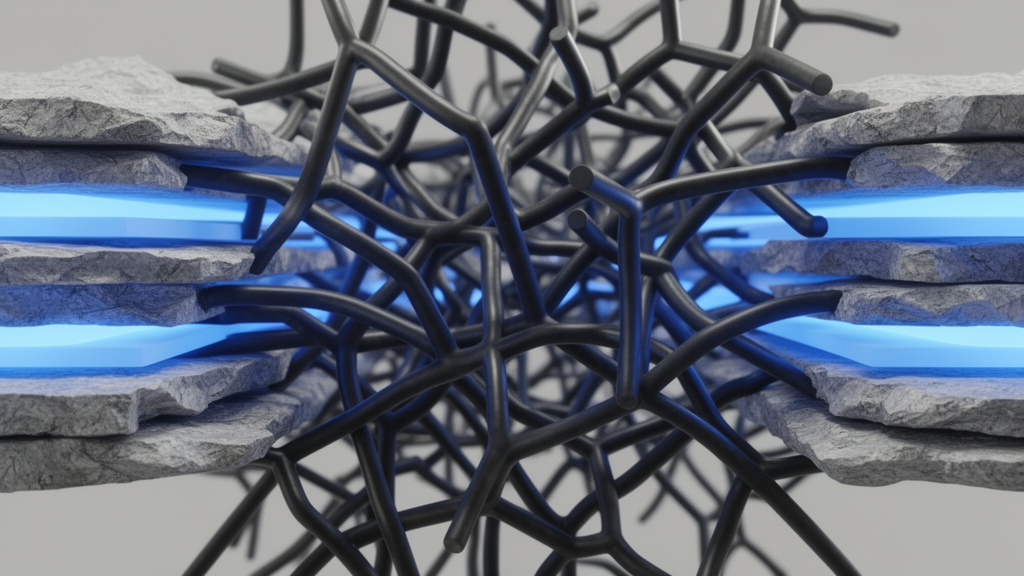
Carbon nanotubes have been added in unusually high concentrations to a thallium-based high-temperature superconductor, and the results reveal a delicate trade-off: the nanotubes appear to heal the boundaries between superconducting grains while simultaneously suppressing the temperature at which the material superconducts. Researchers synthesized composites of the formula (CNT)x/Cu1/2Tl1/2Ba2Ca3Cu4O12−δ, with carbon nanotube additions of 0, 2.5, 5, 7.5 and 10 weight percent, using a two-step solid-state reaction carried out at 900 degrees Celsius. The work, published in Discover Condensed Matter, examined how the nanotubes alter crystal structure, electrical transport, vibrational spectra, microstructure and dielectric response across a wide temperature range.
The Cu1/2Tl1/2-1234 phase belongs to the family of high-temperature superconductors, layered cuprates in which CuO2 conducting planes carry the supercurrent. In this particular compound, the conducting planes are fed by a Cu1/2Tl1/2Ba2O4−δ charge reservoir block whose charge transfer controls the carrier concentration in the planes. The lattice structure and interlayer coupling influence superconducting pairing, while the connectivity between neighboring grains governs how supercurrent moves through the bulk material. Like all oxide high-temperature superconductors, the compound is polycrystalline, meaning its crystals fuse together at grain termination ends, where large composition variations and voids tend to form and degrade the superconducting properties of the final compound.
Carbon is a persistent contaminant in these materials. It enters inadvertently during synthesis, either from the starting compounds such as barium carbonate and calcium carbonate or from atmospheric gases like carbon dioxide and carbon monoxide. The research team behind the new study had previously attempted to fill inter-grain voids with carbon nanoparticles at addition concentrations around one weight percent. Carbon nanotubes, one-dimensional molecular conductors that have attracted attention in energy storage, catalysis and biology, were chosen for the present work because they are easy to synthesize and remain stable during the doping process. Their high aspect ratio and excellent electrical conductivity make them candidates for filling inter-grain voids and establishing conductive pathways between superconducting grains.
The synthesis route was deliberately designed to encourage carbon diffusion. In the first step, a precursor was prepared from barium nitrate, calcium nitrate tetrahydrate and copper cyanide, all at 99 percent purity, ground together and fired twice at 900 degrees Celsius for 24 hours in a quartz boat. Carbon nanotubes were then mixed in at the target percentages and the material was calcined for another 24 hours at 900 degrees Celsius. Thallium oxide was added as the final reactant, the mixture was ground, pelletized under a pressure of 3.8 tons per square centimeter, sealed in a gold capsule and sintered at 900 degrees Celsius for just 16 minutes before quenching to room temperature. The gold wrapping prevents the volatile thallium oxide from escaping and maintains an equilibrium vapor pressure that transforms the amorphous phase into the crystalline superconducting phase.
X-ray diffraction showed that all samples retained an orthorhombic crystal structure in the Pmmm space group, with only a small amount of BaCuO2 impurity, which the authors note is common in CuTl phases. The a-axis length decreased with carbon nanotube additions, while the b-axis first contracted at 2.5 weight percent and then recovered at higher loadings, a behavior the researchers attribute to anisotropic lattice relaxation at low carbon content followed by increasing amounts of carbon remaining at grain boundaries as a secondary phase. Crucially, the c-axis length and the unit cell volume decreased monotonically with nanotube additions. The team interprets this contraction as evidence that some carbon from the nanotubes diffuses into the superconducting unit cells from the inter-grain sites, producing a doped version of the compound, most likely at the charge reservoir layer.
Electrical transport measurements told a consistent story. All samples showed metallic behavior in resistivity from room temperature down to the onset of superconductivity, and room-temperature resistivity decreased with nanotube additions. The onset of superconductivity appeared around 116, 114, 113, 111 and 109 kelvin for the 0, 2.5, 5, 7.5 and 10 weight percent samples respectively, while the zero-resistivity critical temperature fell from about 94 kelvin in the pure compound to about 78 kelvin at the highest loading. The researchers argue that the metallic resistivity shows the nanotubes act as a good cementing material at inter-grain sites, while the partial diffusion of carbon into the intra-grain regions deteriorates the superconducting properties. Carbon, being more electronegative than copper, barium and thallium in the charge reservoir layer, is conjectured to suppress the flow of charge to the conducting CuO2 planes.
Fourier transform infrared spectroscopy provided microscopic corroboration. The spectra displayed three prominent vibrational bands: a CuO2 planar oxygen mode near 670 reciprocal centimeters, an apical oxygen mode of the Cu(2)-OA-Tl type between 420 and 480 reciprocal centimeters, and a second apical oxygen mode of the Cu(2)-OA-Cu(1) type near 500 reciprocal centimeters. With increasing nanotube content, the planar mode and the Cu(2)-OA-Tl mode stayed essentially unchanged, but the Cu(2)-OA-Cu(1) mode hardened, shifting in a way the authors describe as direct microscopic evidence of partial carbon inclusion into the unit cell. Scanning electron microscopy added a morphological picture: nanoparticles filled predominantly the inter-grain spaces, the density of inter-grain voids decreased, and grains coarsened and became more interconnected. Quantitative image analysis showed grain refinement up to intermediate compositions, while at 7.5 and 10 weight percent the samples exhibited increased agglomeration, a broader size distribution and more pronounced intergranular voids.
The dielectric measurements, restricted to the 100 to 1000 hertz range where interfacial polarization is active, revealed negative capacitance and hence a negative real dielectric constant in all samples, a feature the authors attribute to differences in effective carrier masses and Fermi levels between the sample interfaces and the metal electrodes, driving carriers toward the metal. The magnitude of the real dielectric constant decreased with nanotube additions and with increasing frequency, and it also decreased as the measurement temperature dropped from room temperature to 79 kelvin, an effect linked to the falling lattice resistivity. The imaginary component, which represents energy dissipation at grain boundaries, localized defects and interfaces, was largest in the nanotube-free samples and shrank with additions, suggesting the nanotubes efficiently heal the inter-grain sites. The loss factor and the alternating-current conductivity followed the same pattern, both highest in the pure samples and suppressed by nanotube loading, which the team links to carbon diffusion lowering the carrier density.
One striking comparison emerged at 100 hertz, where the real dielectric constant was measured in both the superconducting state at 79 kelvin and the normal state at 290 kelvin. In the superconducting state the values were nearly identical across all compositions, whereas the nanotube-added samples showed a large suppression at room temperature. The authors interpret this as evidence that at low frequency the separation of the bosonic superconducting fluid from the static charges of the charge reservoir layer is hardly affected by the added carbon, while the normal electrons at room temperature are influenced far more appreciably. The overall picture is one of a material in which the same additive that degrades the superconducting transition simultaneously tightens the grain boundaries and damps dielectric losses.
The authors are careful about one claim that appears in their abstract and conclusion: that diffused carbon atoms act as efficient pinning centers. In the discussion they note that although partial carbon incorporation into the superconducting lattice may introduce defects capable of acting as potential flux-pinning centers, direct flux-pinning measurements were not performed. The present results, they write, mainly support improved grain connectivity as the origin of the reduced intergranular losses, while enhanced flux pinning remains a possible effect requiring further magnetic-field-dependent investigation. For now, the study establishes that high-percentage carbon nanotube additions in Cu1/2Tl1/2-1234 composites systematically shrink the unit cell, lower both the onset and zero-resistivity critical temperatures, harden a diagnostic apical oxygen phonon mode and suppress the dielectric response, while leaving the metallic normal-state transport intact.
Subject of Research: The effect of carbon nanotube additions on the superconducting and dielectric properties of Cu1/2Tl1/2-1234 superconducting composites
Article Title: Investigating the impact of CNTs addition on superconducting and dielectric properties of Cu1/2Tl1/2-1234 superconductors
Article References: Safeer, S. H., Ali, F., Naseem, K., Khan, N. A., & Safeer, S. Q. (2026). Investigating the impact of CNTs addition on superconducting and dielectric properties of Cu1/2Tl1/2-1234 superconductors. Discover Condensed Matter, 1(1), Article 5. https://doi.org/10.1007/s44570-026-00005-0
Image Credits: AI Generated
DOI: 10.1007/s44570-026-00005-0
Keywords: carbon nanotubes, Cu1/2Tl1/2-1234, high-temperature superconductors, dielectric constants, critical temperature, X-ray diffraction, FTIR spectroscopy, grain boundaries, solid-state reaction, thallium-based cuprates, interfacial polarization, flux pinning
Cite Scienmag News
Charles Cole. (October 27, 2026). Carbon Nanotubes Reshape Superconductivity in Thallium-Based Cuprate Composites. Scienmag. https://scienmag.com/carbon-nanotubes-reshape-superconductivity-in-thallium-based-cuprate-composites/
Charles Cole. "Carbon Nanotubes Reshape Superconductivity in Thallium-Based Cuprate Composites." Scienmag, 27 October 2026, https://scienmag.com/carbon-nanotubes-reshape-superconductivity-in-thallium-based-cuprate-composites/. Accessed 28 October 2026.
Charles Cole. "Carbon Nanotubes Reshape Superconductivity in Thallium-Based Cuprate Composites." Scienmag. October 27, 2026. https://scienmag.com/carbon-nanotubes-reshape-superconductivity-in-thallium-based-cuprate-composites/