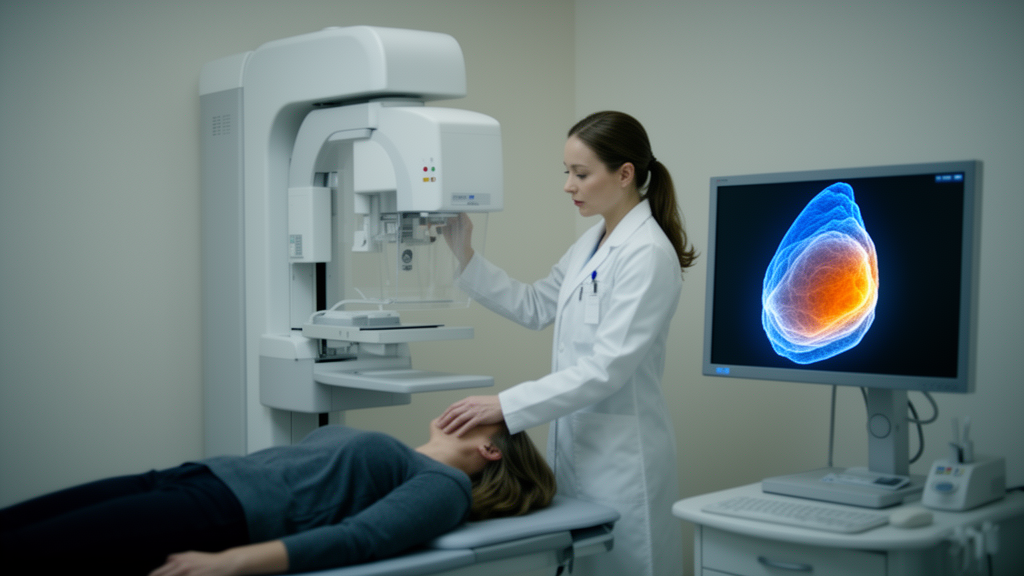
Contrast-enhanced stereotactic breast biopsy delivers an estimated mean average glandular dose of 22.8 milligray, and when the prerequisite contrast-enhanced mammography is included, the cumulative dose reaches 28.9 milligray per biopsied breast, according to a prospective single-center observational study published in European Radiology Breast. The analysis, drawn from a registered cohort of 62 women with lesions visible only on recombined contrast-enhanced mammography images, breaks the radiation exposure down step by step and points to specific imaging acquisitions that could be trimmed without, as the authors emphasize, any evidence yet of clinical harm from doing so.
Contrast-enhanced mammography uses an intravenous iodinated contrast agent to reveal enhancement of potentially malignant lesions, much like breast MRI. Some lesions detected this way are so-called recombined-only lesions: they appear exclusively on the recombined images created by subtracting low-energy from high-energy exposures and have no discernible substrate on low-energy mammography, digital breast tomosynthesis, or targeted ultrasound. Because malignancy rates in such lesions have been reported to range from 23.9 to 66.7 percent, histological sampling is necessary. Until recently, MRI-guided biopsy was the most common route to obtain tissue from these lesions, but since 2020 several vendors have introduced contrast-enhanced stereotactic biopsy on mammography units, offering an alternative that avoids consuming scarce MRI capacity, shortens procedure time, and lowers cost.
The study, a secondary analysis of a prospective cohort registered at ClinicalTrials.gov as NCT06062992, recruited participants between October 2023 and July 2025. Women aged 18 or older with recombined-only lesions on contrast-enhanced mammography were eligible; lesions had to be invisible on low-energy images, tomosynthesis where performed, and targeted ultrasound. Of 65 patients enrolled, three procedures were abandoned because the target could not be seen on scout images, leaving 62 participants in the dose analysis, 54 of whom had undergone the preceding contrast-enhanced mammography at the study institution. The mean age was 58 years, 52 percent had dense breasts of ACR type C or D, and the mean compressed breast thickness was 52 millimeters. Most biopsies, 85 percent, used a craniocaudal approach with a 9-gauge vacuum-assisted needle.
All biopsies were performed on a single Hologic 3Dimensions mammography unit equipped with contrast biopsy software, following the vendor-recommended protocol. That protocol calls for at least one scout image taken at least two minutes after contrast injection, paired images at plus and minus 15 degrees for target selection, paired pre-fire views after needle insertion but before final advancement, paired post-fire views after the needle has been advanced into the target, and paired post-marker placement views, all in dual-energy mode. Dose values for each patient and each procedural step were extracted from DICOM headers via the dose-management system, and missing steps were imputed conservatively using the highest-dose acquisition from the paired images within the same procedure.
The researchers validated the unit’s reported dose values against phantom measurements using a 45-millimeter polymethyl methacrylate phantom and a solid-state detector. Because the system calculates average glandular dose with the Dance model, the team compared system-reported values with doses computed from measured entrance air kerma and half-value layer. The phantom-based values came out 6.0 percent lower for low-energy exposures and 4.3 percent lower for high-energy exposures, meaning the manufacturer’s output slightly overestimates glandular dose, a caveat the authors flag for interpreting their absolute numbers.
The stepwise results show where the dose accumulates. Scout images averaged 2.7 milligray, while each complete paired acquisition, combining the plus and minus 15 degree views, averaged about 5.0 milligray. Low-energy exposures dominated the total, contributing 82 percent of the biopsy dose and 77 percent of the mammography dose, consistent with prior clinical and phantom data. Dose rose exponentially with compressed breast thickness, corroborating established evidence, and 61 of the 62 biopsies fell within a range of 12.2 to 41.4 milligray. The single outlier, at 51.2 milligray, occurred in a patient with the second-highest breast thickness in the cohort, 74 millimeters, combined with ACR type C density. The only adverse event during biopsy was one vasovagal syncope after 11 cores were taken, which led to premature termination without marker placement.
The most consequential finding concerns two steps that may be expendable. Paired post-fire acquisitions contributed a mean of 5.0 milligray yet were not followed by needle repositioning in any of the 62 procedures, suggesting that routine post-fire imaging may merit re-evaluation, although the authors are careful to note that their data do not establish the technical equivalence or clinical safety of omitting the step. Marker-deployment acquisitions, meanwhile, were performed at a median of 12 minutes and 29 seconds after the scout image, with the earliest occurring 9 minutes and 44 seconds after the scout, more than 11 minutes after contrast injection. That places them entirely outside the commonly cited 2-to-10-minute diagnostic window for contrast-enhanced mammography, and post-biopsy changes such as hematomas may further undermine the diagnostic value of the recombined image, suggesting limited value in dual-energy post-marker imaging.
Building on these observations, the authors propose a refined protocol that omits the post-fire acquisition and limits post-marker imaging to the low-energy acquisition only. This adjustment would cut the mean biopsy dose by 6.0 milligray, from 22.8 to 16.9 milligray, a 26 percent reduction. They also note that digital breast tomosynthesis could serve as a post-marker verification step for slightly lower doses still, though they currently lack empirical data to substantiate that option within this study. In risk terms, using lifetime attributable risk factors from the BEIR VII committee, a mean biopsy dose of 22.8 milligray corresponds to an estimated additional lifetime risk of breast cancer incidence of 32.1, 16.0, and 7.1 per 100,000 women aged 40, 50, and 60 respectively, and of breast cancer-related mortality of 8.0, 4.3, and 2.1 per 100,000, figures that are small against baseline lifetime risks of roughly 12,000 cases and 3,000 deaths per 100,000 women, and which the proposed refinement could potentially reduce by about a quarter.
Context with earlier literature supports the plausibility of the numbers. The cohort’s mean mammography dose of 6.1 milligray per breast exceeds the 4.2 to 4.9 milligray reported in prior studies performed predominantly on a GE Senographe Pristina, a difference the authors attribute to system choice and patient build, citing phantom work suggesting the Hologic unit may require up to roughly 50 percent higher dose in dual-energy mode under matched conditions. Their biopsy dose of 22.8 milligray is comparable to the 20.6 milligray reported by Layden and colleagues in a 15-patient cohort on a GE system, and higher than the 11.8 milligray reported by Alcantara and colleagues, whose cohort had a mean compressed breast thickness of 41 millimeters versus 52 millimeters here, and the 14.8 milligray reported by Sammara and colleagues across 69 procedures.
The authors acknowledge several limitations. The Dance model underlying the dose calculations is validated for full-breast exposures rather than the collimated fields used in stereotactic biopsy, which may overestimate true glandular dose, and no widely accepted alternative model exists for this setting, though the relative comparisons between protocol variants remain valid even if absolute values are biased. The conservative imputation strategy may also bias absolute doses upward. Finally, as a single-center study using one mammography unit model, the absolute doses may not generalize to other vendors and clinical settings, although the relative reduction achievable through the proposed protocol refinement is likely transferable. Within those bounds, the study delivers a detailed accounting of where radiation is spent during an increasingly adopted procedure, and a concrete, testable target for reducing it.
Subject of Research: Radiation dose quantification of contrast-enhanced stereotactic breast biopsy and identification of procedural steps for dose reduction
Article Title: Quantifying radiation exposure in contrast-enhanced stereotactic breast biopsy: considerations for dose optimization
Article References: Theunissen, J. E. M., van Haren, L. M. A. A., Berendsen, R. C. M., van Grinsven, B. R. N., Vissers, Y. L. J., Valentijn-Morsing, A., Lobbes, M. B. I., & Bouwman, L. (2026). Quantifying radiation exposure in contrast-enhanced stereotactic breast biopsy: considerations for dose optimization. European Radiology Breast, 1(1), Article 2. https://doi.org/10.1007/s44502-026-00002-z
Image Credits: AI Generated
DOI: 10.1007/s44502-026-00002-z
Keywords: contrast-enhanced mammography, stereotactic breast biopsy, average glandular dose, radiation dose optimization, recombined-only lesions, dose reduction, dual-energy imaging, breast cancer diagnosis, mammography, observational study, Quantifying, radiation
Cite Scienmag News
Ophelia Keating. (October 27, 2026). Breast Biopsy Radiation Dose Mapped Step by Step, Revealing a 26% Cut. Scienmag. https://scienmag.com/breast-biopsy-radiation-dose-mapped-step-by-step-revealing-a-26-cut/
Ophelia Keating. "Breast Biopsy Radiation Dose Mapped Step by Step, Revealing a 26% Cut." Scienmag, 27 October 2026, https://scienmag.com/breast-biopsy-radiation-dose-mapped-step-by-step-revealing-a-26-cut/. Accessed 28 October 2026.
Ophelia Keating. "Breast Biopsy Radiation Dose Mapped Step by Step, Revealing a 26% Cut." Scienmag. October 27, 2026. https://scienmag.com/breast-biopsy-radiation-dose-mapped-step-by-step-revealing-a-26-cut/