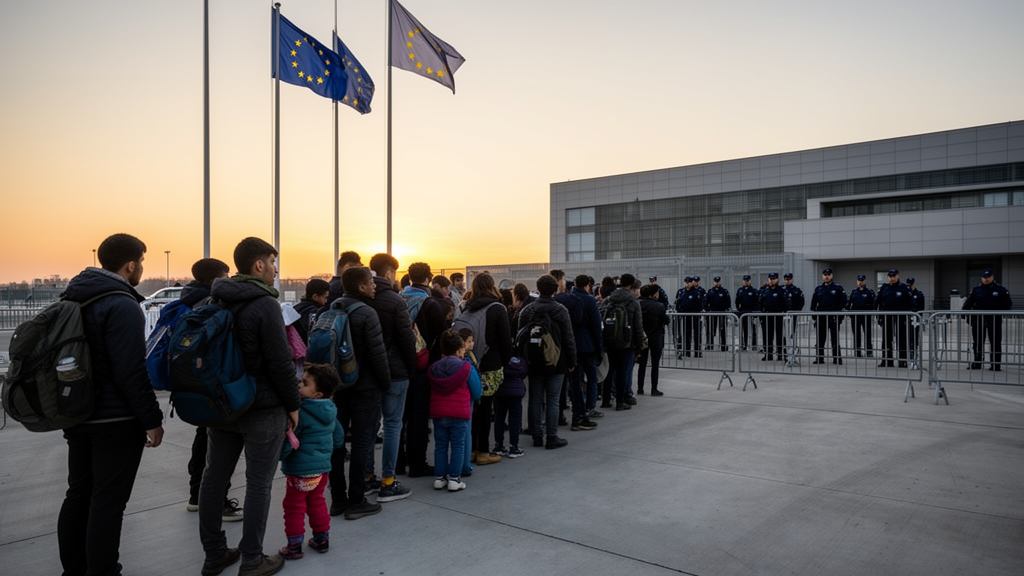
Disparities in how states share responsibility for refugees are not merely unequal but highly inequitable, according to a new open-access analysis published in Comparative Migration Studies by Eiko Thielemann. The paper argues that these inequities can be expected to undermine both the scope and the quality of the protection that states are willing to provide, and it traces how European governments have struggled to address them across decades of forced displacement.
Drawing on Europe’s responses to forced displacement from the former Yugoslavia through to Ukraine, the study demonstrates empirically that European states have repeatedly failed to effectively correct the highly inequitable distribution of refugee responsibilities.
A central finding is that European Union policy makers find it easier to develop symbolic solidarity measures than to establish substantive policy responses.
The reason for this failure, the author argues, lies in a fundamental ethical trilemma. Substantive refugee solidarity initiatives, such as quota-based relocation schemes, may be promising from an equity perspective, but they pose serious challenges to two other values at the heart of the protection system: the national sovereignty of states and the individual autonomy of protection seekers themselves. Relocation quotas that distribute asylum seekers across member states touch directly on governments’ control over their own territories and admission decisions, while mandatory movement can also constrain the choices of the people being relocated.
This three-way tension between equity, sovereignty and autonomy, the paper suggests, explains why meaningful responsibility sharing has remained so elusive in Europe. Measures that satisfy one of the three values tend to come at the expense of the others, leaving policy makers with a set of options in which every substantive solution carries a political or ethical cost.
The study frames the question of how future EU policies will address these solidarity dilemmas as a decisive test. In the author’s assessment, the choices the Union makes in resolving these dilemmas, which lie at the heart of international refugee responsibility-sharing efforts, will reveal much about its commitment to effective refugee protection. The article is published as peer-reviewed, accepted research under open access, with a version of record to follow.
Subject of Research: The ethical trilemma in refugee protection, examining how equity, national sovereignty and the autonomy of protection seekers shape European refugee responsibility-sharing.
Article Title: The ethical trilemma in refugee protection: equity, sovereignty, autonomy
Article References: Thielemann, E. (2026). The ethical trilemma in refugee protection: equity, sovereignty, autonomy. Comparative Migration Studies. https://doi.org/10.1186/s40878-026-00596-7
Image Credits: AI Generated
DOI: 10.1186/s40878-026-00596-7
Keywords: refugee protection, EU policy, responsibility sharing, solidarity, relocation quotas, collective action, former Yugoslavia, Ukraine, sovereignty, asylum seekers, Comparative Migration Studies, ethical
Cite Scienmag News
Courtney Benton. (October 27, 2026). Europe’s refugee solidarity dilemma: equity clashes with sovereignty and autonomy. Scienmag. https://scienmag.com/europes-refugee-solidarity-dilemma-equity-clashes-with-sovereignty-and-autonomy/
Courtney Benton. "Europe’s refugee solidarity dilemma: equity clashes with sovereignty and autonomy." Scienmag, 27 October 2026, https://scienmag.com/europes-refugee-solidarity-dilemma-equity-clashes-with-sovereignty-and-autonomy/. Accessed 28 October 2026.
Courtney Benton. "Europe’s refugee solidarity dilemma: equity clashes with sovereignty and autonomy." Scienmag. October 27, 2026. https://scienmag.com/europes-refugee-solidarity-dilemma-equity-clashes-with-sovereignty-and-autonomy/