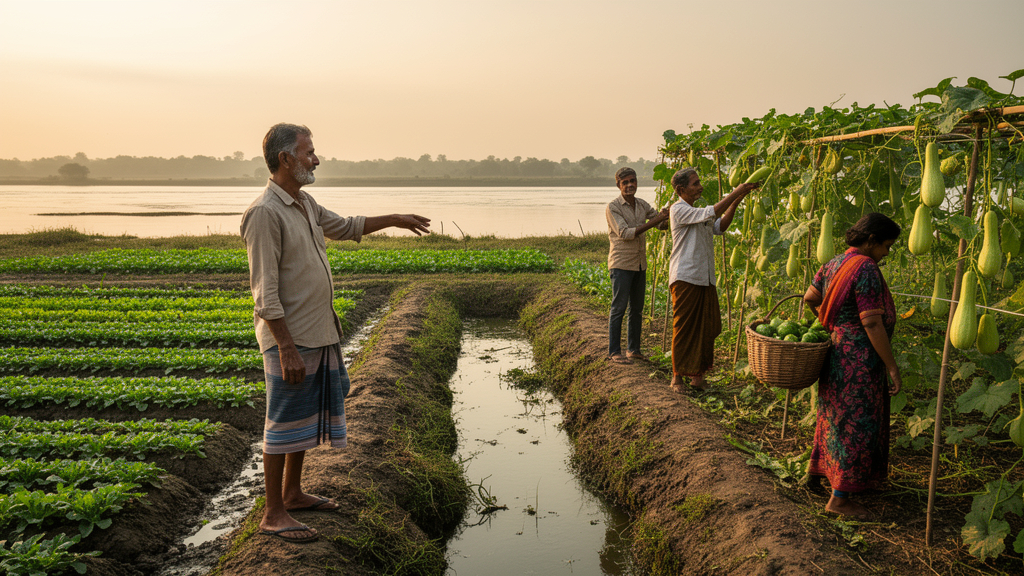
Farmers living on the shifting riverine islands known as chars in Bangladesh generally view government and non-government agricultural interventions favorably, though few describe themselves as highly satisfied, according to a survey of beneficiary farmers in Jamalpur district. The study, published as open access research in Discover Sustainability, found that 85.4 percent of respondents reported medium satisfaction with project-based interventions, while 11.7 percent reported high satisfaction and 2.9 percent reported low satisfaction. Between July 12 and August 10, 2023, researchers conducted structured interviews with 103 randomly selected beneficiary farmers in two char villages of Sadar Upazila.
Participants rated their satisfaction on a four-point scale, and the team also collected information on implementation problems farmers faced. Char communities are considered among the most vulnerable rural populations in Bangladesh, which has motivated many organizations to launch agricultural projects aimed at improving livelihoods on these flood-prone lands. To identify what drives satisfaction, the researchers used linear regression analysis.
Three factors emerged as the most influential: education, training received, and social mobility. Farmers with more education, more exposure to project training, and greater ability to move within social and economic networks reported higher satisfaction with the interventions they received. Despite the generally positive assessments, farmers described concrete obstacles that limited the usefulness of the projects.
The most commonly reported difficulties were inadequate crop-specific training, limited access to finance, and weak irrigation management. The authors conclude that the Department of Agricultural Extension and policymakers should prioritize strengthening the quality of training, expanding financial support for farmers, and upgrading irrigation facilities. Such steps, they argue, could raise satisfaction levels and help sustain livelihood improvements for char land farmers.
Because the findings come from a cross-sectional survey of 103 farmers in two villages of a single upazila, they describe perceptions in that specific setting during the 2023 interview window rather than measured changes in income or productivity, and the authors present the satisfaction categories as farmers' reported perceptions, indicating generally positive but not optimal views of the interventions.
Subject of Research: Farmers' satisfaction with agricultural interventions in the char areas of Bangladesh
Article Title: Assessing farmers’ satisfaction with agricultural interventions in char areas of Bangladesh
Article References: Uddin, M. N., Mashraki, S., Hoque, M. J., & Rahman, S. (2026). Assessing farmers’ satisfaction with agricultural interventions in char areas of Bangladesh. Discover Sustainability. https://doi.org/10.1007/s43621-026-04630-7
Image Credits: AI Generated
DOI: 10.1007/s43621-026-04630-7
Keywords: Bangladesh, char areas, agricultural interventions, farmer satisfaction, rural livelihoods, agricultural extension, training, irrigation, access to finance, Jamalpur district, survey research, Assessing
Cite Scienmag News
Violet Maxwell. (October 27, 2026). Char Farmers in Bangladesh Rate Agricultural Projects Positively but See Room to Improve. Scienmag. https://scienmag.com/char-farmers-in-bangladesh-rate-agricultural-projects-positively-but-see-room-to-improve/
Violet Maxwell. "Char Farmers in Bangladesh Rate Agricultural Projects Positively but See Room to Improve." Scienmag, 27 October 2026, https://scienmag.com/char-farmers-in-bangladesh-rate-agricultural-projects-positively-but-see-room-to-improve/. Accessed 28 October 2026.
Violet Maxwell. "Char Farmers in Bangladesh Rate Agricultural Projects Positively but See Room to Improve." Scienmag. October 27, 2026. https://scienmag.com/char-farmers-in-bangladesh-rate-agricultural-projects-positively-but-see-room-to-improve/