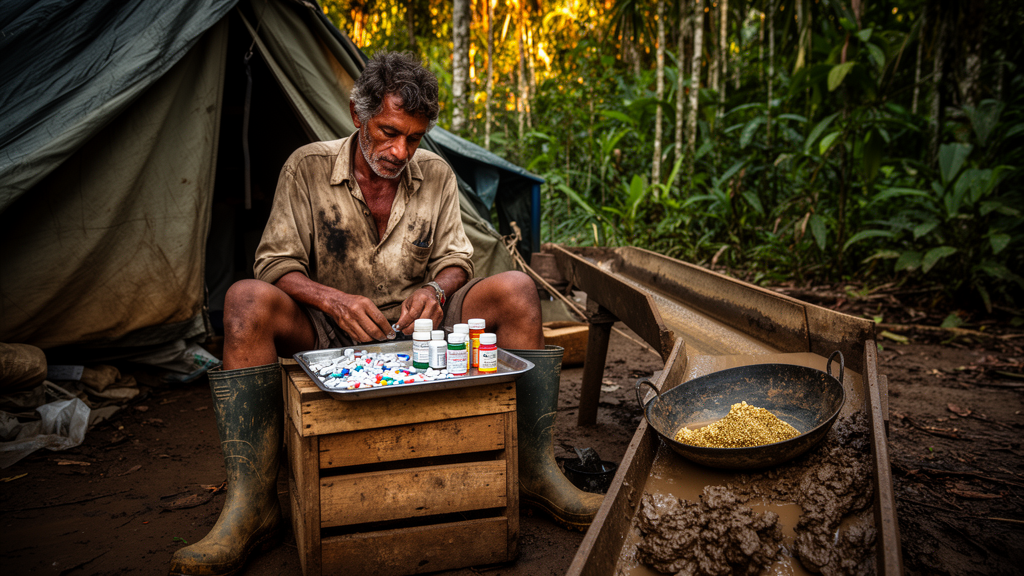
Most people working on illegal gold mining sites in French Guiana treat themselves with medicines bought without a prescription, according to two cross-sectional surveys carried out as part of the Curema project between 2022 and 2025. Among 1,019 adults interviewed at ten cross-border sites along the Maroni and Oyapock rivers, 71.1 percent reported self-medicating in the 2022 survey and 66.9 percent in the 2024–2025 survey, a difference the researchers describe as not statistically significant. The study, published in BMC Public Health, recruited adults who had worked on an illegal gold mining site in the previous seven days.
Because these sites are informal and often remote, participants were reached through chance encounters and snowball sampling rather than random population sampling, and all were interviewed face-to-face using the same self-medication question. The medicines involved were classified by their Anatomical Therapeutic Chemical code, route of administration, regulatory status in France and Brazil, and, in the later survey only, by supply channel. Analgesics dominated the picture.
Paracetamol use rose from 13.0 percent of self-medicating participants in 2022 to 24.8 percent in 2024–2025, while the anti-inflammatory diclofenac fell from 7.9 percent to 4.8 percent. Antibiotics showed the sharpest change, dropping from 39.4 percent to 8.4 percent of those who self-medicated. That decline in antibiotic self-medication is notable because unprescribed antibiotics are a recognised driver of antimicrobial resistance, a concern the authors flag even as they report the improvement.
In the 2024–2025 survey, the leading reasons for self-medication were headache, reported by 23.0 percent of participants, musculoskeletal pain at 17.5 percent, and fever at 14.2 percent. Supply channels split between formal and informal routes. In the later survey, 66.3 percent of participants obtained their medicines from pharmacies in Brazil, Suriname, or French Guiana, while 33.8 percent relied on informal channels.
The cross-border geography matters here: the mining sites sit along rivers that form the borders with Suriname and Brazil, giving workers access to pharmacies operating under different regulatory regimes. The regulatory contrast produced some of the study's most concerning findings. Participants reported using medicines that had been withdrawn from the French market for safety reasons, as well as injectable medicines, which rose from 5.1 percent in 2022 to 9.2 percent in 2024–2025, and treatments that normally require medical supervision.
Injectable use outside clinical settings carries risks of infection at the injection site and of unsafe administration practices, while medicines withdrawn in France may pose hazards that led to their removal in the first place. The authors point to a cluster of potential harms from these practices: exposure to substandard or falsified products, adverse drug effects, treatment failure, and injection-related infections. None of these outcomes was directly measured in the surveys, which recorded reported behaviour rather than clinical consequences, so the risk profile is an inference from the patterns of use rather than a documented burden of harm.
Statistically, the picture was remarkably stable. No factor was consistently associated with self-medication across both surveys, meaning the researchers could not identify demographic or occupational characteristics that reliably predicted who self-medicated. Prevalence estimates were compared using the chi-square test, and associated factors were explored with univariate logistic regression, an approach that examines each variable individually rather than adjusting for others simultaneously.
The team concludes that self-medication is widespread in this population and that further research should assess whether the practice reflects barriers to healthcare access, information that would inform risk-reduction strategies adapted to the context of illegal mining sites. Until such work clarifies the drivers, the surveys stand as a baseline measurement of medicine use in a population that formal health services rarely reach, documenting both an encouraging fall in antibiotic self-medication and persistent exposure to informally sourced and injectable medicines.
Subject of Research: Self-medication prevalence and medicine supply channels among artisanal gold mining workers in French Guiana
Article Title: Self-medication practices and medicine supply channels among individuals working in gold mining in French Guiana (2022–2025)
Article References: Le Querriou, R., Lambert, Y., Petit-Sinturel, M., Plessis, L., Bardon, T., Rabier, S., Suarez-Mutis, M., Vreden, S., Müller, J., Bordalo-Miller, J., Adenis, A., Nacher, M., Carboni, C., Sanna, A., & Douine, M. (2026). Self-medication practices and medicine supply channels among individuals working in gold mining in French Guiana (2022–2025). BMC Public Health. https://doi.org/10.1186/s12889-026-30067-8
Image Credits: AI Generated
DOI: 10.1186/s12889-026-30067-8
Keywords: self-medication, gold mining, French Guiana, antibiotics, antimicrobial resistance, pharmacies, informal medicine supply, injectable medicines, cross-sectional survey, public health, BMC Public Health, Curema project
Cite Scienmag News
Ophelia Keating. (October 27, 2026). Self-medication is widespread among illegal gold miners in French Guiana, survey finds. Scienmag. https://scienmag.com/self-medication-is-widespread-among-illegal-gold-miners-in-french-guiana-survey-finds/
Ophelia Keating. "Self-medication is widespread among illegal gold miners in French Guiana, survey finds." Scienmag, 27 October 2026, https://scienmag.com/self-medication-is-widespread-among-illegal-gold-miners-in-french-guiana-survey-finds/. Accessed 28 October 2026.
Ophelia Keating. "Self-medication is widespread among illegal gold miners in French Guiana, survey finds." Scienmag. October 27, 2026. https://scienmag.com/self-medication-is-widespread-among-illegal-gold-miners-in-french-guiana-survey-finds/