


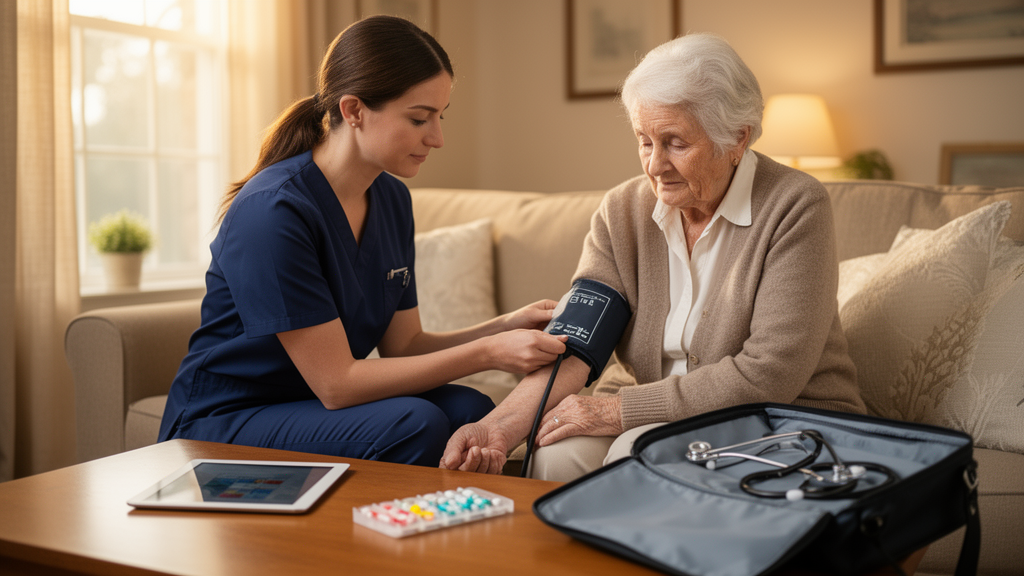
Nurse-led mobile health interventions can meaningfully improve outcomes for people living with heart failure, according to a systematic review and meta-analysis of randomized controlled trials published in BMC Nursing. Pooling data from 11 trials involving 2,437 adult patients, the researchers found that these nurse-delivered digital programs significantly reduced hospital readmissions and emergency department visits while improving self-management, quality of life, and medication adherence.
The analysis, conducted according to the PRISMA 2020 reporting guideline, searched five electronic databases—PubMed, the Cochrane Library, Embase, Scopus, and Web of Science—for randomized controlled trials of nurse-led mHealth interventions in adults with heart failure, covering the literature from inception through May 2026. Two independent reviewers screened studies, extracted data, and assessed risk of bias using the Cochrane Risk of Bias 2.0 tool, and the team used the DerSimonian-Laird random-effects method for the pooled analyses.
The headline result concerned hospital use. Patients receiving nurse-led mHealth interventions were significantly less likely to be readmitted to hospital than those receiving usual care, with a relative risk of 0.78 (95% confidence interval 0.65–0.93, p = 0.005).
The interventions also produced substantial gains in the day-to-day skills that keep heart failure patients stable. Self-management scores improved markedly, with a mean difference of 13.42 points (95% CI 10.18–16.66, p < 0.00001).
Quality of life also improved significantly, with a mean difference of −8.74 points (95% CI −11.53 to −5.95, p < 0.00001), where the negative value reflects a favorable change on the scales used in the included trials. Taken together, the authors report that nurse-delivered mHealth can improve self-management, reduce rehospitalization and emergency department visits, and improve both quality of life and medication adherence in this population.
Not every outcome reached statistical significance. All-cause mortality showed a non-significant trend toward reduction, with a relative risk of 0.82 (95% CI 0.65–1.04, p = 0.10). The confidence interval crosses 1.0, so the pooled data cannot rule out no effect on death, though the point estimate hints at a possible benefit that larger trials would need to confirm.
The researchers also explored whether the type of mobile health technology or the length of follow-up changed the results. In subgroup analyses by intervention type and follow-up duration, effects did not significantly differ, suggesting the benefits were not confined to one particular mHealth modality or time frame.
The authors conclude that these results provide evidence that nurse-led mHealth can be integrated into routine clinical practice for heart failure patients to improve outcomes and reduce health care utilization. Heart failure remains a major driver of hospital readmission and health care burden worldwide, and the review’s authors note that although nurse-led mobile health interventions have been proliferating, no evidence synthesis of this kind previously existed. As with any meta-analysis, the findings reflect the trials included in the pool, and the mortality signal in particular warrants confirmation in further research before firm claims can be made about survival benefits.
Subject of Research: Nurse-led mobile health interventions for self-management and hospital readmission in heart failure patients
Article Title: Effectiveness of nurse-led mobile health (mHealth) interventions on self-management and hospital readmission in patients with heart failure: a systematic review and meta-analysis of randomized controlled trials
Article References: Ma, D., He, J., Yan, C., Tan, D., Quan, X., & Hu, S. (2026). Effectiveness of nurse-led mobile health (mHealth) interventions on self-management and hospital readmission in patients with heart failure: a systematic review and meta-analysis of randomized controlled trials. BMC Nursing. https://doi.org/10.1186/s12912-026-05475-1
Image Credits: AI Generated
DOI: 10.1186/s12912-026-05475-1
Keywords: heart failure, mHealth, nurse-led interventions, systematic review, meta-analysis, hospital readmission, self-management, medication adherence, quality of life, randomized controlled trials, emergency department visits, Effectiveness
Cite Scienmag News
Ophelia Keating. (October 27, 2026). Nurse-led mobile health programs cut heart failure readmissions, meta-analysis finds. Scienmag. https://scienmag.com/nurse-led-mobile-health-programs-cut-heart-failure-readmissions-meta-analysis-finds/
Ophelia Keating. "Nurse-led mobile health programs cut heart failure readmissions, meta-analysis finds." Scienmag, 27 October 2026, https://scienmag.com/nurse-led-mobile-health-programs-cut-heart-failure-readmissions-meta-analysis-finds/. Accessed 27 October 2026.
Ophelia Keating. "Nurse-led mobile health programs cut heart failure readmissions, meta-analysis finds." Scienmag. October 27, 2026. https://scienmag.com/nurse-led-mobile-health-programs-cut-heart-failure-readmissions-meta-analysis-finds/


