


A new species of bolete fungus has been formally described from the mountainous forests of Guizhou Province in southwestern China, based on a combination of detailed morphological examination and multilocus DNA sequencing. The species, named Caloboletus luolongensis after the town of Luolong where it was collected, belongs to the family Boletaceae, an important family of the order Boletales whose members are mostly ectomycorrhizal fungi with significant economic value and taxonomic research significance. The study also adds new collection records and molecular data for a second bolete, Chenrenyua longispora, documenting morphological variation within the species and extending its known distribution.
The new species was found during ongoing surveys of macrofungi in Guizhou. Specimens were collected on 24 September 2025 in Luolong Town, in Daozhen Gelaozu Miaozu Autonomous County of Zunyi City, at an elevation of about 1,347 meters, growing solitary or scattered in mixed forests dominated by Fagaceae trees such as oaks and Castanopsis, together with the pine Pinus massoniana. Two collections of the new species were made, one of which, specimen M83, has been designated the holotype and deposited in the Herbarium of Cryptogams at the Kunming Institute of Botany, Chinese Academy of Sciences.
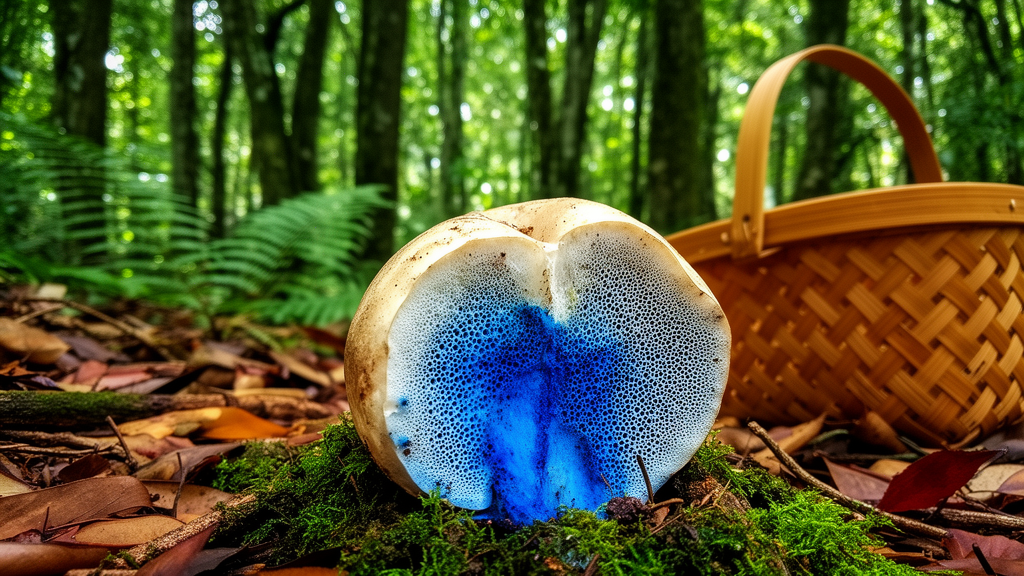
Caloboletus luolongensis produces medium-sized fruiting bodies with caps measuring 6 to 8 centimeters across. The cap surface is dry, pale yellow, finely tomentose and initially rugulose, especially near the margin, which is slightly enrolled. The flesh is pale yellow, 1.3 to 1.7 centimeters thick, and turns light blue quickly when injured, a hallmark reaction of many members of this genus. The pores are angular, 1 to 2 millimeters in diameter, yellowish-white to yellowish-brown, and also shift rapidly to blue when bruised, as do the 4 to 6 millimeter tubes beneath them. The stipe is 8 to 9 centimeters long and 1 to 2 centimeters wide, subcylindrical and solid, bright yellow at the apex, transitioning to rose-red over the middle and lower portions, and yellow again at the base, all covered with a longitudinal reticulation. The species has no distinctive odor, and its taste was not recorded.
Under the microscope, the fungus produces narrowly ellipsoid to subcylindrical, colorless to pale yellow basidiospores measuring roughly 11.9 to 14.9 micrometers long by 5.0 to 6.5 micrometers wide, with a slight suprahilar depression. The basidia are clavate, thin-walled and four-spored, and the cystidia lining the gill edges and pore surfaces are lageniform to fusiform. The cap surface, or pileipellis, consists of interwoven hyphae 4 to 8 micrometers wide encrusted with brown extracellular pigment, while the stipe surface is made of pale yellow parallel hyphae. Clamp connections, small bridges between fungal cells that are useful diagnostic features, are absent in all tissues, and none of the hyphae react with Melzer’s reagent.
These newly generated sequences were aligned together with homologous sequences downloaded from GenBank, producing a concatenated dataset of 2,791 nucleotide positions from 60 sequences. The alignment contained 1,113 distinct patterns, 843 parsimony-informative sites, 85 singleton sites and 1,863 constant sites. Two species of the related genus Rubroboletus served as outgroups to root the resulting trees.
Phylogenetic trees were reconstructed using both maximum likelihood, implemented in RAxML with 1,000 bootstrap replicates, and Bayesian inference in MrBayes, run for 5 million generations with the first 20 percent of sampled trees discarded. The two analyses showed a high degree of topological agreement, differing only in minor statistical support values. Within the well-supported genus Caloboletus, the two Guizhou collections of the new species formed a strongly supported monophyletic lineage with full statistical backing, a bootstrap value of 100 and a posterior probability of 1.00. This lineage is sister to the clade containing Caloboletus griseoflavus, and the combined group falls within a larger assemblage that also includes C. radicans, C. inedulis and C. marshii. The placement clearly separates C. luolongensis from every other known species in the genus.
Independent support for the species’ distinctiveness came from sequence similarity searches against NCBI GenBank. The new species’ nrLSU sequence showed only 97.88 percent identity to its closest match, an unidentified Caloboletus; nrITS showed 92.44 percent identity; tef1-α 95.30 percent; and rpb2 95.32 percent, with the closest rpb2 match being C. radicans. These relatively low similarity values across all four markers are consistent with the interpretation that the Guizhou fungus represents a species not previously described, rather than a minor variant of an existing one.
Morphologically, the new species most closely resembles C. panniformis and C. polygonius, but the authors distinguish it by clear differences. C. panniformis has a reticulate upper stipe that becomes pruinose lower down with a reddish-brown tint toward the base, and its reticulation and pruina appear dull. C. polygonius has a dry cap that cracks into polygonal scales at maturity and a yellow stipe covered with dense reddish fibrils but lacking true reticulation, apart from an occasional faint reticulum at the apex. Other congeners differ even more strikingly: C. taienus and C. xiangtoushanensis have pores ranging from deep red and brownish-red to ruby and from deep orange to reddish-orange respectively, C. griseoflavus has a grayish-white to grayish-brown cap with a yellow stem, C. radicans produces much larger fruiting bodies with caps up to 30 centimeters across and a root-like stipe base, C. marshii has a bulbous, entirely non-reticulate stipe base, and C. inedulis bears conspicuous red reticulation on the stipe and a cap that commonly cracks with age.
The second part of the study concerns Chenrenyua longispora, a species in a recently established bolete genus characterized by a stipe covered with distinct warts, smooth basidiospores and the absence of clamp connections. The genus forms an independent phylogenetic lineage within Boletaceae, distinct from genera such as Caloboletus and Rubroboletus, and includes only two registered names. Two specimens collected at the same Guizhou locality and date as the new Caloboletus were initially suspected to represent an undescribed species of the related genus Rugiboletus, because subtle morphological differences were observed between them and the original description of C. longispora. One specimen has a wrinkled cap with orange-red pores and a thick cylindrical stipe with squamules matching the stipe color, while the other has a cap dusted with a white powdery substance, orange-red pores and a slender, obclavate stipe whose squamules match the pore color. In contrast, the holotype of C. longispora has a hymenophore and context that quickly turn blue when injured and more slender, fusiform basidiospores.
Despite these visible differences, the molecular evidence settled the question. The two Guizhou specimens formed a fully supported monophyletic lineage, clustering together with the type specimen and other authenticated accessions of Chenrenyua longispora with maximum nodal support, confirming their conspecificity. This C. longispora clade is sister to the clade of C. verrucosa, and the two Chenrenyua species together form a well-supported subclade that is phylogenetically sister to the genus Rugiboletus. Chenrenyua longispora was previously known from Zhejiang Province, and the newly documented Guizhou collections extend its recorded distribution to Guizhou while revealing morphological variation beyond the original protologue. According to Index Fungorum, Caloboletus currently includes 22 registered names and Chenrenyua two. The authors note that these findings enrich the species composition of both genera and provide new evidence relevant to understanding the diversification of Boletaceae in East Asia, a region recognized as one of the key hotspots of ectomycorrhizal fungal diversity in the Northern Hemisphere.
Subject of Research: Taxonomic description of a new bolete fungus species and new records of Chenrenyua longispora in Guizhou Province, China, based on morphology and multilocus phylogenetics
Article Title: Caloboletus luolongensis sp. nov. and supplementary notes on Chenrenyua longispora ( Boletaceae ) from Guizhou Province, China
Article References: Mo, X., Qi, Z.-Q., Zhang, Z.-Q., Dai, R., Li, Y.-D., Pei, Y., Li, J.-W., Wen, T.-C., Zhang, W.-P., Zeng, N.-K., & Xu, X.-H. (2026). Caloboletus luolongensis sp. nov. and supplementary notes on Chenrenyua longispora (Boletaceae) from Guizhou Province, China. MycoKeys, 142, 139-155. https://doi.org/10.3897/mycokeys.142.196913
Image Credits: AI Generated
DOI: 10.3897/mycokeys.142.196913
Keywords: Caloboletus luolongensis, Boletaceae, Chenrenyua longispora, Guizhou Province, new species, fungi taxonomy, phylogenetics, ectomycorrhizal fungi, nrITS, rpb2, southwestern China, biodiversity
Cite Scienmag News
Roger Howard. (October 27, 2026). New blue-staining bolete species and new records of recently established genus emerge from Guizhou forests. Scienmag. https://scienmag.com/new-blue-staining-bolete-species-and-new-records-of-recently-established-genus-emerge-from-guizhou-forests/
Roger Howard. "New blue-staining bolete species and new records of recently established genus emerge from Guizhou forests." Scienmag, 27 October 2026, https://scienmag.com/new-blue-staining-bolete-species-and-new-records-of-recently-established-genus-emerge-from-guizhou-forests/. Accessed 27 October 2026.
Roger Howard. "New blue-staining bolete species and new records of recently established genus emerge from Guizhou forests." Scienmag. October 27, 2026. https://scienmag.com/new-blue-staining-bolete-species-and-new-records-of-recently-established-genus-emerge-from-guizhou-forests/


