


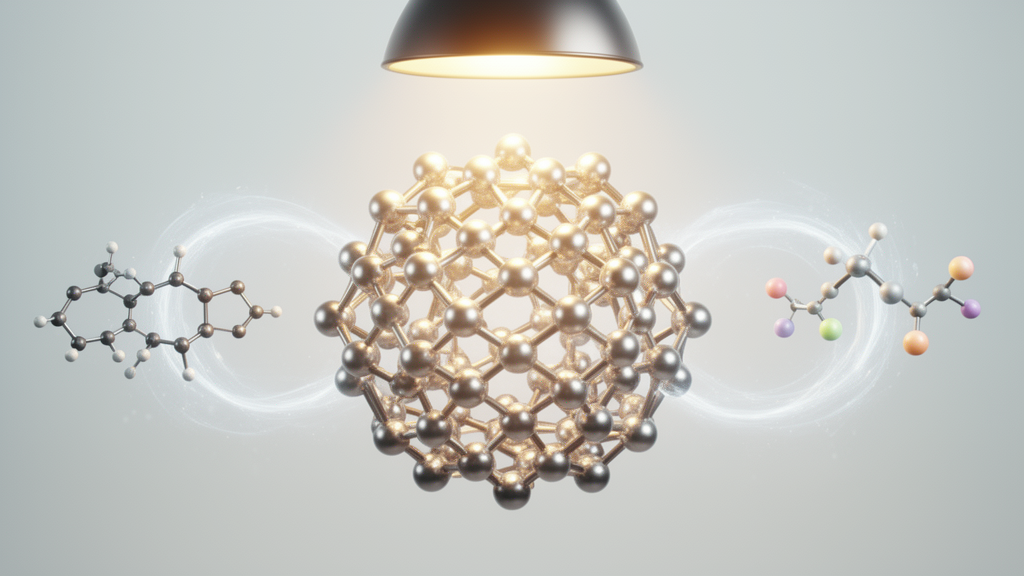
Chemists have built a hybrid photocatalyst that combines a metal-organic framework, a covalent triazine framework, and silver nanoparticles into a single material capable of driving a multi-step organic synthesis using nothing more than visible light, water and ethanol as solvent, and ammonium formate as the hydrogen source. The new composite, named Ag/NH2-MIL-101(Fe)@CTF, converts nitroarenes into anilines under a 20-watt white LED at room temperature and then, in the same vessel, channels those anilines into polysubstituted pyrroles together with acetylacetone and trans-β-nitrostyrene. Under optimized conditions the model reaction reached an isolated yield of 97 percent, and the catalyst could be recovered and reused for five consecutive runs without a significant drop in performance.
The work, published in Results in Chemistry, addresses a long-standing tension in heterocyclic chemistry. Pyrroles are among the most important nitrogen-containing heterocycles, appearing as structural motifs in chlorophyll, vitamin B12, heme, bile pigments such as bilirubin and biliverdin, marine alkaloids, and molecules like pyrroloquinoline quinone, ryanodine, lamellarin, prodigiosin and sceptrin. Substituted pyrroles also show encouraging anti-inflammatory and antibacterial properties, and one polysubstituted pyrrole derivative acts as a selective inhibitor of the cyclooxygenase-2 enzyme. Because of this biological value, chemists have developed many routes to functionalized pyrroles, including the Paal–Knorr condensation, the Buchwald–Hartwig coupling, the Hantzsch and Knorr reactions, and the Van Leusen reaction, which uses TosMIC as a C3 synthon in a base-promoted [3 + 2] cycloaddition with electron-deficient alkenes.
Those classical methods, however, carry familiar burdens: multistep operations, limited substrate scope, unavailable starting materials, reduced yields, unwanted by-products and functional-group compatibility problems. Multicomponent reactions offer a way around some of these issues by converging three or more reactants into a single product, cutting reaction time, energy consumption and cost while improving atom economy and ease of purification. Earlier examples include a one-pot three-component pyrrole synthesis in reusable lactic acid reported by Algul and co-workers, iodine-catalyzed cascade reactions of 1,3-dicarbonyl compounds with ethyl secondary amines developed by Jie-Ping Wan’s group, and Grob–Camenisch type couplings of nitroalkenes, amines and 1,3-dicarbonyl compounds. Photoredox catalysis has recently widened the field further, with Xiao’s group building multi-substituted pyrroles from 2H-azirines and activated alkynes, and Yongqi Yu and colleagues reporting a visible-light [3 + 2] photocatalytic cyclization of N-aryl glycinates with 2-benzylidenemalononitrile.
The new study takes a different entry point: nitrobenzene itself. Nitroarenes are cheap and abundant, and several known pyrrole syntheses use nitrobenzene as a starting material that is reduced during the reaction. Reducing nitroarenes cleanly is itself a challenge. The classical Bechamp reduction with iron powder and hydrochloric acid produces an iron slurry that is difficult to dispose of, while catalytic hydrogenation with H2 demands elevated pressure and temperature and typically relies on transition metals such as nickel and copper or noble metals such as gold, palladium and platinum. Photocatalysts have attracted growing interest for this transformation because of their activity, selectivity and ease of use. Previous visible-light approaches include Wu and colleagues’ 2014 homogeneous reduction using eosin Y with triethanolamine as reductant, and Bezaatpour and co-workers’ photoreduction of nitroarenes with rGO/BiVO4 under low-power visible light with hydrazine hydrate at room temperature.
Formic acid and its salts have emerged as attractive reductants for this chemistry. Formic acid is a common industrial chemical with promise as a hydrogen carrier, and light-induced hydrogen atom transfer from formate salts can generate the carbon dioxide radical anion, a species useful as a reductant or carbonyl source. Bin-Dong Li and co-workers reported in 2024 a visible-light-promoted reduction of nitroarenes in which formate salt served as the reductant and the carbon dioxide radical anion acted as the key intermediate. A major limitation of many photocatalysts, however, is that they absorb only ultraviolet light, even though the visible portion of the solar spectrum carries more than half of the sun’s energy. Nanoparticles of platinum, copper, silver and gold overcome this through the surface plasmon resonance effect, which lets them absorb visible light efficiently; Manirul Islam’s group showed in 2020 that an Ag/TFPG-DMB COF could drive a one-pot nitroarene reduction and formylation under sunlight.
First they prepared the iron-based MOF NH2-MIL-101(Fe) solvothermally from iron(III) chloride hexahydrate and 2-aminoterephthalic acid in dimethylformamide at 110 °C for 20 hours. They then grafted a covalent triazine framework onto the MOF surface using 2,4,6-trichloro-1,3,5-triazine, 6-methyl-1,3,5-triazine-2,4-diamine and potassium carbonate, and finally decorated the composite with polyvinylpyrrolidone-stabilized silver nanoparticles reduced from silver nitrate by sodium borohydride. Characterization by FTIR, powder X-ray diffraction, TGA, FE-SEM, TEM, EDS and nitrogen adsorption confirmed each step. Electron microscopy showed the CTF coating the octahedral MOF particles and the silver nanoparticles spread relatively evenly over the surface, with a core-shell structure visible in the final catalyst.
The measurements reveal why the three components work together. Bare NH2-MIL-101(Fe) absorbs broadly into the visible region thanks to its amino groups and Fe3-μ3-oxo clusters, but its photocatalytic performance is limited by fast recombination of charge carriers. Coupling it with the π-conjugated CTF creates a Type II heterojunction: electrons migrate from the MOF conduction band to the CTF while holes flow the opposite way, suppressing recombination and redshifting the absorption edge to around 470 nm. The silver nanoparticles add localized surface plasmon resonance, generating hot electrons and extending absorption to longer wavelengths, while also acting as electron sinks that capture photogenerated electrons. Photoluminescence spectroscopy showed markedly reduced emission intensity for the composite compared with the pristine MOF, indicating fewer radiative recombination events, and electrochemical impedance spectroscopy showed a significant drop in charge-transfer resistance under a modest 0.3 V anodic bias.
Band-structure measurements support the proposed charge flow. Mott-Schottky plots gave positive slopes for both NH2-MIL-101(Fe) and CTF, indicating n-type semiconductor behavior, with flat-band potentials near −1.0 eV and −0.50 eV versus SCE respectively. The conduction and valence bands of CTF were placed at −0.46 and 3.24 eV relative to NHE, while the MOF’s conduction and valence bands sit at −0.96 and 1.34 eV. Under illumination, electrons in the MOF conduction band can therefore migrate to the CTF or be trapped by silver, while holes in the CTF valence band move to the MOF. There, the holes oxidize formate from ammonium formate to the carbon dioxide radical anion and protons, and the protons are reduced to hydrogen gas, a powerful reductant for the nitroarenes. Surface area measurements tracked the assembly as well: the MOF’s specific surface area fell from 359.54 to 152.42 m²/g after CTF and silver incorporation, with pore size dropping from 9.5 to 9.15 Å, consistent with the mesopores being filled by the coating.
The optimization study pinned down the best operating conditions. Among solvents, polar media outperformed non-polar ones; pure water gave 70 percent yield because nitrobenzene dissolves poorly, while a water/ethanol mixture of 1:2 mole ratio delivered 97 percent, with extra ethanol promoting nitrosobenzene and azobenzene by-products. Control experiments underscored the need for every component: without catalyst the yield fell below 10 percent, in the dark the reaction did not progress, and the bare MOF, bare CTF, MOF@CTF without silver and Ag/CTF all gave lower yields of 42, 28, 74 and 68 percent respectively. Ammonium formate proved the best hydrogen donor; formic acid instead produced N-arylformamide by formylating the aniline intermediate, oxalic acid nearly suppressed the reaction at room temperature, and chloroform with potassium hydroxide generated more by-products. White light beat blue and green LEDs, raising the lamp from 7 to 20 watts improved the yield while 32 watts brought no further gain, and eight hours of irradiation was optimal, with shorter times mainly furnishing aniline.
The substrate scope tolerated both electron-poor halogen substituents and electron-rich methyl or methoxy groups on the nitroarene, giving high to excellent yields, while strongly electron-deficient 1,4-dinitrobenzene reduced reactivity and gave only moderate yield. Substituents on the β-nitrostyrene partner had little effect on reaction times or yields, although electron-donating methyl groups gave somewhat higher yields than electron-withdrawing nitro groups. Trapping experiments with silver nitrate, triethanolamine and TEMPO pointed to a concerted photoredox mechanism in which photogenerated electrons, holes and radical intermediates all participate. After each run the catalyst was recovered by centrifugation, washed and dried; XRD and FTIR of the fifth-run catalyst matched the fresh material, and ICP-AES found essentially no silver leaching into the aqueous phase. Compared with reported methods that require organic solvents, expensive or homogeneous catalysts, high temperatures or long reaction times, this aqueous, room-temperature, light-driven route offers a comparatively green path to polysubstituted pyrroles, though its yields and scope remain to be tested beyond the reported examples.
Subject of Research: Visible-light-driven nitroarene reduction and polysubstituted pyrrole synthesis using an Ag/NH2-MIL-101(Fe)@CTF heterogeneous photocatalyst
Article Title: Design of Ag/NH 2 -MIL-101(Fe)@CTF heterogeneous photocatalyst for visible-light-driven nitroarene reduction and sustainable synthesis of polysubstituted pyrroles
Article References: Darvishi, A., Jadidi Nejad, M., & Heydari, A. (2026). Design of Ag/NH2-MIL-101(Fe)@CTF heterogeneous photocatalyst for visible-light-driven nitroarene reduction and sustainable synthesis of polysubstituted pyrroles. Results in Chemistry, 32, Article 103969. https://doi.org/10.1016/j.rechem.2026.103969
Image Credits: AI Generated
DOI: 10.1016/j.rechem.2026.103969
Keywords: photocatalysis, metal-organic framework, covalent triazine framework, silver nanoparticles, nitroarene reduction, pyrrole synthesis, heterojunction, visible light, ammonium formate, multicomponent reaction, heterogeneous catalysis, Type II heterojunction
Cite Scienmag News
Bethany Barker. (October 27, 2026). Silver-boosted MOF–COF photocatalyst turns nitroarenes into pyrroles under visible light. Scienmag. https://scienmag.com/silver-boosted-mof-cof-photocatalyst-turns-nitroarenes-into-pyrroles-under-visible-light/
Bethany Barker. "Silver-boosted MOF–COF photocatalyst turns nitroarenes into pyrroles under visible light." Scienmag, 27 October 2026, https://scienmag.com/silver-boosted-mof-cof-photocatalyst-turns-nitroarenes-into-pyrroles-under-visible-light/. Accessed 27 October 2026.
Bethany Barker. "Silver-boosted MOF–COF photocatalyst turns nitroarenes into pyrroles under visible light." Scienmag. October 27, 2026. https://scienmag.com/silver-boosted-mof-cof-photocatalyst-turns-nitroarenes-into-pyrroles-under-visible-light/


