


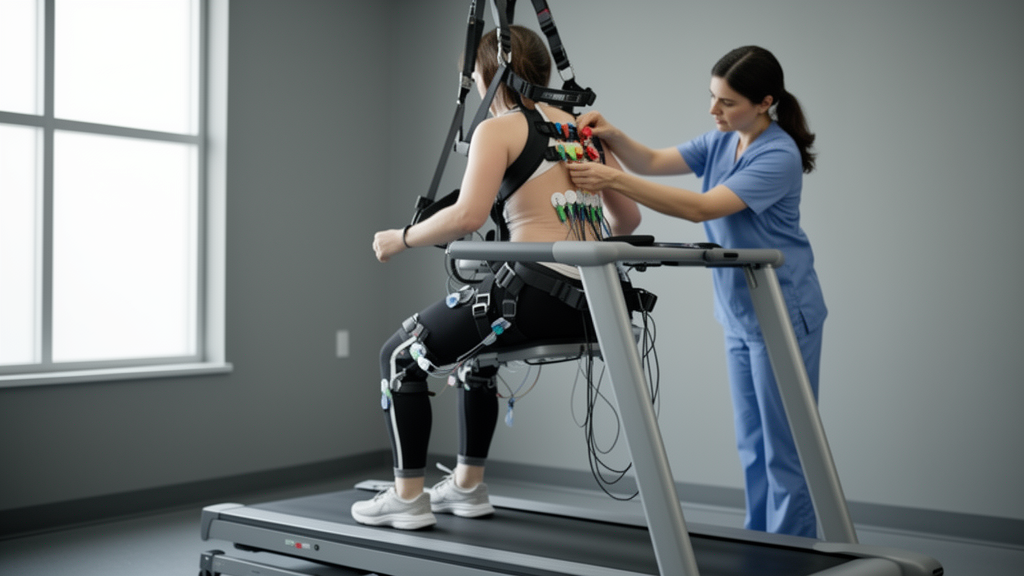
People living with spinal cord injury may one day benefit from a stimulation strategy that targets both the brain and the body at once, but a new review of the human evidence concludes that the field is not yet there. A structured narrative review published in Frontiers in Neurology examined transcranial magnetic stimulation-based multisite neuromodulation, an approach in which magnetic pulses to the motor cortex are combined with stimulation of peripheral nerves, the spinal cord, or nerve roots. The review found that such paired stimulation can reliably change measures of neural excitability, yet sustained improvements in strength, hand function, or walking were reported less consistently, and the added value of the second stimulation site remains unproven across most approaches.
The review team searched PubMed, Web of Science Core Collection, and SPORTDiscus from database inception through August 1, 2026. The searches returned 260 records, which reduced to 100 unique database records after deduplication, with five more identified through citation tracking and targeted author searches. After screening, 26 eligible publications reporting completed human studies formed the core synthesis: 17 investigated cortical-peripheral nerve stimulation, seven investigated cortical-spinal stimulation, and two investigated cortical-nerve-root stimulation. One mixed-modality multisegment Hebbian study was considered separately because its upper-limb and lower-limb phases used different stimulation designs. Single case reports, conference abstracts, and trial protocols were excluded from the evidence synthesis.
The rationale for multisite stimulation rests on the biology of spinal cord injury. Even when an injury is classified as clinically complete, some axonal continuity and subclinical supraspinal influence may remain across the lesion, and preserved descending and ascending pathways are more common after incomplete injuries. Recovery therefore depends not only on cortical excitability but also on transmission through residual corticospinal pathways and communication among supraspinal, spinal, and peripheral motor systems. Conventional transcranial magnetic stimulation generally targets the motor cortex alone, and the review argues that boosting cortical excitability by itself may not translate into meaningful motor improvement when transmission across the lesion or recruitment of spinal and peripheral pathways remains limited.
The most precisely timed paradigms pair stimuli at the millisecond scale. In paired corticospinal-motoneuronal stimulation, or PCMS, a descending volley triggered by motor cortex TMS is timed to interact with an antidromic volley from peripheral motor-nerve stimulation at the corticospinal-motoneuronal synapse in the spinal cord. In one within-subject mechanistic study of 19 people with chronic cervical spinal cord injury, individualized timing placed the descending volley about one to two milliseconds before the antidromic volley, and this facilitatory order increased motor-evoked potentials, finger force, and Nine-Hole Peg Test performance, whereas the reverse order did not produce the same changes. A lower-limb extension of the approach reported short-term increases in tibialis anterior motor-evoked potentials, electromyographic activity, and dorsiflexion force.
Dose and task state also shaped responses in the included studies. A within-subject dose-comparison study of 22 people with spinal cord injury found that 360 paired stimuli produced larger physiological and hand-performance changes than 180 pairs. Mild voluntary contraction increased the PCMS response in a separate mechanistic study. Not every outcome moved in the same direction, however: one experimental study targeting elbow-flexor pathways in 11 people with chronic cervical injury found no clear improvement in maximal voluntary elbow flexion, indicating that neurophysiological changes were not consistently accompanied by improvement across motor tasks.
Repeated treatment has extended these single-session findings. In a controlled repeated-treatment study, 38 people with chronic spinal cord injury received PCMS plus exercise, sham PCMS plus exercise, or PCMS alone. Motor-evoked potentials and maximal voluntary contraction increased in the two active-PCMS groups, while short-term functional task performance improved across groups, including the exercise control condition. Among participants who completed follow-up, some changes were maintained for up to six months in the PCMS-plus-exercise group, although the additional functional effect of combining PCMS with exercise was not consistent across outcomes.
A distinct line of work called high-PAS combines high-intensity TMS with high-frequency peripheral nerve stimulation using individualized latency-based pairing. Repeated protocols lasting 20 to 24 weeks were associated with the return of voluntary activation in selected previously paralyzed muscles in a proof-of-concept case series of two people, and subsequent studies in non-traumatic injury, lower-limb strength and walking, and shorter upper-limb courses generally reported improvements in selected measures of strength or function. A randomized, double-blind, sham-controlled study published in 2026 evaluated repeated high-PAS during the subacute stage after cervical injury and reported greater improvements in selected weak muscles and fine motor performance in the active group, while broader measures of independence did not differ clearly between groups.
Cortical-spinal and cortical-nerve-root approaches showed a similar pattern of encouraging but qualified results. In a randomized four-group pilot study, combined intermittent theta-burst stimulation and transspinal direct-current stimulation produced a larger increase in motor-evoked potential amplitude than either target alone or sham, but the effect declined after the eight-week treatment ended and was not accompanied by an equally clear sustained difference in clinical motor outcomes. Three publications from a single registered project that paired single-pulse TMS with thoracolumbar transcutaneous spinal stimulation during robot-assisted walking reported that stimulation order differentially modulated spinal reflex circuits, but because the intervention was delivered alongside locomotor training without separate cortical-only or spinal-only treatment groups, the contribution of paired stimulation could not be isolated from the training. In the cortical-nerve-root category, a randomized single-blind sham-controlled trial of 30 people with incomplete injury found greater improvements in motor-evoked potentials, knee strength, lower-extremity motor scores, independence, and selected gait measures with active sequential cortical iTBS and nerve-root magnetic stimulation, yet cortical-only and nerve-root-only groups were not included, so the specific contribution of each component was not examined.
The review’s central caution concerns what the evidence can and cannot establish. Studies that specified a proposed site of neural interaction and used physiology-based stimulus timing reported timing-dependent changes in corticospinal or spinal excitability, and repeated interventions were associated with improvements in selected measures of strength, hand function, or walking. Neurophysiological effects, however, were reported more consistently across studies than sustained clinical improvements. Interpretation was limited by small sample sizes, heterogeneous stimulation parameters, overlapping cohorts, limited use of active single-target controls, and differences in treatment exposure. Several publications from the Pulverenti and Helsinki high-PAS series arose from overlapping projects or participant cohorts and should not be treated as independent samples. The review also notes that the two cortical-nerve-root studies used sequential stimulation separated by roughly ten minutes rather than millisecond-scale pairing, meaning that simply using two stimulation sites does not establish an associative interaction between the stimuli.
On safety, the studies that reported adverse events described no serious stimulation-related events. Tolerability issues in long-term high-PAS studies mainly involved transient discomfort from peripheral nerve stimulation and the burden of prolonged sessions, with some protocols gradually increasing peripheral intensity and using topical lidocaine or prilocaine cream to reduce local discomfort. A separate study examining heart-rate variability during a single high-PAS session found no sustained increase in sympathetic activity during or after stimulation. As a structured narrative review, the analysis did not include formal risk-of-bias assessment or meta-analysis, and the authors note that potential selection and interpretation bias inherent to narrative synthesis cannot be excluded. Looking forward, they call for trials with active single-target comparators, individualized timing where relevant, matched treatment exposure, prespecified stratification by clinically relevant injury characteristics, and long-term clinically meaningful outcomes, so that the field can determine whether adding a second stimulation site genuinely justifies the added complexity of treatment.
Subject of Research: TMS-based multisite neuromodulation for motor recovery after spinal cord injury
Article Title: Transcranial magnetic stimulation-based multisite neuromodulation for motor recovery after spinal cord injury: a structured narrative review
Article References: Luo, Y., Huang, X., Wang, K., Lu, S., Song, J., Yang, X., Li, F., & Luo, Y. (2026). Transcranial magnetic stimulation-based multisite neuromodulation for motor recovery after spinal cord injury: a structured narrative review. Frontiers in Neurology, 17, 2000924. https://doi.org/10.3389/fneur.2026.2000924
Image Credits: AI Generated
DOI: 10.3389/fneur.2026.2000924
Keywords: spinal cord injury, transcranial magnetic stimulation, multisite neuromodulation, paired associative stimulation, corticospinal plasticity, motor recovery, neurorehabilitation, PCMS, high-PAS, transspinal stimulation, nerve-root stimulation, structured narrative review
Cite Scienmag News
Cassandra Pierce. (October 27, 2026). Combining Brain and Body Stimulation After Spinal Cord Injury Shows Promise but Unproven Benefit. Scienmag. https://scienmag.com/combining-brain-and-body-stimulation-after-spinal-cord-injury-shows-promise-but-unproven-benefit/
Cassandra Pierce. "Combining Brain and Body Stimulation After Spinal Cord Injury Shows Promise but Unproven Benefit." Scienmag, 27 October 2026, https://scienmag.com/combining-brain-and-body-stimulation-after-spinal-cord-injury-shows-promise-but-unproven-benefit/. Accessed 27 October 2026.
Cassandra Pierce. "Combining Brain and Body Stimulation After Spinal Cord Injury Shows Promise but Unproven Benefit." Scienmag. October 27, 2026. https://scienmag.com/combining-brain-and-body-stimulation-after-spinal-cord-injury-shows-promise-but-unproven-benefit/


