


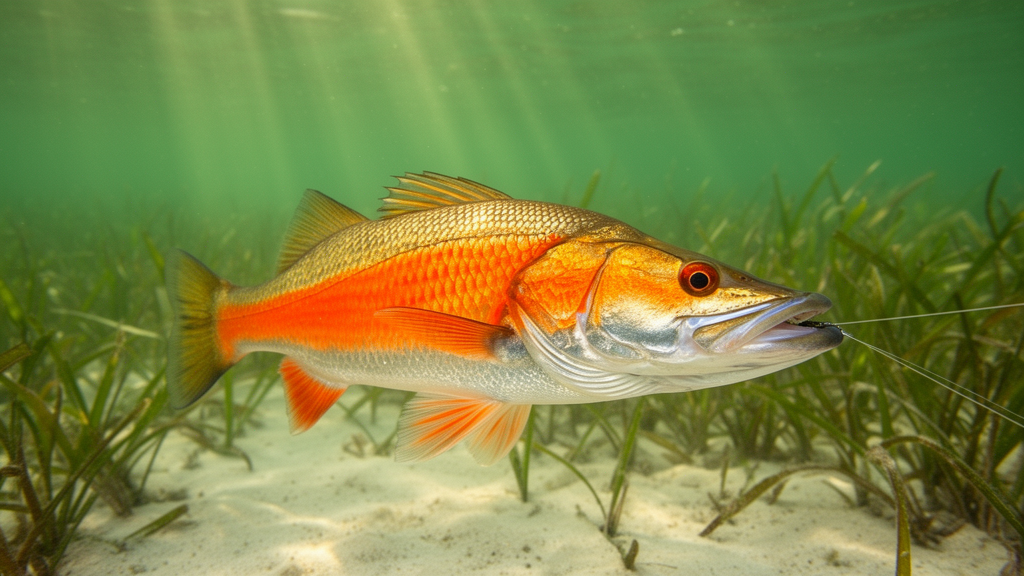
A common snook landed off the coast of Tabasco in the southern Gulf of Mexico has become the first fish recorded with xanthochromism, an abnormal yellow-orange coloration, anywhere in the Gulf of Mexico. The female specimen, described in a study published in Acta Ichthyologica et Piscatoria, measured 774 millimeters in total length and weighed 5 kilograms after gutting. Instead of the species’ usual dark grey flanks, silvery sides and white belly, the fish’s body was entirely orange, with a lighter shade of orange on the belly.
The specimen was caught on 12 May 2021 by a small-scale commercial fleet operating near José María Morelos y Pavón, Tabasco. According to the capture details recorded in the study, the fish was taken 10 kilometers northeast of that landing site, at coordinates 18°30′13″N, 093°6′54″W, by a 7.62-meter fishing boat fitted with an outboard motor. The gear was a gill net with a mesh size of 152.4 millimeters, and the capture occurred at a maximum depth of 22 meters, a figure provided by the fisherman and estimated with a Garmin fish finder. After landing, the fish was measured to the nearest 0.1 centimeter for total length and standard length, and its gutted weight was obtained using a commercial Torrey weight scale.
Because common snook are a commercial species, the specimen did not remain with researchers for long. Once the fisherman eviscerated the fish, its gonads were examined to determine sex and maturity stage using a table of macroscopic characteristics, confirming that the abnormally colored individual was female.
Identification of the species was confirmed through a combination of anatomical features rather than color, which would have been misleading in this case. The authors used the taxonomic key of Rivas (1986) and listed the diagnostic traits that pointed to Centropomus undecimalis: an anal fin with three spines and six rays, 72 scales along the lateral line, pectoral fins similar in length to the pelvic fins, and a third dorsal spine that stands higher than the fourth when the fin is extended. In a fish whose outward appearance deviates so dramatically from the norm, these structural characters provided the objective evidence needed to attach the record confidently to the correct species.
The coloration itself was documented in detail. Most of the fish’s surface, including the fins, the lateral line and the dorsal part of the body, was orange, while the ventral part was whitish orange. Normal common snook, by contrast, range in color from dark brown to dull grey with a yellow to green tint on the dorsal surface. Their lateral surface tends to be silvery and their ventral surface generally white, while the pectoral fins, pelvic fins, second dorsal fin and the dorsal lobe of the caudal fin are usually bright yellow, although some individuals are considerably darker. Against that baseline, the captured female represented a near-total departure: the pigments that normally produce the species’ muted greys and silvers had apparently given way to a dominant yellow-orange tone across virtually the entire body.
Xanthochromism, also called xanthism, is a particular form of hypomelanosis in which bright yellow or orange body coloration becomes prevalent. It is recognized as a genetic disorder that reduces the production of black melanin and causes yellow pigments to dominate in certain parts or the whole of an animal’s body. Cases of total xanthochromism have been identified in several marine and freshwater fish families, and many other reports describe animals in which only parts of the body are affected. In marine fishes specifically, the abnormality has been reported, whether totally or partially expressed, in a total of 68 species, including seven chondrichthyans and 61 teleosts. The new record adds the common snook, a carangiform teleost of the family Centropomidae, to that global list and marks the first report of the condition in any fish from the Gulf of Mexico.
The finding also fills a geographic gap within Mexico itself. Four cases of xanthochromism had previously been described in Mexican fishes, each representing a different family: Leuciscidae, Epinephelidae, Kyphosidae and Pomacentridae. None of those cases had been reported from the Gulf of Mexico. The Tabasco snook therefore represents both a first for the species and a first for the region, extending the documented occurrence of this color abnormality into a large and ecologically distinct tropical basin where it had not previously been recorded.
What caused the orange coloration in this particular fish remains unknown, and the authors are careful on this point. Among the possible causes or triggers of xanthochromism cited in the scientific literature are nutrition, mutation of recessive genes, parasitic infections, the presence of contaminants, and wounds caused by other organisms during antagonistic interactions. The study does not identify which, if any, of these mechanisms applies to the Tabasco specimen. What the authors do note is that the fish appeared normal and clearly healthy despite its unusual color. This matters because some researchers have suggested that organisms with xanthochromism should have low survival rates compared with normally colored individuals, since the bright coloration makes them easier for predators to detect. Yet the specimens that have actually been reported are healthy and capable of reproducing, which could suggest that the abnormal coloration does not necessarily compromise an individual’s ability to survive.
Perhaps the most intriguing element of the report comes not from the single specimen but from the fisherman’s account. According to the fisher, this was not the first time the phenomenon had been observed in the area. Cases of xanthochromism had been seen before in common snook, photographs of which circulate on social networks from the same region, as well as in other species such as the crevalle jack, Caranx hippos. Separately, cases of color and morphological abnormalities have recently been reported in the common snook and other fish species in the area. Taken together, these observations suggest to the authors that one or more environmental stressors could be causing such alterations, although they emphasize that no specific cause has been proven.
One candidate stressor stands out in the region’s profile. In the area where the orange snook was caught, oil extraction and related activities are intense, so pollution is a possible cause of the abnormalities, although, as the authors state, this has not been demonstrated. Until then, the bright orange female from Tabasco stands as a well-documented anomaly, a reminder that even familiar commercial species can still produce surprises, and a prompt for researchers to look more closely at the waters of the southern Gulf of Mexico.
Subject of Research: First record of xanthochromism, an abnormal orange coloration, in a common snook from the southern Gulf of Mexico
Article Title: First records of xanthochromism in common snook, Centropomus undecimalis ( Actinopterygii : Carangiformes : Centropomidae ), collected in the Gulf of Mexico
Article References: Wakida-Kusunoki, A. T., Anislado-Tolentino, V., Del Moral-Flores, L. F., & Castro-Barbosa, R. (2024). First records of xanthochromism in common snook, Centropomus undecimalis (Actinopterygii: Carangiformes: Centropomidae), collected in the Gulf of Mexico. Acta Ichthyologica et Piscatoria, 54, 283-286. https://doi.org/10.3897/aiep.54.138051
Image Credits: AI Generated
Keywords: xanthochromism, common snook, Centropomus undecimalis, Gulf of Mexico, fish color abnormality, hypomelanosis, Tabasco, small-scale fisheries, environmental stressors, marine fish, pigmentation, First
Cite Scienmag News
Amanda Bryant. (October 27, 2026). Bright Orange Snook Caught in Gulf of Mexico Is First Xanthochromic Fish Recorded There. Scienmag. https://scienmag.com/bright-orange-snook-caught-in-gulf-of-mexico-is-first-xanthochromic-fish-recorded-there/
Amanda Bryant. "Bright Orange Snook Caught in Gulf of Mexico Is First Xanthochromic Fish Recorded There." Scienmag, 27 October 2026, https://scienmag.com/bright-orange-snook-caught-in-gulf-of-mexico-is-first-xanthochromic-fish-recorded-there/. Accessed 27 October 2026.
Amanda Bryant. "Bright Orange Snook Caught in Gulf of Mexico Is First Xanthochromic Fish Recorded There." Scienmag. October 27, 2026. https://scienmag.com/bright-orange-snook-caught-in-gulf-of-mexico-is-first-xanthochromic-fish-recorded-there/


