


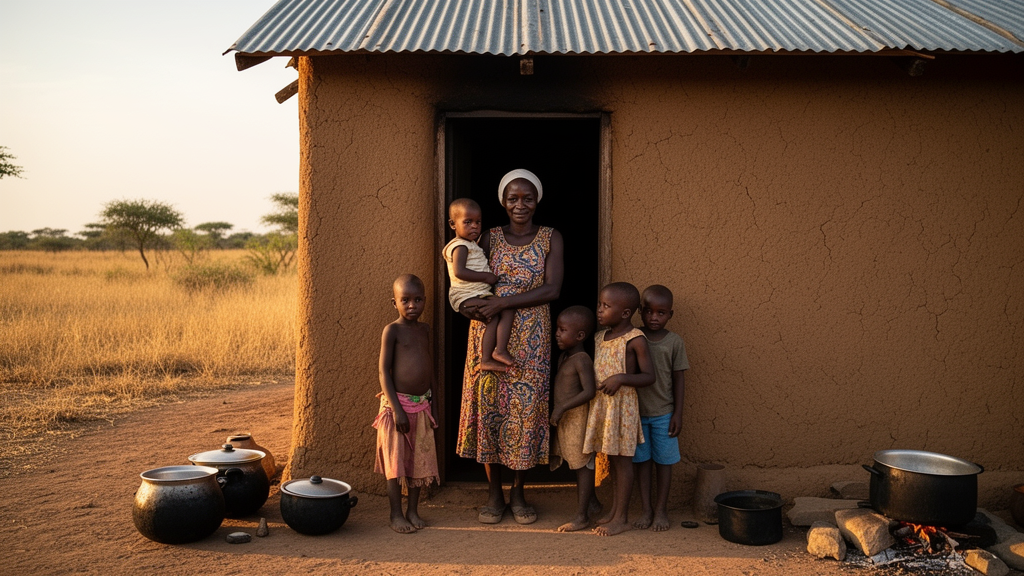
Child poverty in northern Tanzania is shaped less by a child’s own characteristics than by the economic and demographic makeup of the household around them, according to a new cross-sectional study of 504 children aged 7 to 17 in the Moshi area of the Kilimanjaro Region. The research, published in Frontiers in Sociology, used a multidimensional poverty measure built from children’s own reports of deprivation and an ordered logistic regression model to identify which socio-economic and demographic factors predict where a child falls on a three-tier poverty scale: very poor, poor, or not poor.
The study was conducted in Moshi District Council and Moshi Municipal Council, two administratively distinct areas spanning rural and urban environments. The researchers chose the location deliberately: the Kilimanjaro Region records one of the lowest monetary poverty rates in Tanzania at 4.4 percent, yet the national multidimensional child poverty rate stands at roughly 74 percent, meaning about three-quarters of Tanzanian children aged 0 to 17 are deprived in three or more dimensions. That contrast, the authors argue, makes Moshi a compelling setting for examining what actually drives child deprivation at the household level, beneath a surface of regional economic success.
To build the sample, the team used a probability-based, multi-stage sampling procedure modeled on the 2019 UNICEF Child Poverty in Tanzania survey. First, 13 of the area’s 52 wards were randomly selected as primary sampling units, stratified across the two councils. Then one primary and one secondary school were randomly chosen within each selected ward. Finally, systematic random sampling from school class registers picked roughly 19 to 20 students per school. The sample size calculation, based on a 95 percent confidence level and 5 percent precision, yielded a minimum of 385 children, raised to 462 to allow for non-response; fieldwork ultimately produced 504 valid responses, all retained for analysis.
The poverty measure itself departed from the common practice of equating child poverty with household poverty. Children answered structured questionnaires covering three dimensions with nine indicators: basic needs such as food, clothing, and shelter; child rights, including the ability to attain personal desires and express opinions at home and at school; and access to social services such as clean water, schooling, and health services outside school. Indicators were originally measured on a seven-point Likert scale and then aggregated using an average indexing approach into a continuous composite index for each child. Fixed cut-off thresholds segmented the sample into the three rank-ordered categories, with very poor indicating high deprivation and low average scores.
The descriptive results showed that most children fell into the not poor category, but with sharp variations across groups. Children in the rural-dominated Moshi District Council were classified as very poor at 10.2 percent, compared with 6.0 percent in the urban Municipal Council, and the residence-poverty association was statistically significant. Age mattered strongly: children aged 7 to 13 recorded 15.1 percent very poor and 23.2 percent poor, against 5.8 percent and 18.4 percent for those aged 14 to 17. By contrast, differences between boys and girls were modest and statistically non-significant, with boys slightly more likely to be very poor at 9.4 percent versus 7.9 percent for girls.
Household structure and livelihoods also showed strong bivariate patterns. Children of unemployed household heads fared worst, with 35.1 percent classified as very poor and only 42.2 percent not poor, while children in non-agricultural households had the highest proportion of not poor status at 77.9 percent. Children in female-headed households were more likely to be poor, at 28.4 percent versus 16.8 percent in male-headed households, and single-parent households showed higher rates of both extreme and general poverty than two-parent families. Poverty also rose with the number of children in the household, a relationship the authors link to population pressure and family planning policy.
The ordered logistic regression refined these patterns while adjusting for confounders. Adolescents aged 14 to 17 had 2.09 times higher odds of being in a less severe poverty category than younger children. Children in two-parent households had higher adjusted odds of being classified as non-poor compared with those in single-parent settings. Children in non-farming households had 1.52 times higher odds of falling into less severe poverty categories than those from agriculture-dependent families, a gap the authors attribute to the structural and climate challenges of subsistence farming in northern Tanzania rather than to farming itself. When the household head was unemployed, a child’s odds of escaping severe poverty dropped drastically, with an adjusted odds ratio of 0.23.
Household size emerged as a critical factor in the multivariate model. While households with two to four children showed no statistically significant differences from single-child households, children in households with five members had significantly lower odds of being in a less severe poverty category, and the same held for households with six or more members. The authors interpret this through the resource-dilution perspective, which holds that households operate with a finite reservoir of resources that stretches thinner as families expand or face economic shocks, leaving less support for each child. The sex of the household head also remained significant after adjustment, with children in female-headed households showing lower odds of being in a less severe poverty category, a result the authors suggest may reflect deeper inequalities in jobs, property, and credit access for women.
Notably, two factors often emphasized in the child poverty literature did not reach statistical significance in this sample. The child’s sex showed no significant association with multidimensional poverty, suggesting that household-level deprivation may affect boys and girls similarly in this setting. School level was likewise non-significant, which the authors read as evidence that household poverty may exert a stronger influence than schooling itself, limiting children’s opportunities regardless of their education level. The overall model was jointly significant, indicating that the selected socio-economic and demographic traits meaningfully account for variation in child poverty status.
The study carries clear limitations. The cross-sectional design captures only a localized snapshot of Moshi District, so the findings cannot be readily generalized to other parts of Tanzania with different socio-economic conditions. The authors also note the absence of data on land tenure and farm size, which in agrarian areas can heavily determine household wealth, and the lack of measurement of household proximity to regional economic drivers such as agro-industries or tourism. Future research, they suggest, should adopt longitudinal designs across wider geographic areas and incorporate land registration, farm acreage, and crop commodity data. Based on the evidence, the authors recommend livelihood diversification beyond subsistence agriculture, targeted social protection for high-dependency households, expanded family planning education, and programs that integrate children’s own voices into policy design.
Subject of Research: Socio-economic and demographic determinants of multidimensional child poverty among children aged 7 to 17 in the Moshi area of northern Tanzania
Article Title: Assessment of socio-economic and demographic factors on child poverty: a case study of Northern Zone of Tanzania
Article References: Mutalemwa, L. A., & Miraji, H. (2026). Assessment of socio-economic and demographic factors on child poverty: a case study of Northern Zone of Tanzania. Frontiers in Sociology, 11, Article 1905874. https://doi.org/10.3389/fsoc.2026.1905874
Image Credits: AI Generated
DOI: 10.3389/fsoc.2026.1905874
Keywords: child poverty, Tanzania, multidimensional poverty, household size, ordered logistic regression, cross-sectional survey, Kilimanjaro Region, resource dilution, household structure, social protection, family planning, sub-Saharan Africa
Cite Scienmag News
Alan Morgan. (October 27, 2026). Household Size and Head’s Job Drive Child Poverty in Northern Tanzania. Scienmag. https://scienmag.com/household-size-and-heads-job-drive-child-poverty-in-northern-tanzania/
Alan Morgan. "Household Size and Head’s Job Drive Child Poverty in Northern Tanzania." Scienmag, 27 October 2026, https://scienmag.com/household-size-and-heads-job-drive-child-poverty-in-northern-tanzania/. Accessed 27 October 2026.
Alan Morgan. "Household Size and Head’s Job Drive Child Poverty in Northern Tanzania." Scienmag. October 27, 2026. https://scienmag.com/household-size-and-heads-job-drive-child-poverty-in-northern-tanzania/

