


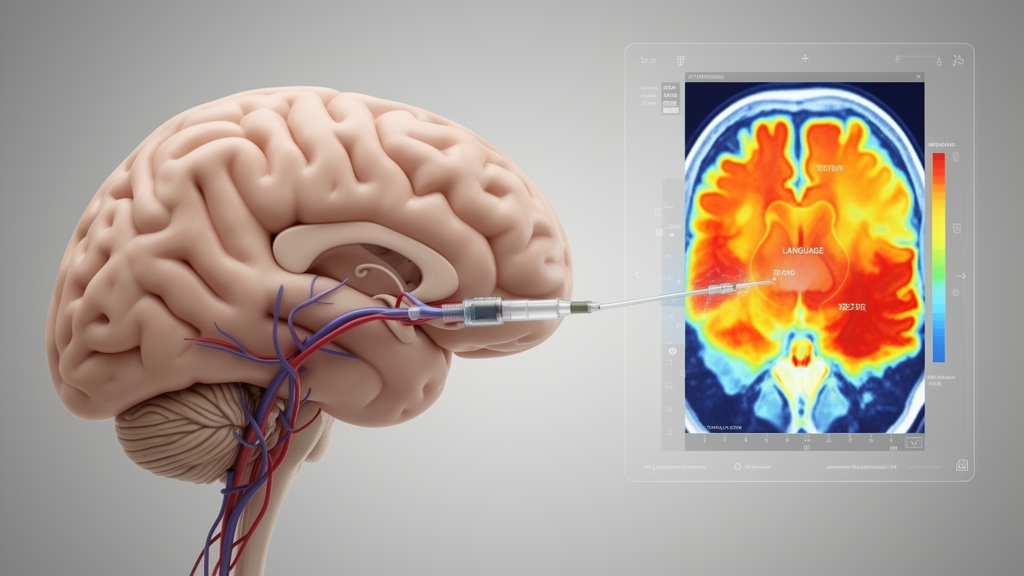
Neurosurgeons planning operations for brain tumors or drug-resistant epilepsy have long faced an awkward gap: they can localize where seizures start with remarkable precision, but mapping which patches of cortex carry language, calculation, or attention functions has relied on methods that either blur the details or require the patient to be awake on the operating table. A team at Fujita Health University in Japan now reports a way to make one of the oldest tests in functional neurology literally visible, by pairing the Wada test with computed tomography perfusion imaging and fusing the result with the patient’s own MRI and electrode scans.
The Wada test, introduced in the late 1940s, temporarily anesthetizes one cerebral hemisphere by injecting a drug into the internal carotid artery, allowing clinicians to determine which side of the brain dominates language and memory. It has been a mainstay of presurgical evaluation for decades, but it has never functioned as a visualizable imaging modality in its own right. The new approach, described in Frontiers in Neuroimaging, pushes the technique further downstream: instead of flooding an entire hemisphere, the researchers threaded a microcatheter into distal arterial branches of the middle cerebral artery and, when needed, the anterior or posterior cerebral artery, delivering propofol only to a small, well-defined perfusion territory.
The procedure took place in an angiography suite equipped with a 320-detector-row CT scanner. Before each propofol injection, the team performed CT perfusion imaging, injecting a small bolus of contrast and capturing images for 15 seconds. Perfusion data were analyzed with block singular value deconvolution, a method chosen because it remains reliable even when contrast arrival is delayed by arterial stenosis or collateral flow. Perfusion territories were derived from cerebral blood volume maps, giving the researchers a patient-specific picture of exactly which brain region the catheter was supplying. Because the CT perfusion run was performed immediately before propofol administration with the microcatheter held in the same position, the imaged territory served as an approximation of the drug’s distribution, though the authors caution that exact correspondence cannot be guaranteed.
Functional testing followed a strict protocol. A certified speech-language-hearing therapist administered tasks in a fixed order without pretest rehearsal, completing all assessments within three minutes of injection. The battery covered repetition, naming, and reading, each given in three trials, plus single-digit addition for calculation and a line bisection test for spatial neglect, with additional tasks added when clinically indicated. Language impairment was defined as clear and sustained incorrect responses, cessation of response, or marked delay relative to baseline, and each assessment was evaluated by two speech-language-hearing therapists and three neurosurgeons, with an independent blinded reviewer consulted when interpretation was uncertain.
The cohort consisted of 23 consecutive patients evaluated between August 2021 and June 2025, all of whom met inclusion criteria requiring either determination of language dominance or assessment of a specific functional domain the patient wished to preserve. Their mean age was 43.6 years, 56.5 percent were left-handed or had a history of handedness conversion, 18 had brain tumors, and 15 had epilepsy. Language dominance was left-sided in 18 patients, bilateral in three, and right-sided in two. No complications related to the procedure were observed during hospitalization, and radiation dose data collected for 20 patients showed a cumulative dose-length product of 3,929 mGy·cm.
The territory-level results revealed a striking asymmetry in how language functions distribute across middle cerebral artery branches. In the superior trunk territory, repetition, naming, and reading each produced positive findings in roughly 70 percent of tested injections. The inferior trunk told a different story: repetition and reading were impaired in 93.8 percent of injections, but naming positivity dropped to 56.3 percent. The authors interpret this as evidence that the superior trunk alone does not cover all language-related regions, and that naming involves processing distinct from the networks supporting repetition and reading, a pattern they note is consistent with prior functional MRI work implicating the visual word form area and lateral occipital complex in reading and naming tasks.
Calculation showed an even sharper territorial split. Positive responses to single-digit addition occurred in 9 of 15 patients overall, but the superior trunk accounted for most of them, with a positivity rate of 53.3 percent against just 13.3 percent for the inferior trunk. Line bisection abnormalities appeared in both the dominant and non-dominant hemispheres at similar rates, a finding that runs against the classical association of hemispatial neglect with non-dominant lesions. Motor weakness, assessed by arm drift and impaired handgrip, clustered in the anterior cerebral artery and superior trunk territories but still appeared in roughly 30 percent of inferior trunk injections. The authors emphasize that these vascular-territory associations are presented descriptively, with no formal hypothesis testing, because multiple assessments came from the same patients and the sample was exploratory.
The clinical payoff emerges most clearly in the case reports. One right-handed man in his 40s with a left insular glioma later developed drug-resistant epilepsy after resection; SEEG identified four seizure-onset contacts, and fused imaging showed one contact within the anterior cerebral artery territory and two within the inferior trunk territory, where all language tasks had been impaired during injection. Because resection would have required awake surgery with uncertain feasibility of removing all seizure-onset tissue, he elected continued medical management. In another case, a right-handed woman in her 70s who worked as a sign-language interpreter and insisted on preserving that ability underwent ssWada with a sign-language task; the lesion and functional response both fell within the inferior trunk territory, awake resection proceeded without impairment of sign-language performance during stimulation, and she has remained seizure-free for over a year while continuing her professional work.
A third case illustrates how the fused maps can guide intraoperative decisions directly. A right-handed woman in her 30s with a recurrent seizure focus near an old meningioma resection cavity underwent SEEG after video-EEG failed to localize the seizure onset zone. One contact posterolateral to the cavity was identified as the seizure onset, and fusion of the electrode CT, postoperative MRI, and ssWada perfusion data placed it within the inferior trunk territory, where injection had induced language disturbance. Awake resection was planned, and during surgery, manipulation roughly 10 millimeters from the seizure-onset contact reproduced her habitual nausea, while subcortical stimulation near the resection margin induced aphasia consistent with the ssWada finding. After resection, the habitual symptoms ceased, though she experienced transient postoperative aphasia.
The authors are candid about the limits of the approach. Super-selective vessels were chosen according to lesion location rather than uniformly sampled, middle cerebral artery branching patterns vary substantially between individuals, and the task battery covered only repetition, naming, reading, single-digit calculation, and line bisection. Within-patient clustering precluded formal statistical comparison. Still, the technique offers something the established alternatives do not: functional MRI and magnetoencephalography provide whole-brain coverage but struggle with specificity in perilesional regions where lesion-related artifacts and disrupted neurovascular coupling can distort signals, while direct cortical stimulation during awake craniotomy is highly reliable but carries procedure-specific risks and is unsuitable for some patients. By linking pharmacologically inactivated territories to the individual patient’s anatomy and electrode data, and by importing the fused images into a neuronavigation system for intraoperative reference, the method adds a spatially resolved, imaging-based layer to presurgical planning, applicable not only to epilepsy but also to brain tumors and vascular lesions requiring SEEG evaluation.
Subject of Research: Combining super-selective Wada testing with CT perfusion to visualize functional brain territories for preoperative surgical mapping
Article Title: Visualization of super-selective Wada with computed tomography perfusion: toward a novel option in preoperative functional mapping
Article References: Nakae, S., Hayakawa, M., Kumon, M., Kawase, N., Suyama, K., Fujiwara, E., Kojima, D., Ohba, S., Imamura, S., Sato, Y., Inamoto, Y., Fukunaga, M., & Hirose, Y. (2026). Visualization of super-selective Wada with computed tomography perfusion: toward a novel option in preoperative functional mapping. Frontiers in Neuroimaging, 5, Article 1876584. https://doi.org/10.3389/fnimg.2026.1876584
Image Credits: AI Generated
DOI: 10.3389/fnimg.2026.1876584
Keywords: super-selective Wada test, CT perfusion, preoperative mapping, epilepsy surgery, SEEG, language dominance, brain tumors, propofol, middle cerebral artery, awake craniotomy, neuronavigation, functional neuroimaging
Cite Scienmag News
Ophelia Keating. (October 27, 2026). Super-selective Wada test paired with CT perfusion maps language zones before brain surgery. Scienmag. https://scienmag.com/super-selective-wada-test-paired-with-ct-perfusion-maps-language-zones-before-brain-surgery/
Ophelia Keating. "Super-selective Wada test paired with CT perfusion maps language zones before brain surgery." Scienmag, 27 October 2026, https://scienmag.com/super-selective-wada-test-paired-with-ct-perfusion-maps-language-zones-before-brain-surgery/. Accessed 27 October 2026.
Ophelia Keating. "Super-selective Wada test paired with CT perfusion maps language zones before brain surgery." Scienmag. October 27, 2026. https://scienmag.com/super-selective-wada-test-paired-with-ct-perfusion-maps-language-zones-before-brain-surgery/


