


In a greenhouse in Paraguay that has grown tomatoes for roughly fifteen consecutive years, researchers put a simple agricultural technique to a demanding test. The soil beneath the plastic mulch carried a persistent population of Ralstonia solanacearum, the soilborne bacterium responsible for bacterial wilt, one of the most destructive diseases of solanaceous crops. Over the previous five years, wilt had been observed continuously in this greenhouse, making it an ideal setting to ask whether grafting commercial tomato varieties onto a resistant rootstock could simultaneously lift yield and protect plants under real, naturally established disease pressure rather than artificial inoculation.
The trial, conducted at the Horticultural Center of the Facultad de Ciencias Agrarias of the Universidad Nacional de Asunción in San Lorenzo from April to November 2022, was published in Frontiers in Horticulture. The team, led by Noelia Isabel Godoy Medina and Victoria Rossmary Santacruz Oviedo, evaluated two commercial hybrid scion varieties, Ravena and Grazianni, each grown both as ungrafted plants and grafted onto the Woodstock rootstock from Sakata Seed Corporation. Woodstock is commercially characterized as carrying high resistance to Ralstonia solanacearum as well as to Verticillium dahliae race 1, Fusarium oxysporum f. sp. lycopersici races 1 and 2, and root-knot nematodes of the genus Meloidogyne.
The researchers used a randomized complete block design with a two-by-two factorial arrangement of cultivar and grafting status, giving four treatments with six replications each. Six rows of twenty meters inside a pampean-type greenhouse served as blocks, and each row was subdivided into four five-square-meter plots, one per treatment, randomly assigned. Each plot held ten plants spaced half a meter apart, of which the four central plants were evaluated while the end plants served as borders, yielding sixty plants per treatment and 240 plants in total. Individual plants were treated as subsamples rather than independent replicates, and the plot was the unit of analysis, a distinction that matters for how the statistics should be read.
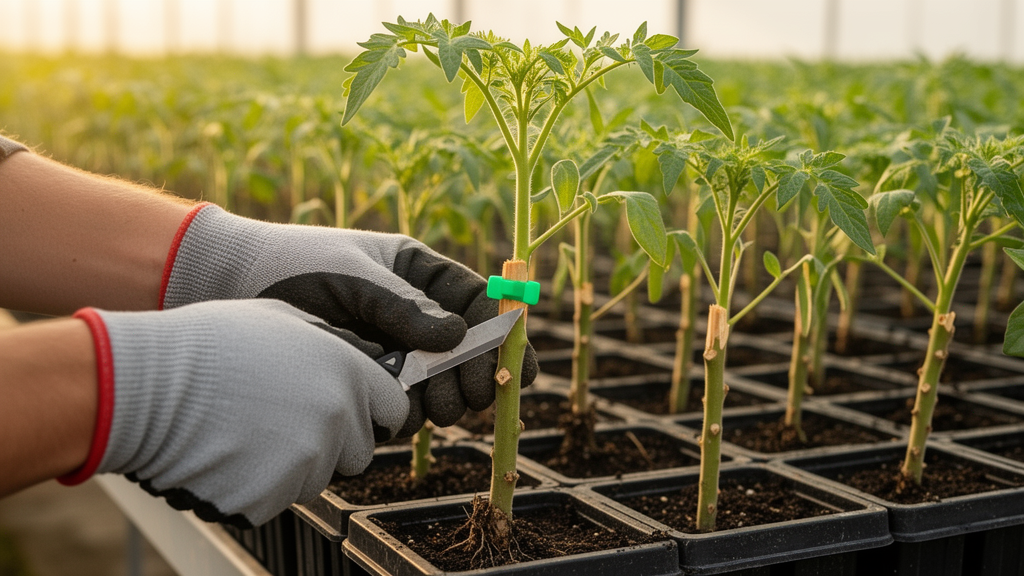
Grafting was performed by the splice technique with a 45-degree bevel cut on both scion and rootstock stems, joined with two-millimeter plastic clips. Scions were sown on April 19, 2022 and rootstocks on April 12, so that grafting could occur at thirty and thirty-seven days after sowing respectively. The grafted seedlings spent seven days in a healing chamber in total darkness at 22 degrees Celsius and 80 percent relative humidity before acclimatization, and all plants were transplanted into the greenhouse on June 3, 2022. Graft take rates were high, at 92 percent for Grazianni and 90 percent for Ravena. Fertigation followed a stage-based program supplying 154 kilograms of nitrogen, 66.6 kilograms of phosphorus and 371 kilograms of potassium per hectare over the cycle, and harvest ran across twelve pickings from September to mid-November.
The yield results were consistent and, in places, striking. Grafted plants produced an average of 29.62 fruits per plant against 24.94 for non-grafted plants, an increase of 18.8 percent. Individual fruit mass also rose, from 94.80 grams to 104.10 grams, and fruit length increased from 6.21 to 6.73 centimeters, although fruit diameter did not differ significantly between treatments. Notably, the two cultivars performed similarly on these traits, with no significant differences between Ravena and Grazianni in fruit number, diameter, length or individual mass, and no cultivar-by-grafting interaction, meaning the grafting benefit held across both genetic backgrounds.
Total and marketable fruit mass told a similar story with more nuance. Grafting significantly increased total fresh fruit mass, and the cultivar effect was also significant: Grazianni grafted reached the highest value at 3,189.74 grams per plant, followed by Ravena grafted at 2,967.48 grams, Grazianni non-grafted at 2,641.69 grams and Ravena non-grafted at 2,104.71 grams. Marketable mass followed the same ordering, from 1,992.72 grams per plant for grafted Grazianni down to 1,385.67 grams for non-grafted Ravena, with a significant grafting effect but no significant variety effect. Interestingly, the proportion of the harvest that was marketable averaged 62.4 percent across treatments and responded differently in each cultivar: grafting raised the marketable fraction in Grazianni, from 57.7 to 62.3 percent, but slightly lowered it in Ravena, from 66.4 to 63.1 percent, suggesting that the commercial benefit of grafting should be judged on total yield rather than fruit quality fraction alone.
The phytosanitary results were the most dramatic finding of the study. Under the natural soil inoculum present in the greenhouse, non-grafted plants of both varieties succumbed at high rates: every one of the sixty Ravena plants developed wilt symptoms, a 100 percent incidence, while 52 of 60 Grazianni plants, or 86.7 percent, did so. In contrast, not a single grafted plant of either variety showed wilt symptoms at any point during the evaluation period, giving 0 percent incidence in both grafted treatments. Disease was monitored daily across the entire population of 240 plants, with incidence calculated as the pooled count of symptomatic plants per treatment.
To confirm what was killing the non-grafted plants, the researchers isolated bacteria from the stem exudates of symptomatic plants and characterized three independent strains. On tetrazolium chloride medium, the colonies developed the reddish coloration with whitish edges described as typical of Ralstonia solanacearum, and Gram staining showed the Gram-negative cell wall expected for this species. Molecular testing with the species-specific 759/760 polymerase chain reaction primers amplified a single band of the expected size, approximately 280 base pairs, in the two strains examined. The authors are careful, however, about the weight of this molecular evidence: the gel included no positive or negative control lanes, the PCR products were not sequenced, and two of the isolates came from the same experimental unit, so the result is presented as supportive evidence complementary to the phenotypic characterization rather than independent confirmation of identity.
That caution extends to the central biological interpretation. The complete absence of symptoms in grafted plants reflects disease expression under naturally occurring inoculum, and the authors explicitly state that it does not by itself constitute experimental proof of genetic resistance in the strict phytopathological sense. Soil inoculum density was never quantified, and the spatial distribution of the pathogen within the greenhouse is unknown, so the magnitude of the protective effect is inherently contingent on the pressure prevailing in each plot. Formal demonstration of resistance would require controlled inoculation trials with a characterized strain at defined inoculum densities, work that lies beyond the scope of this study. The results are nonetheless consistent with the rootstock’s commercial resistance specification and with earlier field research showing that resistant rootstocks sharply reduce bacterial wilt incidence in naturally infested soils.
The study’s limitations frame how broadly its conclusions can travel. Only one rootstock was tested, so the effects cannot be attributed specifically to the Woodstock genotype as opposed to grafting in general, and only two cultivars were used, at a single site during a single growing season, which does not capture year-to-year variation in inoculum pressure and temperature. No physiological or root measurements were taken to explain the yield gains mechanistically, no economic analysis of grafting costs was performed, and plot-level disease counts were not retained, preventing statistical analysis of incidence at the experimental-unit level.
Subject of Research: Grafting tomato cultivars onto a resistant rootstock to improve yield and suppress bacterial wilt in subtropical protected cultivation
Article Title: Impact of grafting on yield and plant health of tomato varieties cultivated under protected subtropical climate
Article References: Godoy Medina, N. I., Santacruz Oviedo, V. R., Grabowski Ocampos, C. J., Enciso-Garay, C. R., & Burgos Rotela, R. (2026). Impact of grafting on yield and plant health of tomato varieties cultivated under protected subtropical climate. Frontiers in Horticulture, 5, 1966164. https://doi.org/10.3389/fhort.2026.1966164
Image Credits: AI Generated
DOI: 10.3389/fhort.2026.1966164
Keywords: tomato, grafting, rootstock, bacterial wilt, Ralstonia solanacearum, protected cultivation, subtropical agriculture, yield, plant pathology, greenhouse, Paraguay, Woodstock rootstock
Cite Scienmag News
Maeve Vickers. (October 27, 2026). Grafting Tomato Onto Resistant Rootstock Boosts Yield and Blocks Bacterial Wilt. Scienmag. https://scienmag.com/grafting-tomato-onto-resistant-rootstock-boosts-yield-and-blocks-bacterial-wilt/
Maeve Vickers. "Grafting Tomato Onto Resistant Rootstock Boosts Yield and Blocks Bacterial Wilt." Scienmag, 27 October 2026, https://scienmag.com/grafting-tomato-onto-resistant-rootstock-boosts-yield-and-blocks-bacterial-wilt/. Accessed 27 October 2026.
Maeve Vickers. "Grafting Tomato Onto Resistant Rootstock Boosts Yield and Blocks Bacterial Wilt." Scienmag. October 27, 2026. https://scienmag.com/grafting-tomato-onto-resistant-rootstock-boosts-yield-and-blocks-bacterial-wilt/


