

Tuesday, October 27, 2026
Science
No Result
View All Result
  • Login
  • HOME
  • SCIENCE NEWS
  • CONTACT US
  • HOME
  • SCIENCE NEWS
  • CONTACT US
No Result
View All Result
Scienmag
No Result
View All Result
Home Science News Technology and Engineering

Stacked 3D DRAM offers a path beyond two-dimensional scaling limits

October 27, 2026
in Technology and Engineering
Denise Maddox
By Denise Maddox Scienmag Editorial Profile - Mechanical Engineering
Reading Time: 3 mins read
0
Stacked 3D DRAM offers a path beyond two-dimensional scaling limits

Stacked 3D DRAM offers a path beyond two-dimensional scaling limits

65
SHARES
587
VIEWS
Share on FacebookShare on Twitter
ADVERTISEMENT

Dynamic random-access memory has long advanced by shrinking cells onto flat, two-dimensional wafers, but a new review argues that this approach is running out of room. According to a Review article published in Nature Reviews Electrical Engineering, moving to sub-10-nanometre process nodes raises serious concerns about the scalability and long-term viability of conventional 2D DRAM architectures, and the authors make the case that cell-stacked three-dimensional DRAM is the most credible route forward.

The review, led by Joon Young Kang and Cheol Seong Hwang with colleagues, traces the evolution of 2D DRAM and identifies the specific bottlenecks that now constrain it. As cells shrink below the 10-nanometre mark, capacitor scaling becomes increasingly difficult, word-line resistance rises, and cell-to-cell interference grows more troublesome. The authors also highlight the row-hammer effect, a well-known reliability problem in dense DRAM arrays, as one of the challenges facing continued two-dimensional scaling.

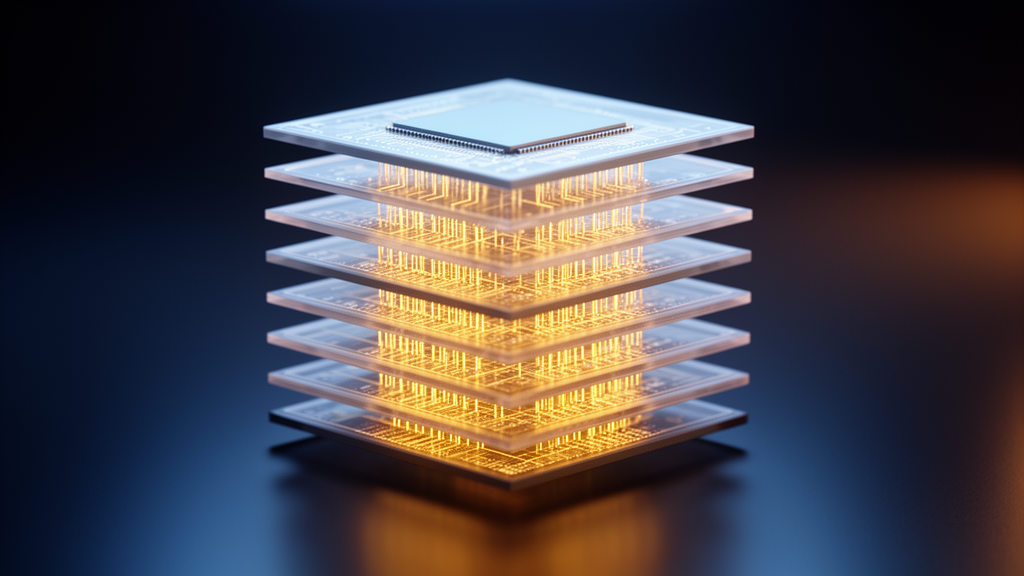
The proposed solution is distinct from chip-stacked high-bandwidth memory, the approach already used in some advanced computing products. Instead of stacking complete memory chips on top of one another, cell-stacked 3D DRAM would integrate the memory cells themselves in a vertical arrangement, allowing bit density to grow in the third dimension rather than in the plane of the wafer.

One of the review’s key quantitative claims concerns when this transition becomes worthwhile. The authors calculate that cell-stacked 3D DRAM can surpass the bit density of 2D DRAM at approximately 100 stacked layers, providing a scalable path beyond planar architectures.

Realizing such a memory will require more than simply turning existing structures on their side. The review identifies circuit and structural innovations as prerequisites, including vertical bit-line designs, gate-all-around transistors, and new channel materials. Among those materials, single-crystal silicon remains the leading candidate, while amorphous oxide semiconductors such as indium gallium zinc oxide are emerging as promising alternatives for future 3D DRAM devices.

The vertical bit-line architecture carries a particularly concrete benefit. According to the review, it can reduce bit-line capacitance by approximately threefold compared with horizontal bit-line designs, which improves sensing scalability.

The authors are candid about the obstacles that remain. Process integration challenges, including the fabrication of staircase word-line contacts and wafer bonding, currently hinder the realization of scaled 3D DRAM. High aspect-ratio fabrication, interconnect design and long-term reliability are also listed among the key challenges that must be solved before practical stacked memory can reach production.

Despite these hurdles, the review’s overall assessment is optimistic. As a review article, the work synthesizes existing research and outlines a development roadmap rather than reporting a new experimental device, but it frames the coming architectural transition in unusually concrete terms: the planar era of DRAM is nearing its limits, and the vertical era is the planned successor.

Subject of Research: Three-dimensional stacked DRAM as a successor to scaled two-dimensional DRAM architectures

Article Title: Three-dimensional dynamic random-access memory beyond two-dimensional scaling limits

Article References: Kang, J. Y., Choi, J., Shin, J., Song, H., Park, T. W., Han, J.-W., Ha, D., Kim, J. J., & Hwang, C. S. (2026). Three-dimensional dynamic random-access memory beyond two-dimensional scaling limits. Nature Reviews Electrical Engineering. https://doi.org/10.1038/s44287-026-00347-x

Image Credits: AI Generated

DOI: 10.1038/s44287-026-00347-x

Keywords: DRAM, 3D memory, semiconductor scaling, vertical bit line, gate-all-around transistors, oxide semiconductors, wafer bonding, memory architecture, artificial intelligence computing, row hammer, capacitor scaling, high aspect-ratio fabrication

Cite Scienmag News

Denise Maddox. (October 27, 2026). Stacked 3D DRAM offers a path beyond two-dimensional scaling limits. Scienmag. https://scienmag.com/stacked-3d-dram-offers-a-path-beyond-two-dimensional-scaling-limits/

Denise Maddox. "Stacked 3D DRAM offers a path beyond two-dimensional scaling limits." Scienmag, 27 October 2026, https://scienmag.com/stacked-3d-dram-offers-a-path-beyond-two-dimensional-scaling-limits/. Accessed 27 October 2026.

Denise Maddox. "Stacked 3D DRAM offers a path beyond two-dimensional scaling limits." Scienmag. October 27, 2026. https://scienmag.com/stacked-3d-dram-offers-a-path-beyond-two-dimensional-scaling-limits/


Tags: 3D memory3D stacked DRAM technologyalternatives to high-bandwidth memory stackingartificial intelligence computingcapacitor scalingcapacitor scaling issues in DRAMcell stacking in memory architecturesDRAMfuture of memory device scalinggate-all-around transistorshigh aspect-ratio fabricationlimitations of 2D DRAM scalinglong-term viability of DRAM scalingmemory architectureovercoming two-dimensional memory bottlenecksoxide semiconductorsrow hammerrow-hammer reliability problemsemiconductor scalingsub-10 nanometre process node challengesthree-dimensional memory integrationvertical bit linevertical memory cell arrangementwafer bonding
Share26Tweet16
Previous Post

Agility and Aerobic Exercise Show Distinct Acute Effects on Attention in Male Adolescents

Next Post

Quantum code-breaking estimates collapsed, but the calendar did not, review warns

Related Posts

Quantum code-breaking estimates collapsed, but the calendar did not, review warns
Science News

Quantum code-breaking estimates collapsed, but the calendar did not, review warns

October 27, 2026
Survey maps how LLM agents moved from single tool calls to multi-tool orchestration
Technology and Engineering

Survey maps how LLM agents moved from single tool calls to multi-tool orchestration

October 27, 2026
Smart Biosensors and 3D Bioprinting Move Engineered Tracheas Closer to the Clinic
Science News

Smart Biosensors and 3D Bioprinting Move Engineered Tracheas Closer to the Clinic

October 27, 2026
Automated Software and High-Tilt Holders Push Atomic-Resolution Electron Tomography Into 3D Interface Imaging
Technology and Engineering

Automated Software and High-Tilt Holders Push Atomic-Resolution Electron Tomography Into 3D Interface Imaging

October 27, 2026
Stool biomarkers distinguish confirmed necrotizing enterocolitis in preterm infants
Technology and Engineering

Stool biomarkers distinguish confirmed necrotizing enterocolitis in preterm infants

October 27, 2026
Human-inspired AI model sharpens sound localization while keeping the network compact
Technology and Engineering

Human-inspired AI model sharpens sound localization while keeping the network compact

October 27, 2026
Next Post
Quantum code-breaking estimates collapsed, but the calendar did not, review warns

Quantum code-breaking estimates collapsed, but the calendar did not, review warns

  • Mothers who receive childcare support from maternal grandparents show more optimized

    Mothers who receive childcare support from maternal grandparents show more parental warmth, finds NTU Singapore study

    27656 shares
    Share 11059 Tweet 6912
  • University of Seville Breaks 120-Year-Old Mystery, Revises a Key Einstein Concept

    1061 shares
    Share 424 Tweet 265
  • Bee body mass, pathogens and local climate influence heat tolerance

    682 shares
    Share 273 Tweet 171
  • Researchers record first-ever images and data of a shark experiencing a boat strike

    546 shares
    Share 218 Tweet 137
  • Groundbreaking Clinical Trial Reveals Lubiprostone Enhances Kidney Function

    531 shares
    Share 212 Tweet 133
Science

Embark on a thrilling journey of discovery with Scienmag.com—your ultimate source for cutting-edge breakthroughs. Immerse yourself in a world where curiosity knows no limits and tomorrow’s possibilities become today’s reality!

RECENT NEWS

  • Quantum code-breaking estimates collapsed, but the calendar did not, review warns
  • Stacked 3D DRAM offers a path beyond two-dimensional scaling limits
  • Agility and Aerobic Exercise Show Distinct Acute Effects on Attention in Male Adolescents
  • Rubber Antioxidants Pose Mostly Low Ecological Risk in Chinese Freshwaters, Model Study Finds

Categories

  • Agriculture
  • Anthropology
  • Archaeology
  • Athmospheric
  • Biology
  • Biotechnology
  • Blog
  • Bussines
  • Cancer
  • Chemistry
  • Climate
  • Earth Science
  • Editorial Policy
  • Marine
  • Mathematics
  • Medicine
  • Pediatry
  • Policy
  • Psychology & Psychiatry
  • Science Education
  • Science News
  • Social Science
  • Space
  • Technology and Engineering

Subscribe to Blog via Email

Enter your email address to subscribe to this blog and receive notifications of new posts by email.

Join 5,151 other subscribers

© 2025 Scienmag - Science Magazine

Welcome Back!

Login to your account below

Forgotten Password?

Retrieve your password

Please enter your username or email address to reset your password.

Log In
No Result
View All Result
  • HOME
  • SCIENCE NEWS
  • CONTACT US

© 2025 Scienmag - Science Magazine

Discover more from Science

Subscribe now to keep reading and get access to the full archive.

Continue reading