


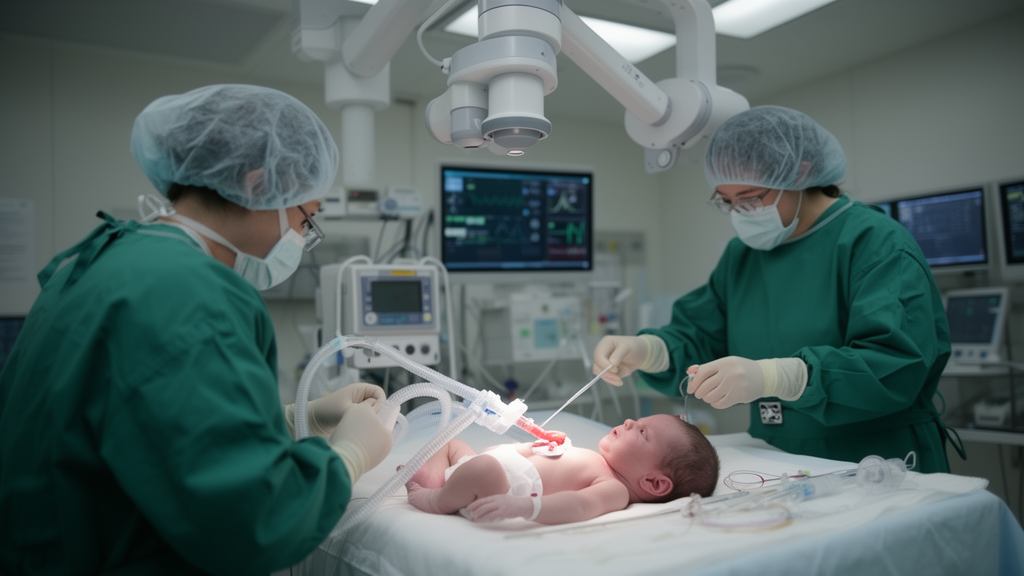
A five-month-old infant born prematurely at 29 weeks of gestation, with severe bronchopulmonary dysplasia, chronic respiratory failure, an atrial septal defect and suspected pulmonary hypertension, underwent a cardiac catheterization in which the ventilator settings used during the procedure changed the measured hemodynamics so markedly that they determined whether she qualified for defect closure. The case, published in Frontiers in Pediatrics, reports that when the anesthetic ventilation was adjusted to match the chronic ventilation needs of bronchopulmonary dysplasia, the measured pulmonary vascular resistance fell from 7.5 to 4.1 Wood units times square meters and the pulmonary-to-systemic blood flow ratio rose from 1.3 to 1.5, values that met the pre-defined criteria for closing the atrial septal defect. The authors, a team from Texas Children’s Hospital and Baylor College of Medicine with collaborators at McGovern Medical School and Texas A&M College of Medicine, present the report as a demonstration of how procedure-specific ventilation can distort or restore the accuracy of hemodynamic measurements in infants whose lungs are far from normal.
The infant had remained in intensive care since birth. Her prenatal history included prolonged premature rupture of membranes, and her postnatal course was complicated by ileal atresia. Serial echocardiography showed elevated right heart pressures, a moderate left-to-right shunt across the atrial septal defect, right atrial and ventricular dilation, enlarged pulmonary arteries, and mild to moderate right ventricular dysfunction. Because of her young age, her chronic respiratory failure and the risks of cardiac catheterization in such a small patient, the team initially deferred hemodynamic assessment. Pulmonary hypertension was instead diagnosed by echocardiography, and treatment with sildenafil at 1 mg/kg every six hours was started.
That decision ran into a well-recognized hazard. According to the report, initiation of sildenafil in infants with bronchopulmonary dysplasia can be associated with worsening hypoxemia from ventilation-perfusion mismatch, hypotension, and the development of pulmonary edema. This child did clinically worsen, requiring increased respiratory support and the start of diuretics. Chest imaging showed interval worsening of acute-on-chronic pulmonary edema, raising concern that blood flowing through the atrial septal defect was increasing pulmonary congestion. A chest CT ruled out pulmonary vein stenosis or abnormal venous drainage. Fluid restriction and furosemide at 2 mg/kg every eight hours were tried, but imaging continued to show pulmonary edema and echocardiography continued to show the left-to-right shunt and right heart changes.
Faced with pulmonary edema that could not be balanced while the shunt persisted, the team discussed tracheostomy and weighed the fact that the infant was considered young for atrial septal defect device closure. The respiratory symptoms, however, appeared to be partly driven by the edema itself, exacerbated by shunt flow. She was therefore referred for right heart catheterization under Heart Center-approved criteria: a pulmonary-to-systemic blood flow ratio above 1.5 and an indexed pulmonary vascular resistance below 6 Wood units times square meters. At the time of the procedure she was 51 weeks postmenstrual age, weighed 6.22 kg, and was on CPAP at 10 cmH2O with an inspired oxygen fraction of 0.3, on which her capillary blood gas showed a pH of 7.46 and a PCO2 of 51 mmHg. She remained fluid-restricted and continued on furosemide and sildenafil.
After induction of anesthesia with fentanyl, propofol and rocuronium, she was intubated and placed on an anesthesia ventilator with a peak inspiratory pressure of 18 cmH2O, positive end-expiratory pressure of 5 cmH2O, and an inspired oxygen fraction of 0.5. Tidal volumes ranged from 20 to 45 mL, equivalent to 3 to 7 mL/kg. The initial hemodynamic measurements showed a Qp:Qs of 1.3 and an indexed pulmonary vascular resistance of 7.5 Wood units times square meters. Those numbers suggested more pulmonary vascular disease than would be expected from the shunt alone, and they were inconsistent with the clinical picture of increased pulmonary blood flow. Had the procedure ended there, the infant would not have met the criteria for defect closure.
What happened next is the core of the report. In real time, the interventional cardiologist, the anesthesiologist and the pulmonary hypertension pulmonologist concluded that the intraprocedural ventilation was inadequate for the child’s underlying physiology. The settings were changed to reflect chronic bronchopulmonary dysplasia ventilation and her pre-procedural support: peak inspiratory pressure of 22 cmH2O, positive end-expiratory pressure of 10 cmH2O, inspired oxygen fraction of 0.85, and inhaled nitric oxide increased to 40 ppm. These adjustments yielded tidal volumes of about 10 mL/kg. On the new settings, repeat catheterization measured a Qp:Qs of 1.5 and an indexed pulmonary vascular resistance of 4.1 Wood units times square meters, meeting the pre-defined criteria for intervention. The authors attribute the shift to a lower pulmonary vascular resistance in response to the higher oxygen fraction and inhaled nitric oxide, together with ventilator settings better suited to the effects of bronchopulmonary dysplasia.
The full hemodynamic table documents the magnitude of the change. Right ventricular pressure fell from 68/10 to 54/12 mmHg, mean pulmonary artery pressure from 39 to 33 mmHg, and mean right femoral artery pressure from 63 to 51 mmHg, while pulmonary artery wedge pressure stayed at 8 mmHg in both conditions. Superior vena cava oxygen saturation rose from 62 to 79 percent and pulmonary artery saturation from 71 to 87 percent. End-tidal carbon dioxide fell from 51 to 45 mmHg and arterial PCO2 from 54 to 52 mmHg, with arterial pH moving from 7.38 to 7.34. Arterial PO2 rose from 190 to 344 mmHg. The defect was then closed successfully with a 20 mm GORE CARDIOFORM Septal Occluder delivered through a modified 8-French Amplatzer sheath, and the infant returned to the intensive care unit in stable condition.
The aftermath of the procedure supports the physiological reasoning behind the ventilatory adjustment. The infant was able to continue sildenafil treatment for pulmonary hypertension without recurrence of pulmonary edema, and after device closure she was gradually weaned from inhaled nitric oxide and ventilatory support while remaining on oral sildenafil. The authors frame this as the measured and clinical effect of disease-specific perioperative ventilation on hemodynamics in the bronchopulmonary dysplasia population, and as evidence that a multidisciplinary team approach was needed to reach that outcome. They are careful to note that the ventilatory changes that worked for this infant are not universal to all infants with bronchopulmonary dysplasia and should be approached with individualized care.
The mechanistic explanation offered in the discussion is that standard anesthetic ventilator approaches, built around physiologic positive end-expiratory pressure, normal tidal volumes and age-appropriate rates, assume normal lung compliance and homogeneous time constants. Infants with bronchopulmonary dysplasia often sit on the far right of the lung volume-pulmonary vascular resistance curve because of chronic air trapping. In the presence of heterogeneous parenchymal lung disease, such standard settings can worsen variable obstruction, time constant heterogeneity and disparate inflation, compressing pulmonary vessels and promoting hypoxemia- and acidosis-related vasoconstriction. The report states that even when the blood gas looks normal before measurements are taken, regional hypoxia and acidosis can develop over the course of a catheterization, and that the resulting measurements may underestimate Qp:Qs and overestimate pulmonary vascular resistance.
From this single case, the authors draw a general procedural recommendation: assuming the infant has achieved a chronic respiratory steady state, the pre-procedure chronic ventilator settings should be maintained or approximated during catheterization, with attention to inspiratory and expiratory cycling time, positive end-expiratory pressure and tidal volume. They describe a targeted bronchopulmonary dysplasia approach built around higher tidal volumes of 10 to 15 mL/kg, higher positive end-expiratory pressure often above 10 cmH2O, longer inspiratory times, lower respiratory rates, permissive hypercarbia with PCO2 above 45 mmHg, and oxygen saturation goals of 90 to 94 percent, with volume-targeted ventilation and maintenance of functional residual capacity to reduce alveolar collapse and air trapping. Collaboration among neonatology, pulmonology, cardiology, pulmonary hypertension, intensive care and anesthesia teams is described as crucial for respiratory optimization, procedural safety and data integrity. The report is a case study of one infant, so its conclusions describe a mechanism and an approach rather than a tested treatment effect across a population, but it documents in detail how the same heart, catheterized twice under two ventilation strategies within one procedure, produced two different answers, and how the answer that matched the bedside clinical picture was the one obtained under lung-appropriate ventilation.
Subject of Research: Perioperative ventilation strategy during cardiac catheterization in an infant with bronchopulmonary dysplasia and pulmonary hypertension
Article Title: Approach to procedural ventilation in a BPD infant undergoing hemodynamic assessment: a case report
Article References: Filley, E. P., Mossad, E. B., Webb, M. K., Villafranco, N. M., Coleman, R., & Varghese, N. P. (2026). Approach to procedural ventilation in a BPD infant undergoing hemodynamic assessment: a case report. Frontiers in Pediatrics, 14, 1894996. https://doi.org/10.3389/fped.2026.1894996
Image Credits: AI Generated
DOI: 10.3389/fped.2026.1894996
Keywords: bronchopulmonary dysplasia, pulmonary hypertension, atrial septal defect, cardiac catheterization, ventilation, case report, pediatrics, hemodynamics, sildenafil, pulmonary edema, anesthesia, premature infant
Cite Scienmag News
Harold Sullivan. (October 27, 2026). Ventilation Choices Reshaped Heart Catheterization Results in an Infant with Lung Disease. Scienmag. https://scienmag.com/ventilation-choices-reshaped-heart-catheterization-results-in-an-infant-with-lung-disease/
Harold Sullivan. "Ventilation Choices Reshaped Heart Catheterization Results in an Infant with Lung Disease." Scienmag, 27 October 2026, https://scienmag.com/ventilation-choices-reshaped-heart-catheterization-results-in-an-infant-with-lung-disease/. Accessed 27 October 2026.
Harold Sullivan. "Ventilation Choices Reshaped Heart Catheterization Results in an Infant with Lung Disease." Scienmag. October 27, 2026. https://scienmag.com/ventilation-choices-reshaped-heart-catheterization-results-in-an-infant-with-lung-disease/


