


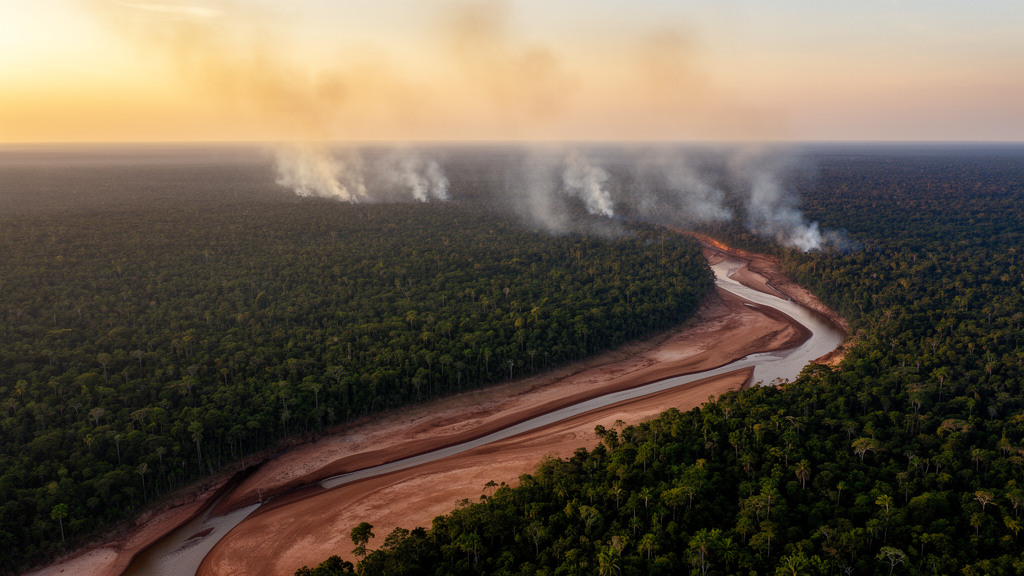
The Amazon rainforest released an average of 0.32 ± 0.08 petagrams of carbon per year into the atmosphere over the past 15 years, according to a new analysis of atmospheric carbon dioxide measurements published in Nature. Fires were the dominant source of that carbon, contributing 0.40 ± 0.07 petagrams per year, while the remaining natural processes of the forest — growth, respiration and non-fire emissions combined — were close to neutral, at −0.08 ± 0.12 petagrams per year. The finding underscores that direct human activity, not the forest’s own carbon cycle, is the principal force turning Amazonia into a carbon source.
The study, led by Luciana V. Gatti and colleagues, draws on 1,017 vertical profiles of air collected twice a month over 15 years from aircraft flying above four Amazonian sampling sites operated under the CARBAM project. The sites span the northeast (Santarem), southeast (Alta Floresta), southwest (Rio Branco) and northwest Amazon region, with the northwest represented by Tabatinga from 2010 to 2012, Tefé from 2013 to 2021 and Cruzeiro do Sul from 2022 onward. Air samples were collected in descending spirals from 4,420 metres down to about 300 metres above sea level, typically between noon and 1 p.m. local time, and analysed with a non-dispersive infrared analyser for carbon dioxide and gas chromatography for carbon monoxide.
To convert those measurements into region-wide carbon fluxes, the team used a column budget technique. They compared the carbon dioxide mole fraction measured in each vertical profile with an estimated background mole fraction, derived from NOAA marine reference stations at Ragged Point, Barbados, and Ascension Island, accounting for the travel time of air parcels moving from the coast to each site. The regions of influence of the four sites were defined by the density of atmospheric back-trajectories computed with the HYSPLIT model, and the whole Amazonia study area — restricted to forest ecosystems and covering 6,700,798 square kilometres — was divided into three regions for scaling. Fire emissions were separated from the total using observed carbon monoxide to carbon dioxide ratios in clearly identifiable dry-season plumes, which ranged from about 56 to 74 parts per billion of carbon monoxide per part per million of carbon dioxide across the sites.
The 15-year record revealed pronounced interannual variability in the carbon balance, ranging from −0.12 to 0.75 petagrams of carbon per year. The authors argue that this swings the need for decadal-scale analyses if the Amazon’s role in the global carbon cycle is to be defined accurately, and they stress that spatial representativeness matters too, given the large variability across the subregions studied. Uncertainties were quantified through Monte Carlo error propagation with 1,000 iterations, incorporating measurement uncertainty of 0.03 parts per million for carbon dioxide, background uncertainties derived from residuals of the fitted carbon dioxide curve, and uncertainties in back-trajectory travel times.
By clustering the 15 years of data with principal component analysis and k-means grouping, the researchers identified three distinct year groups that reveal how the Amazon’s carbon balance shifts with climate stress and human pressure. Group 1 — the wetter years 2011 to 2014, 2017 and 2018, with low deforestation, biomass burning and degradation — showed the smallest emissions, 0.11 ± 0.08 petagrams of carbon per year, representing the forest’s role in the global carbon balance under relatively benign conditions. Group 2, spanning 2019 to 2022, captured years of low climatic stress but high human activity, dominated mainly by deforestation and degradation, with emissions of 0.43 ± 0.13 petagrams per year. Group 3 — 2010, 2015, 2016, 2023 and 2024 — comprised warm and dry years marked by El Niño events and warming of the Tropical North Atlantic Ocean, and produced the highest emissions, 0.49 ± 0.07 petagrams per year, associated with biomass burning.
Notably, the authors report that groups 2 and 3 do not differ significantly in their carbon emissions, and that both are dominated by human activity — deforestation in the low-stress years and biomass burning in the warm, dry years. Across all three groups, the net biome exchange, which represents natural sources and sinks plus non-fire anthropogenic emissions, remained close to neutral. In the authors’ assessment, this pattern indicates that direct human activities are the main risk to the Amazon forest, with climate stress acting as an amplifier of human impacts rather than the primary driver.
The analysis also quantified how long-term deforestation and degradation have altered the region’s climate itself. Over the past 46 years, these pressures reduced annual precipitation by about 8 percent and dry-season peak precipitation by about 20 percent, while raising the annual mean temperature by 1.13 ± 0.13 degrees Celsius and the dry-season temperature by 1.81 ± 0.18 degrees Celsius. Forest loss reduces precipitation, increases temperatures and lengthens the dry season, driving higher carbon emissions; climate stress is stronger in more deforested regions, rendering forests progressively more flammable. Large-scale climate events such as El Niño further amplify these regional impacts.
The fire signal is central to the findings. The authors conclude that drastic fire reduction is essential to avert a tipping point, especially as escalating climate stress amplifies human impacts and vice versa. They note a caveat in their fire estimates: as the forest becomes drier and hotter over time, the carbon monoxide to carbon dioxide ratio in burning tends to decline, so using a single mean ratio likely underestimates recent fire emissions. It is probable, they write, that carbon emissions from fires in 2023 and 2024 — both drought years — were higher than their averages indicate.
Looking forward, the study draws on the consequences of the very strong 2015–2016 El Niño, after which the southeast Amazon region became an increasing source of carbon, and expects similar consequences following the strong El Niño and Tropical North Atlantic warming events of 2023–2024. The authors highlight the urgent need to implement a zero-deforestation policy, strengthen controls on biomass burning and prioritize forest restoration programmes.
The work rests on a dense observational and methodological apparatus. Deforestation data came from the PRODES project of Brazil’s National Institute for Space Research, based on a historical series of Landsat images with an accuracy of 93.5 percent, and monthly deforestation and degradation alerts came from the DETER system. Burned area was taken from MapBiomas Fire, validated with a global accuracy of 89 percent, and fire spots from INPE’s BDQueimadas monitoring programme. Precipitation, temperature, vapour pressure deficit and vegetation index data were drawn from the GPCP, ERA-5 and Climatic Research Unit products, weighted spatially by each site’s region of influence. Missing monthly flux data were imputed with the missForest algorithm, and group differences were assessed with Welch’s analysis of variance followed by Games–Howell post hoc tests, chosen for their robustness given the small sample size of 15 years. The authors also addressed a proposed correction to their gas measurements based on comparisons with in situ cavity ring-down spectrometer data, concluding that such an adjustment would conflate multiple methodological differences between the two systems and was therefore not applied. All underlying carbon dioxide and carbon monoxide data, backgrounds and trajectories are archived in the PANGAEA Data Archive for the period 2010 to 2024.
Subject of Research: A 15-year atmospheric measurement study of Amazonian carbon fluxes, fire emissions and the roles of deforestation and drought
Article Title: Amazon carbon emissions driven by human actions amplified by droughts
Article References: Gatti, L. V., Cunha, C. L., Blas, J. C. G., Denning, A. S., Reis, M. S., Marani, L., Arai, E., Messias, C. G., Conciani, D. E., Miller, J. B., Schumacher, V., Naccarato, K. P., Marengo, J., Alencar, A. A. C., Soler, L., Almeida, C., Domingues, L. G., Correia, C. S. C., Neves, R. A. L., … Machado, G. B. M. (2026). Amazon carbon emissions driven by human actions amplified by droughts. Nature. https://doi.org/10.1038/s41586-026-11168-1
Image Credits: AI Generated
DOI: 10.1038/s41586-026-11168-1
Keywords: Amazon rainforest, carbon balance, carbon dioxide, deforestation, biomass burning, El Niño, drought, vertical profiles, carbon monoxide, fire emissions, climate stress, net biome exchange
Cite Scienmag News
Sloane Callahan. (October 27, 2026). Fires and drought push Amazon carbon balance to 0.32 PgC per year. Scienmag. https://scienmag.com/fires-and-drought-push-amazon-carbon-balance-to-0-32-pgc-per-year/
Sloane Callahan. "Fires and drought push Amazon carbon balance to 0.32 PgC per year." Scienmag, 27 October 2026, https://scienmag.com/fires-and-drought-push-amazon-carbon-balance-to-0-32-pgc-per-year/. Accessed 27 October 2026.
Sloane Callahan. "Fires and drought push Amazon carbon balance to 0.32 PgC per year." Scienmag. October 27, 2026. https://scienmag.com/fires-and-drought-push-amazon-carbon-balance-to-0-32-pgc-per-year/


