


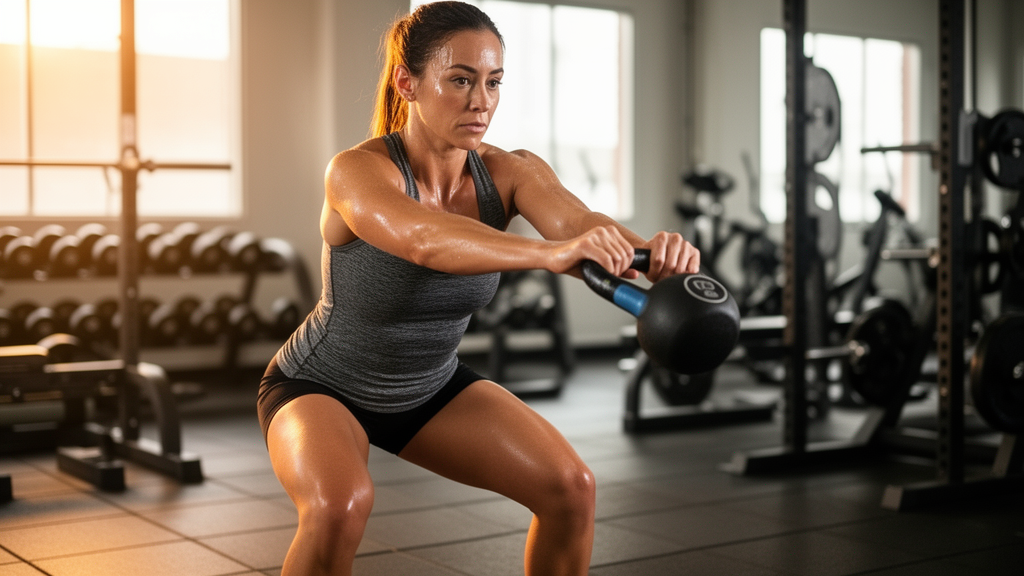
Coaches and athletes who train in the style of high-intensity functional training, or HIFT, have long lacked a reliable way to say how much work a workout actually demands. A new review article published in Frontiers in Sports and Active Living on 27 October 2026 offers a standardized set of equations for estimating the positive external mechanical work of the exercises most commonly programmed in HIFT, drawing on simplified biomechanical models, published movement standards, and average anthropometric data from competitive athletes. The authors, Gerald T. Mangine and Caralynn Doese of Kennesaw State University and Adam R. Jajtner of Kent State University, present their work as an exercise compendium covering weightlifting, plyometric, calisthenic, gymnastics, and continuous modalities.
The problem the paper addresses is structural. Unlike traditional strength or endurance training, where specific workouts recur frequently and coaches can adjust familiar workloads with minor tweaks, HIFT workouts rarely repeat. They combine multiple exercise modalities, prescribe different loads and repetition counts, and offer no consistent recommendations for sequencing or volume. A recent scoping review of 60 studies examining acute responses to 35 different HIFT workouts found inconsistent research methods and extreme variability in physiological responses, with sample populations and outcome variables often different and poorly described. The one consistent finding was that intensity, measured by heart rate and lactate responses, matched the terms “high intensity” or “vigorous” effort, but the qualifying ranges for those terms are too large to distinguish true difficulty between workouts.
Without a common workload metric, coaches cannot associate a specific physiological response with a precise intensity or workload, making it impossible to predict whether an intended stimulus is being met or exceeded. The authors note that when training programs cannot consider the simultaneous physiological effects of a stimulus, there is an elevated risk of overtraining, maladaptation, and injury. Although research on HIFT injury does not suggest an enhanced risk compared with traditional training styles, the risk appears most affected by training experience, training frequency, and coaching quality. The compendium aims to fill this gap by giving coaches a reproducible, field-based method for quantifying the mechanical demands of individual exercises and entire workouts.
The core physics is straightforward. Mechanical work is the product of force and displacement in the direction of that force, conventionally expressed in joules. Because the simplified equations generally multiply load mass in kilograms by vertical displacement in meters, results are reported as kilogram-force meters, where one kgf·m equals 9.80665 joules. For many HIFT exercises, positive external mechanical work is dominated by vertical displacement against gravity, and the expected displacement can be approximated because correct execution depends on adherence to published movement standards. The estimates characterize positive external mechanical work only and should not be interpreted as direct measures of force, internal joint work, tissue stress or strain, or musculoskeletal loading.
To build the models, the authors estimated concentric displacement and force expression for every exercise programmed into the CrossFit Open between 2011 and 2025, using the movement standards described in official workout cards and enforced by certified judges. Displacements were quantified for the minimum standard, meaning exactly parallel for a parallel squat, based on anthropometric data for the average male competitor, 85.6 kilograms and 177.2 centimeters tall, and the average female competitor, 62.6 kilograms and 163.6 centimeters tall. Body-segment lengths for the head, neck, torso, arms, legs, and feet were estimated using established techniques, and segment masses were assigned as percentages of total body mass. For each exercise, the vertical displacement of the external load multiplied by its mass is added to the displacement of the athlete’s center of mass multiplied by the relevant percentage of body mass.
The tables distinguish carefully between exercises. Deadlifts and shoulder press are the only movements where body mass is excluded from the calculation, because changes in the center of mass position come almost entirely from the external load. Squatting exercises assign 88 percent of body mass to the moving center of mass, walking lunges 84 percent, and push-ups 72.1 percent, the average of reported values for the up and down positions. Squat depths were calculated from previously identified average joint angles at the ankle, knee, and hip during the front squat for parallel squats, a 45-degree knee and hip angle for quarter squats, and kinematic analysis of a pistol squat for deep squats. For exercises beginning from the floor, such as hang power cleans or thrusters, the equations cover subsequent repetitions and recommend adding an initial deadlift or clean to account for the first repetition from the ground.
The gymnastics section introduces adjustments for technique. Because kipping and butterfly pull-ups use momentum and elastic energy to reduce the force needed per repetition, the authors performed a kinematic analysis of a kipping pull-up to quantify the gravitational potential energy generated during the kip, then subtracted it from the strict-movement work, assuming complete conservation of energy. Kipping handstand push-ups are estimated at roughly 72 percent of the strict version, based on a recent study of axial head and neck forces that reported mean kipping peak force of 991 newtons against an estimated strict requirement of about 775 newtons. Toes-to-bar, which follows an arced rather than linear path, is modeled through hip rotation using adjusted Zatsiorsky-Seluyanov segment parameters, with only the lower-body mass, roughly a third of total body mass, contributing to the work.
Continuous modalities require different approaches. For rowing, skiing, and cycling on ergometers, workload can be derived from the performance monitor by multiplying average watts by duration in seconds and converting joules to kgf·m. When calories are the prescribed variable, they must first be corrected for body mass, since Concept2 bases its calorie estimate on a 79.5-kilogram reference user, then converted to energy and adjusted for the roughly 75 to 80 percent of energy lost as heat. The authors caution that these data should be compared within, not between, ergometer brands, because only Concept2 has publicly disclosed the basis of its monitor estimates. For running, the estimate relies on an approximation of 0.25 kilocalories of external mechanical work per kilogram per kilometer, converted to kgf·m.
Worked examples apply the equations to select CrossFit Open workouts using 50th-percentile scores. For workout 13.4, a seven-minute AMRAP of clean and jerks and toes-to-bar, the estimated total work was 5,900 kgf·m for men and 3,244 kgf·m for women, corresponding to work rates of 843 and 463 kgf·m per minute. Workout 23.2a, a 15-minute AMRAP of burpee pull-ups and shuttle runs, produced the largest estimates at 24,005 and 15,516 kgf·m. A sensitivity analysis found that changing stature alone had no effect on rowing estimates, changed box jump estimates by less than 1 percent, and changed thruster, burpee, and kipping pull-up estimates by about 4 percent, while the largest differences, roughly 13 percent below to 14 percent above the standard models, occurred when stature and body mass changed together.
The authors are explicit about the limits of their framework. The equations have not been validated against criterion measurements from force platforms or three-dimensional motion capture, and they assume repetitions are performed exactly to movement standards with optimal efficiency, making them minimum-displacement estimates rather than exact representations of any athlete’s movement. Metabolic work cannot yet be reliably estimated during HIFT, and work rate should not be interpreted as a measure of fatigue, metabolic stress, or tissue loading. Eccentric work, horizontal resistance such as sled pushing, and exercises lacking published standards, including kettlebell swings and rope climbs, are excluded. Still, the framework offers coaches and researchers a common language for comparing workout prescriptions, organizing program design, and reporting the mechanical demands of HIFT, with the authors recommending that athlete-specific measurements replace the standardized inputs whenever they are available.
Subject of Research: Standardized methods for estimating mechanical work in high-intensity functional training exercises
Article Title: Standard methods for estimating mechanical work in high-intensity functional training: an exercise compendium
Article References: Mangine, G. T., Doese, C., & Jajtner, A. R. (2026). Standard methods for estimating mechanical work in high-intensity functional training: an exercise compendium. Frontiers in Sports and Active Living, 8, 1974999. https://doi.org/10.3389/fspor.2026.1974999
Image Credits: AI Generated
DOI: 10.3389/fspor.2026.1974999
Keywords: high-intensity functional training, mechanical work, CrossFit Open, biomechanics, training load, work rate, exercise programming, anthropometrics, kipping, ergometry, movement standards, coaching
Cite Scienmag News
Katie Riggs. (October 27, 2026). New Equations Estimate the Mechanical Work of CrossFit-Style Workouts. Scienmag. https://scienmag.com/new-equations-estimate-the-mechanical-work-of-crossfit-style-workouts/
Katie Riggs. "New Equations Estimate the Mechanical Work of CrossFit-Style Workouts." Scienmag, 27 October 2026, https://scienmag.com/new-equations-estimate-the-mechanical-work-of-crossfit-style-workouts/. Accessed 27 October 2026.
Katie Riggs. "New Equations Estimate the Mechanical Work of CrossFit-Style Workouts." Scienmag. October 27, 2026. https://scienmag.com/new-equations-estimate-the-mechanical-work-of-crossfit-style-workouts/


