


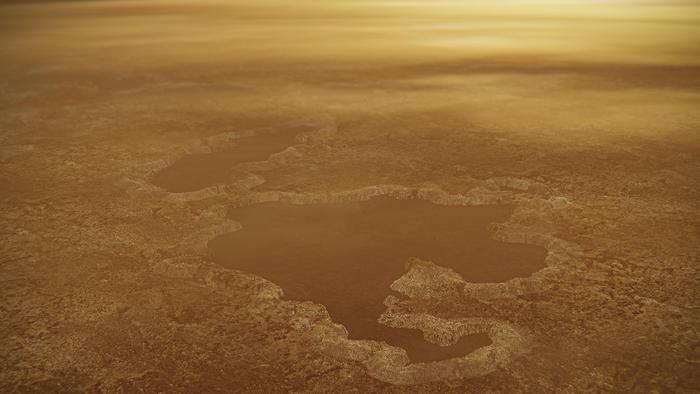
Titan, the largest moon of Saturn, has long captured the attention of scientists and enthusiasts alike with its eerie, alien landscapes. Distinctive for its rivers and lakes composed of liquid methane, alongside icy terrains and dark, soot-like dunes, Titan is a subject of immense intrigue because of its intriguing geology and chemical composition. The thick, hazy atmosphere enveloping the moon fuels speculation about the potential for life to exist beneath its icy crust. This desire to uncover the mysteries of Titan has led to groundbreaking research spearheaded by an international team of scientists.
In a recent study, a collaborative effort led by Antonin Affholder, a postdoctoral research associate at the University of Arizona’s Department of Ecology and Evolutionary Biology, alongside researchers from Harvard University, aims to shed light on what life on Titan might resemble, where it might thrive, and the implications of its existence. This investigation is particularly concentrated on Titan’s distinctive characteristics compared to other icy moons in our solar system. Among these differentiating features is the rich abundance of organic materials, which lay the groundwork for potential biological processes.
Utilizing bioenergetic modeling, the research team indicated that Titan’s subsurface ocean, estimated to plunge approximately 300 miles beneath the moon’s surface, may provide conditions conducive to lifeforms that thrive on organic materials. Despite the findings being published in The Planetary Science Journal, the conclusions suggest that while Titan has the propensity to host simple, microscopic life, the overall biomass it can sustain is likely limited to only a few pounds. This estimate poses challenging questions regarding the potential for life in such a frigid and distant environment.
Often characterized as “Earth-like on the surface and an ocean world underneath,” Titan is set to be explored further through NASA’s forthcoming Dragonfly mission. The discussions surrounding potential life scenarios on Titan have expanded based on its complex organic chemistry; however, previous models have at times been overly simplistic, a critique raised by Affholder during the study’s dissemination. The common theory posited that Titan’s plentiful organics would inherently denote a rich food source available to sustain life. Yet, Affholder’s research indicates the necessity for a more detailed analysis of the moon’s biochemical environment.
At the heart of this innovative research lies a straightforward yet focused approach to exploring life on Titan: fermentation. This metabolic process, which many Earth-dwellers might recognize through its use in the culinary realm—think sourdough bread and beer brewing—entirely circumvents the need for an oxidant like oxygen. This pivotal study aims to delineate whether microbes, potentially akin to terrestrial lifeforms, could thrive on organic substrates in the harsh, ethereal environment of Titan.
Fermentation is posited to have appeared early in Earth’s biological evolution, underscoring its foundational nature. This premise leads scientists to consider whether similar forms of life might exist on Titan. Affholder articulated this hypothesis, questioning the potential for microorganisms to infest the moon’s subsurface habitat, which could be nourished by the vast stockpile of abiotic organic compounds produced in Titan’s atmosphere and collected at its surface.
An essential component of this detailed exploration examined a specific organic molecule: glycine, the simplest known amino acid. Glycine is believed to be a common entity across primordial materials throughout the solar system, found in various extraterrestrial domains like asteroids and comets. Capturing the significance of glycine, Affholder noted its notable abundance across celestial objects involved in the formation of the solar system. The presence of autochthonous materials is foundational to understanding Titan’s potential for hosting life.
However, computer simulations that accompanied the study revealed a sobering reality: a significant portion of Titan’s extensive organic compounds may not be bioavailable for microbial consumption. The survival of hypothetical glycine-consuming microbes in Titan’s ocean hinges upon a consistent influx of glycine from the surface, across the moon’s formidable icy shell. Previous research by the same team revealed that impacts from meteorites on Titan’s icy crust could create transient melt pools, allowing substances from the surface to filter into the ocean beneath.
Affholder elucidated that the results showed the availability of these nutrients may be insufficient to support even a modest microbial community. The projections suggest a meager living biomass; an estimate indicates merely a few kilograms could exist within the entire oceanic expanse of Titan, comparing this to the mass equivalent of a small dog. Such limited biology means the expected average density of life forms could result in less than a single cell residing per liter of oceanic water—a staggering realization when one considers the vastness of Titan’s subsurface ocean.
As scientists prepare for future missions to explore Titan, the likelihood of locating life – should it exist – might prove tantamount to searching for a needle in an expansive haystack. The overarching conclusion drawn from the study suggests that Titan’s intriguing inventory of organic compounds may not contribute to the moon’s habitability as freely as one may instinctively surmise, emphasizing the necessity of a more comprehensive understanding of the moon’s environmental dynamics.
This research was funded by the International Space Science Institute in Bern, Switzerland, reflecting the collaborative nature of the scientific inquiry involved in exploring one of the solar system’s most enigmatic bodies. As exploration continues, the anticipation surrounding discoveries on Titan remains high, urging scientists to ponder the larger questions regarding life’s origins and the diversity of biological processes that may exist beyond our home planet.
Keywords
Titan, Saturn, life forms, glycine, organic molecules, bioenergetic modeling, fermentation, extraterrestrial biology.
Cite Scienmag News
Violet Maxwell. (April 7, 2025). New Study Suggests Saturn’s Moon Titan May Support Limited LifeForms. Scienmag. https://scienmag.com/new-study-suggests-saturns-moon-titan-may-support-limited-lifeforms/
Violet Maxwell. "New Study Suggests Saturn’s Moon Titan May Support Limited LifeForms." Scienmag, 7 April 2025, https://scienmag.com/new-study-suggests-saturns-moon-titan-may-support-limited-lifeforms/. Accessed 31 August 2026.
Violet Maxwell. "New Study Suggests Saturn’s Moon Titan May Support Limited LifeForms." Scienmag. April 7, 2025. https://scienmag.com/new-study-suggests-saturns-moon-titan-may-support-limited-lifeforms/


