


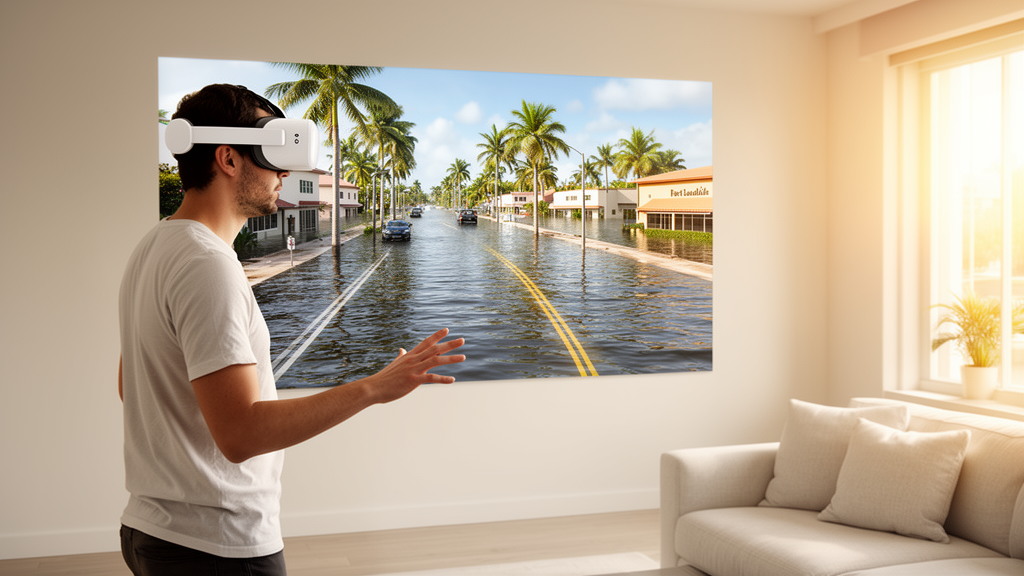
The experience, called Flooding Explorer: Fort Lauderdale, was developed by Florida Atlantic University and its partners and uses a 3D simulation anchored at the historic Bonnet House Museum and Gardens. Users can navigate the city, view aerial perspectives and adjust a slider to compare flooding scenarios involving high tides, heavy rainfall, storms and future sea level rise.
“Virtual reality lets people experience flooding in ways that maps and statistics alone cannot,” said Serena Hoermann, Ph.D., director of FAU’s Center for Urban and Environmental Solutions and an assistant research professor in the School of Environmental, Coastal, and Ocean Sustainability within FAU’s Charles E. Schmidt College of Science, who spearheaded the project. “By showing how flooding could affect familiar places, we hope to make these risks more tangible and demonstrate how decisions made today can help communities prepare for the future.”
The experience opens at Bonnet House, a 35-acre historic estate built in 1920 on a subtropical barrier island. Its builders selected the highest available ground, approximately 13 feet above sea level, illustrating how people have long adapted to the challenges of living along the coast. Today, however, rising seas and changing flood conditions pose growing challenges even for places with a history of resilience. From that starting point, users can explore a 3D model of Fort Lauderdale that stretches from Las Olas Boulevard and waterfront hotels to the Museum of Discovery and Science, Victoria Park and other inland neighborhoods.
The model shows how water can affect areas far from the ocean, including a scenario at Caron Drive and Northeast 20th Avenue where water moves inland from the Intracoastal Waterway. The simulation also shows how a five-year storm could flood streets and neighborhoods under current conditions. With 3 feet of sea level rise combined with king tides, flooding could reach farther inland.
The scenarios escalate from there. At 4 feet of sea level rise, stormwater drainage systems could be strained across large areas, while 5 feet could leave some residential and commercial areas persistently or permanently flooded, forcing difficult decisions about infrastructure, adaptation and potential relocation. The developers are careful to frame these images as possibilities rather than forecasts. “It’s important to note that these are illustrative scenarios, not predictions,” Hoermann said. “They demonstrate how rising seas and extreme weather can compound flood risks and why planning ahead is essential.”
The timing of the release is especially relevant as South Florida enters another period of exceptionally high seasonal tides. The South Florida Water Management District identifies Oct. 27, 2026, as a predicted annual maximum high-tide peak along Florida’s east coast. Fort Lauderdale’s broader king tide period runs from Oct. 24 to 31, when elevated water levels, rainfall and other weather conditions could increase flooding in vulnerable areas. Actual water levels and local flooding will depend on conditions at the time, the university notes.
The experience is not only about depicting risk. It also highlights solutions to reduce flood risks, including improved drainage, pumping stations, elevated seawalls, wetland restoration and green infrastructure. It emphasizes flexible, phased adaptation strategies that address immediate risks while preparing communities for future conditions. “Flooding is an engineering challenge, a community planning challenge and an economic challenge,” said Fred Bloetscher, Ph.D., associate dean for undergraduate studies and community outreach in FAU’s Department of Civil, Environmental and Geomatics Engineering within the College of Engineering and Computer Science. “We need to understand not only where water may go, but also how our drainage systems, roads, buildings and other infrastructure will perform as conditions change. Experiences like this can help people visualize those challenges and recognize the importance of investing in solutions before the next flood occurs.”
The project brings together FAU, Virtual Planet Technologies, the Florida Division of Emergency Management, the Federal Emergency Management Agency, Bonnet House Museum and Gardens, and the Museum of Discovery and Science. Funding was provided by the Florida Division of Emergency Management and FEMA. Juliano Calil, Ph.D., founder of Virtual Planet Technologies, is among the project’s collaborators, along with Bloetscher and other contributors. The VR experience is designed to support education, research and resilience planning by helping residents, students, decision makers and visitors consider how today’s choices could affect tomorrow’s communities.
The experience is available in English and Spanish, includes closed captions, and is also accessible through a web-based version, extending its reach beyond those using VR headsets. That broader reach matters because the underlying questions the simulation poses apply well beyond one city: what would Fort Lauderdale look like with 3, 4 or 5 feet of sea level rise, how could a king tide or a sudden downpour flood neighborhoods far from the beach, and what can communities do today to prepare for a future in which flooding becomes more frequent.
Subject of Research: A virtual reality simulation of flooding scenarios in Fort Lauderdale, Florida.
Article Title: New FAU virtual reality experience brings Fort Lauderdale’s flooding future to life
Article References: New FAU virtual reality experience brings Fort Lauderdale’s flooding future to life. Original publication (Bibliographic details unavailable.)
Image Credits: AI Generated
DOI: Not provided
Keywords: virtual reality, Fort Lauderdale, sea level rise, king tides, flooding, Florida Atlantic University, coastal resilience, climate adaptation, stormwater drainage, Bonnet House, South Florida, flood risk
Cite Scienmag News
Sloane Callahan. (October 27, 2026). Virtual Reality Puts Users Inside Fort Lauderdale’s Possible Flooding Future. Scienmag. https://scienmag.com/virtual-reality-puts-users-inside-fort-lauderdales-possible-flooding-future/
Sloane Callahan. "Virtual Reality Puts Users Inside Fort Lauderdale’s Possible Flooding Future." Scienmag, 27 October 2026, https://scienmag.com/virtual-reality-puts-users-inside-fort-lauderdales-possible-flooding-future/. Accessed 27 October 2026.
Sloane Callahan. "Virtual Reality Puts Users Inside Fort Lauderdale’s Possible Flooding Future." Scienmag. October 27, 2026. https://scienmag.com/virtual-reality-puts-users-inside-fort-lauderdales-possible-flooding-future/


