


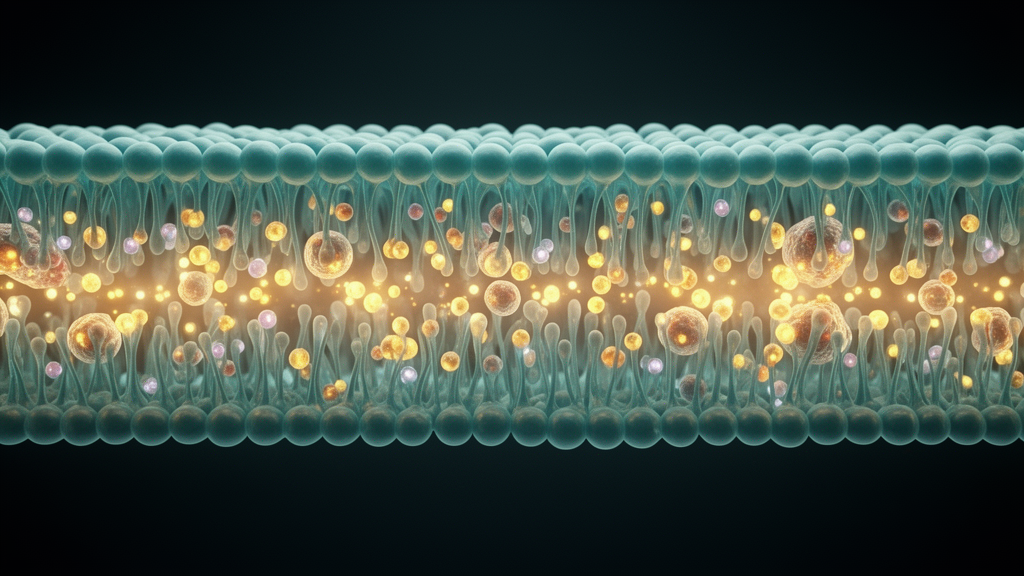
Membrane science is quietly undergoing a conceptual shift. For decades, membranes were treated as passive barriers: thin sheets that let some molecules through and held others back. A new mini review published in Frontiers in Membrane Science and Technology argues that this picture no longer matches reality. In many modern systems, the authors write, a membrane is better described as a miniature reactor in which chemical transformations are coupled with the simultaneous separation of the reaction products. The review, led by Victor Nikonenko of Kuban State University in Krasnodar, Russia, together with colleagues from the Kurnakov Institute of General and Inorganic Chemistry in Moscow, traces how the field moved from the simple models of the 1950s and 1960s to today’s nanoscale, multifunctional designs.
In the early decades of membrane applications, the dominant processes were electrodialysis, an electrically driven method using single-layer cation- and anion-exchange membranes, and reverse osmosis, a pressure-driven process using finely porous membranes that could pass only water molecules. The theoretical picture matched this simplicity: ions and molecules were treated as point charges interacting with a charged matrix solely through electrostatic and friction forces. That framework was adequate because the membranes themselves were structurally simple and the target processes, desalination and concentration, demanded little more than a coarse barrier function.
Today’s membranes are far more demanding. The review organizes the field with a structure-to-transport-mechanism-to-process-to-application framework, ordered by increasing transport complexity: from a single driving force and a single conduction mechanism, through transport coupled with chemical reactions and mixed ionic-electronic conduction, to systems that apply two driving forces at once. The authors argue that less attention has been paid to the whole chain linking membrane structure, selective transport mechanisms, process-level performance and applications across membranes of different natures, polymeric, ceramic and metallic, and different driving forces. Their review is an attempt to close that gap.
One of the most striking recent results concerns the so-called conductivity-selectivity trade-off. Conventionally, making a membrane more conductive comes at the cost of losing selectivity, and vice versa. The authors emphasize that this trade-off is an empirical tendency rather than a fundamental law, although it holds for most conventional membranes. They cite work on perfluorosulfonic acid membranes of the Aquivion type, which have shorter side chains than Nafion. Shorter side chains have lower mobility and create a higher concentration of fixed groups, favouring higher conductivity. As the external electrolyte concentration rose from one to 1.5 moles per litre, researchers observed both membrane conductivity and selectivity increasing together, behaviour that defies the classical trade-off. The explanation lies in structural rearrangement: neighbouring ionic clusters merge and intercluster channels narrow, shortening the transport path of the counterion while lengthening that of the coion.
The review also highlights a class of membranes that could dramatically cut the cost and environmental burden of perfluorinated materials. Track-etched porous substrates filled with perfluorosulfonic acid polymer can be as thin as 10 micrometres, yet their mechanical strength exceeds that of homogeneous Nafion membranes. One reported PFSA-track-etched membrane, 20 micrometres thick with pores of 140 nanometres in diameter and 14 percent porosity, showed an electrical resistance of 0.4 ohm square centimetres in 0.5 molar sodium chloride solution, considerably lower than the 1.9 ohm square centimetres of Nafion 117. Its sodium ion transport number was 0.976, slightly below Nafion’s 0.999, but it contains 16 times less perfluorinated polymer per unit area, and 2.6 times less than even the thin Nafion NRE 211 membrane. Lower cost, the authors suggest, could extend perfluorinated membrane use into electrodialysis concentration applications.
Selectivity itself is being rethought. The main mechanism in commercial monovalent-ion-selective membranes is electrostatic repulsion, for example a layer of anion-exchange material deposited on a cation-exchange membrane that blocks multivalent cations more than monovalent ones. But the review stresses that the difference in dehydration energy between ions is more significant than the difference in electrostatic interaction energy. To enter a membrane pore, an ion must overcome several barriers of different natures: steric exclusion, dielectric exclusion, electrostatic interactions with fixed charges, dynamic selectivity based on ion mobility, differences in hydration energy, and pH effects. These mechanisms are not unique to electrically driven processes; steric, electric and dielectric exclusion equally govern ion rejection in pressure-driven nanofiltration.
Tuning the interplay between these barriers opens a route to membranes selective towards one specific ion. Crystalline-framework and metal-polymer membranes with ordered sub-nanometre channels have been developed that recover monovalent ions by a precise match between channel size and dehydration energy. Charged layered double hydroxide membranes exploiting both size exclusion and electrostatic effects have yielded selectivity coefficients of 5.7 for potassium over lithium and 4.0 for sodium over lithium in binary-cation systems. Even more striking are membranes containing lithium-bearing mixed-metal oxides such as spinel LiMn2O4 combined with electronically conducting carbon nanotubes. In the spinel lattice, lithium occupies tetrahedral sites connected by narrow channels largely inaccessible to sodium, potassium and magnesium, and each inserted lithium ion is charge-compensated by the reduction of one manganese ion. Under cathodic polarization the material takes up lithium from the feed; under anodic polarization it releases it, making the process cyclic or pseudo-continuous, an electrochemical ion pump.
The practical payoff of this mechanism-driven design is visible in lithium and ammonium recovery, applications the authors say increasingly drive the study of transport mechanisms. A comparison table in the review shows that selective electrodialysis and nanofiltration with commercial membranes deliver high lithium fluxes at moderate selectivity, while membrane capacitive deionization with LiMn2O4 electrodes achieves far higher selectivity for lithium over sodium and potassium, and an electrochemical ion pump shows moderate lithium-magnesium selectivity at lower fluxes. Energy consumption for the latter two processes falls within 0.2 to 1 kilowatt-hour per mole of lithium. The authors caution, however, that most of these data were obtained on membrane areas of only 0.0001 to 0.01 square metres, and that verification with real feeds and at larger scale is a necessary next step. Manganese dissolution from LiMn2O4 during cycling, fouling, scaling and reproducibility in large-area fabrication all remain practical obstacles.
Ammonium recovery illustrates how membrane methods can compete with established industrial chemistry. Electrodialysis methods of ammonia recovery from wastewater have experimentally demonstrated energy consumption of 12 to 20 megajoules of electrical energy per kilogram of nitrogen, which corresponds to roughly 23 to 38 megajoules per kilogram when converted to primary energy. The Haber-Bosch process, by contrast, consumes about 40 megajoules of primary energy per kilogram of nitrogen as a world-average value, and requires about 6.4 times ten to the twelfth megajoules per year worldwide, roughly one percent of global energy consumption and 0.93 percent of greenhouse-gas emissions. A life-cycle assessment cited in the review found that, among electrodialysis, membrane contactor and ion exchange technologies for ammonium recovery, electrodialysis showed the lowest environmental impact, and it can run reagent-free while simultaneously rendering wastewater harmless by removing the ammonium that would otherwise cause eutrophication.
The review closes with a warning that applies across the field: a highly selective membrane can lose much of its benefit if concentration polarization is not controlled. At high current densities, transport control passes from the membrane itself to the depleted diffusion layer at its surface, which is non-selective, and coupled phenomena such as electroconvection and water splitting come into play. Hydrodynamic design, through spacers and profiled membranes, must therefore advance together with new selective materials; replacing a flat anion-exchange membrane with a profiled one in an experimental channel increased mass transfer by a factor of three, and up to ten at lower feed concentrations. The broader trajectory the authors describe is unmistakable: membranes are evolving from passive barriers towards multifunctional systems in which transport is coupled with chemical reactions, electronic conduction or a second driving force, and realizing that vision will depend on both new materials and predictive multiscale modelling, increasingly assisted by artificial intelligence.
Subject of Research: The interplay between membrane nanostructure, ion-selective transport mechanisms and emerging coupled membrane processes
Article Title: Membrane transport and applications: from structure and selectivity mechanisms to coupled processes
Article References: Nikonenko, V., Yaroslavtsev, A., Pismenskaya, N., & Butylskii, D. (2026). Membrane transport and applications: from structure and selectivity mechanisms to coupled processes. Frontiers in Membrane Science and Technology, 5, Article 1979356. https://doi.org/10.3389/frmst.2026.1979356
Image Credits: AI Generated
DOI: 10.3389/frmst.2026.1979356
Keywords: membrane science, ion transport, selectivity, electrodialysis, lithium recovery, ammonium recovery, bipolar membranes, concentration polarization, mixed ionic-electronic conduction, nanofiltration, LiMn2O4, dehydration energy
Cite Scienmag News
Denise Maddox. (October 27, 2026). Membranes evolve from passive barriers into multifunctional selective reactors. Scienmag. https://scienmag.com/membranes-evolve-from-passive-barriers-into-multifunctional-selective-reactors/
Denise Maddox. "Membranes evolve from passive barriers into multifunctional selective reactors." Scienmag, 27 October 2026, https://scienmag.com/membranes-evolve-from-passive-barriers-into-multifunctional-selective-reactors/. Accessed 27 October 2026.
Denise Maddox. "Membranes evolve from passive barriers into multifunctional selective reactors." Scienmag. October 27, 2026. https://scienmag.com/membranes-evolve-from-passive-barriers-into-multifunctional-selective-reactors/


