


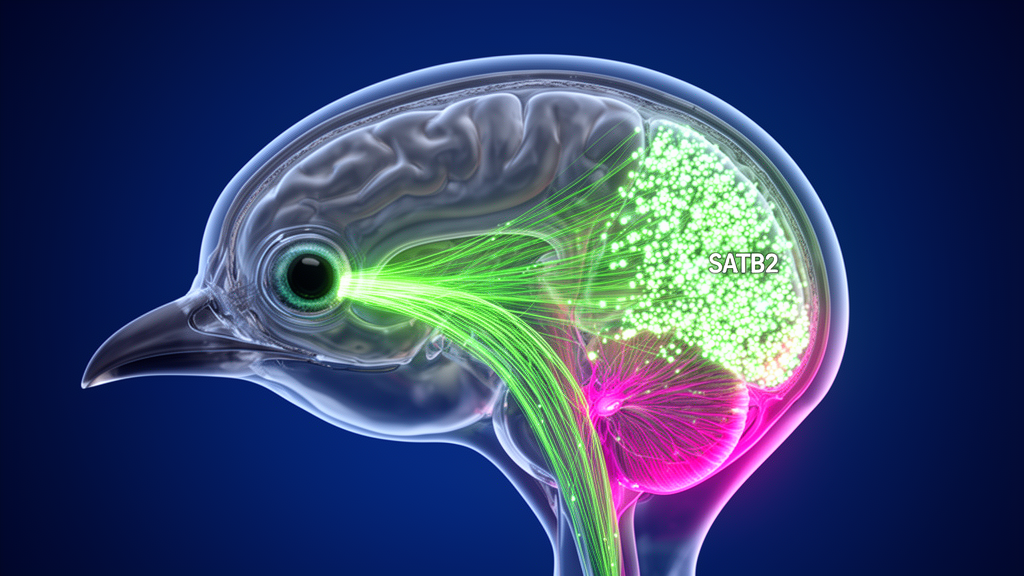
In a study of pigeons published in iScience, researchers traced connections between the entopallium (E), a region that handles elementary visual features such as color, orientation and luminance, and the mesopallium ventrolaterale (MVL), a higher-order area implicated in invariant object recognition and complex category learning. The work combined viral neural tracing, immunocytochemistry, single-cell transcriptomic analysis, computational ligand-receptor prediction, electrophysiology and three-dimensional neuron reconstruction to build what the authors describe as a comprehensive picture of the E-MVL circuit.
In this pathway, the thalamic nucleus rotundus projects to the entopallium, and the entopallium in turn projects to further regions including the MVL, the nidopallium and the arcopallium. The entopallium is regarded as functionally comparable to the mammalian extrastriate cortex, whereas the MVL carries out more abstract computations. During amniote evolution, the avian pallium, characterized by its nuclear organization, has undergone substantial morphological changes relative to the mammalian neocortex. Comparative developmental and transcriptomic studies indicate that although most inhibitory neuron types are conserved among amniotes, glutamatergic pallial neurons have diverged, making the avian visual system an instructive case for understanding how sensory processing is organized in advanced vertebrates.
To map the physical wiring, the team injected an anterograde herpes simplex virus tracer, HSV-H129-4G, unilaterally into either the E or the MVL of pigeons. After testing labeling intervals between 36 and 76 hours, they settled on 56 hours as the optimal window for visualizing projections. The result was a pronounced bias in connectivity. When the tracer was injected into the E, dense labeling appeared within the MVL. When it was injected into the MVL, labeled cells were only sparsely distributed in the E. In other words, the feedforward projection from E to MVL is far more numerous than the feedback projection running in the opposite direction, a pattern the authors characterize as a numerically dominant feedforward pathway with a low-density feedback component, consistent with earlier reports using other tracers.
The circuit is nonetheless closed. When the researchers injected both the anterograde HSV tracer and a retrograde tracer, cholera toxin subunit B conjugated to a fluorescent label, into the same site within the internal part of the entopallium, they observed double-labeled neurons in the MVL. These neurons receive afferent innervation from the E and, in return, send output feedback to the E, forming a reciprocal E-MVL loop. The authors note that the anatomical location and size of the MVL are difficult to determine in Nissl-stained brain sections, so they used cytochrome oxidase staining and retrograde CTB-labeling to confirm the boundaries of the region during injections and analysis.
A central question was the identity of the neurons participating in this loop. SATB2 is a homeodomain transcription factor that recruits transcriptional and epigenetic regulators to its DNA-binding sites. In the mammalian embryonic cortex, it is expressed in superficial layers and regulates the development of callosal and corticocortical projection neuron identity by repressing Ctip2 transcription. In birds, the mesopallium, including the MVL, has been found to be a region particularly enriched with SATB2, but how these SATB2-positive neurons are incorporated into the E-MVL circuit had remained unresolved. Immunocytochemistry in the pigeons showed that some retrogradely and anterogradely labeled MVL neurons projecting to and from the E were also positive for SATB1/2. Because single-cell transcriptomic results from the chick brain indicate that most excitatory neurons in the region corresponding to the MVL are either SATB2-positive only or double-positive for SATB1 and SATB2, with only a small proportion expressing SATB1 alone, the authors conclude that the double-labeled cells were predominantly SATB2-positive projection neurons.
Transcriptomic analysis sharpened this molecular picture. Using region-of-interest masks delineated with reference to a stereotaxic atlas of the chick brain, the researchers obtained 75 cells in the MVL and 1,620 cells in the E for analysis. The E was significantly enriched for the excitatory subtypes Ex_DACH2_ADAMTS5 and Ex_DACH2_ZMAT4, while the MVL was highly enriched for Ex_SATB2_ZNF385B and Ex_KIAA1217 excitatory subtypes, with adjusted p values ranging from 0.016 down to 1.03 x 10^-10 under Fisher’s exact test with Benjamini-Hochberg correction. The team then applied NeuronChat, a computational tool that predicts ligand-receptor interaction patterns from transcriptomic data. The analysis predicted enriched interactions within the MVL, particularly adhesion-related pairs such as Nrxn3-Nlgn1 and Nrxn1-Nlgn1, and a directional bias toward E-to-MVL signaling, with predicted E-to-MVL interaction strength exceeding MVL-to-E by a factor of 2.12. Ex_DACH2 neurons in the E were predicted to interact preferentially with MVL neurons via adhesion-related pairs, along with gaseous and peptidergic signaling including the NO-Gucy1a1 and Adcyap1-Vipr1 pairs, whereas inferred MVL-to-E interactions were relatively sparse and dominated by Nts-Ntsr1. This molecular asymmetry mirrors the anatomical bias seen in the tracing experiments.
Physiological recordings then revealed how the two regions differ in their responses to visual stimuli. The researchers presented a 3.6-degree colored square stimulus for 500 milliseconds at random positions within the visual field and recorded receptive fields from 16 neurons in the E and 24 neurons in the MVL, each from two pigeons. Although receptive field areas did not differ significantly between the regions, MVL receptive fields exhibited significantly higher aspect ratios than E receptive fields, 2.31 versus 1.90, forming more elongated elliptical shapes. Both regions showed a strong concentration of receptive field orientations toward the north-northeast direction, but the MVL showed significantly reduced angular dispersion of orientation axes, with a markedly lower circular standard deviation than the E, 4.24 degrees versus 14.16 degrees, indicating a more concentrated and population-aligned orientation preference. The authors suggest such features are concerned with effective coupling between spatial frequency and orientation processing by reducing variability in receptive field orientation.
The final component of the study examined the dendritic architecture of the SATB2-positive MVL neurons that receive projections from the E. Using Neurolucida reconstruction of 14 neurons from three pigeons, the team found a mean total dendritic tree length of 524.4 plus or minus 133.4 micrometers and a spine density of 6.27 plus or minus 0.71 per 10 micrometers. Sholl analysis revealed dendritic arbors extending to 106.4 plus or minus 12.1 micrometers from the soma, with peak branching complexity at 30.7 plus or minus 4.1 micrometers. Dividing dendrites into proximal, intermediate and distal compartments based on Sholl curves, the researchers found that mushroom spines were preferentially enriched in the proximal compartment, declining from 9.5 percent proximally to 4.0 percent distally, whereas thin spines progressively accumulated distally, rising from 41.3 percent to 86.7 percent, with all comparisons statistically significant. The authors propose that mushroom spines may be involved in processing relatively stable, locally weighted inputs, while plastic thin spines have been shown to facilitate local functional clustering of synaptic inputs and dendritic nonlinear integration.
The authors are careful to flag the limitations of their approach. They acknowledge that their immunohistochemical analysis cannot fully rule out nonspecific antibody binding, even though they are confident the signals in the MVL are predominantly derived from SATB2. The NeuronChat ligand-receptor database was developed for mouse and human datasets, so despite stringent one-to-one ortholog filtering, cross-species application carries inherent limitations, including potential species-specific differences such as post-translational modifications that may influence ligand-receptor function. The cross-species use of single-cell RNA sequencing comparisons from songbird, chick, turtle and mouse may introduce additional uncertainty. The authors also caution that glutamatergic pallial neurons, including SATB2-expressing populations, are not strongly conserved between birds and mammals, so SATB2 is used here primarily as a lineage or organizational marker rather than implying conserved mammalian circuit function. Finally, because the three-dimensional reconstructions were obtained from brain slices approximately 50 micrometers thick, some dendrites may have been truncated, potentially underestimating total dendritic length and branching complexity. With those caveats in place, the study offers a layered view of how a numerically dominant feedforward stream, a sparse feedback loop built on SATB2-positive neurons, and compartmentalized dendritic spine organization may together support visual processing in the avian brain.
Subject of Research: Neural connectivity, molecular identity and dendritic organization of the visual circuit between the avian entopallium and mesopallium ventrolaterale
Article Title: Comprehensive approach to characterize the circuit between the E and the MVL concerned with visual processing in the avian pallium
Article References: Lu, S., Zhang, X., Wang, R., Cang, Y., Peng, Y., Li, X., Zhu, Y., Shi, L., & Zeng, S. (2026). Comprehensive approach to characterize the circuit between the E and the MVL concerned with visual processing in the avian pallium. iScience, 29(11), Article 117356. https://doi.org/10.1016/j.isci.2026.117356
Image Credits: AI Generated
DOI: 10.1016/j.isci.2026.117356
Keywords: avian pallium, entopallium, mesopallium ventrolaterale, tectofugal pathway, SATB2, viral tracing, pigeon, single-cell transcriptomics, ligand-receptor interactions, receptive fields, dendritic spines, visual processing
Cite Scienmag News
Cassandra Pierce. (October 27, 2026). Viral Tracing Reveals an Asymmetric Visual Circuit in the Bird Brain Built Around SATB2 Neurons. Scienmag. https://scienmag.com/viral-tracing-reveals-an-asymmetric-visual-circuit-in-the-bird-brain-built-around-satb2-neurons/
Cassandra Pierce. "Viral Tracing Reveals an Asymmetric Visual Circuit in the Bird Brain Built Around SATB2 Neurons." Scienmag, 27 October 2026, https://scienmag.com/viral-tracing-reveals-an-asymmetric-visual-circuit-in-the-bird-brain-built-around-satb2-neurons/. Accessed 27 October 2026.
Cassandra Pierce. "Viral Tracing Reveals an Asymmetric Visual Circuit in the Bird Brain Built Around SATB2 Neurons." Scienmag. October 27, 2026. https://scienmag.com/viral-tracing-reveals-an-asymmetric-visual-circuit-in-the-bird-brain-built-around-satb2-neurons/


